
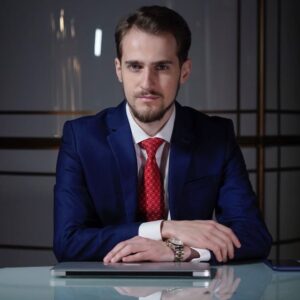
Nazariy Volyansky became the new Head of the ZPP Representative Office in Ukraine. The Union of Entrepreneurs and Employers (ZPP) is a fast-growing and one of the most active employers’ organizations in Poland. The Union was founded in 2010 and unites 17 regional and 19 sectoral organizations, as well as a number of Polish and international companies (over 21 thousand in total). ZPP supports the principles of free market, fair competition, legal stability and transparency.
ZPP is a member of the Social Dialogue Council in Poland, operates in Brussels through its own Representative Office, and is a member of the European Enterprise Alliance and SME Connect. It has two representatives in the European Economic and Social Committee and is the first Polish employers’ organization to open an office in Ukraine.
Together with European financial institutions, ZPP is actively involved in providing economic support to Ukraine in times of war and promotes the development of Ukrainian-Polish business cooperation at all levels.
In this context, in 2022, ZPP launched a global initiative – “Europe-Poland-Ukraine. Rebuild Together”, within the framework of which the Business for Ukraine Centre (BFUC) was opened in Warsaw, and the ZPP Representative Office was opened in Kyiv on July 8, 2022. The initiative is aimed at establishing bilateral trade relations, facilitating the implementation of joint investment projects, and assisting Ukrainian companies considering options for entering the European market through Poland. BFUC provides Ukrainian companies with free legal, tax, information and consulting services to establish and develop direct business contacts on an ongoing basis, assist in the process of relocation, export-import operations, and use of technical and economic services (logistics, warehouses, production infrastructure, access to Polish modern equipment).
ZPP supports the investment activities of Ukrainian companies in Poland to enter the EU market, using the mechanisms of cooperation between the state and business developed in Poland to expand the presence of Ukrainian companies in the relevant segments of foreign economic activity. In this context, the search, selection, and implementation of promising investment projects in Ukraine is carried out with the involvement of Polish state financial institutions (Polish Development Fund (PFR), Bank of National Economy (BGK)) with the support of Polish government agencies.
In June 2023, ZPP, together with the Warsaw Institute of Entrepreneurship (WEI), launched the Polish Service for the Reconstruction of Ukraine project. The aim of this project is to support the modernization and reconstruction of Ukraine in the process of economic development by involving Polish companies in the reconstruction and promoting Ukrainian-Polish cooperation. The project is aimed at establishing contacts with central and local authorities, businesses, and creating a database of investment needs of cities and regions. It covers eight western and central regions: Lviv, Volyn, Rivne, Ternopil, Ivano-Frankivsk, Zhytomyr, Khmelnytsky, and Vinnytsia. The project opened a WEI office in Kyiv and three contact points in Lviv, Lutsk, and Vinnytsia to facilitate connections between Polish and Ukrainian entrepreneurs/local authorities.
To assist Ukrainian citizens in finding employment abroad, ZPP has implemented a separate educational project called IT Skills 4U. This is a free program aimed at improving IT skills and assisting in finding a job and gaining professional knowledge in the IT industry.
About Nazariy:
Nazariy has extensive experience in international relations, communications and investments. He started his career in journalism, where he worked for more than a decade as a production editor, anchor, and head of international affairs at leading Ukrainian TV channels and portals. After the full-scale invasion, Nazariy created the English-language project “Spotlight Ukraine” on one of the country’s most popular TV channels, Espresso. The goal of the project is to raise international awareness of the events in Ukraine.
In 2021, Nazariy was appointed Director of Corporate Communications at the Ukrainian Chamber of Commerce and Industry (UCCI). In this position, he focused on raising the brand of the chamber system both in Ukraine and abroad. An important part of his work was establishing communication with the UCCI members, regional offices and local authorities, as well as organizing various events to increase the UCCI’s visibility in the information space of Ukraine and the world.
In 2023, Nazariy Volyansky was appointed Head of the Department of International Relations and Communications at the Government Office for Investment Attraction and Support under the Cabinet of Ministers of Ukraine (UkraineInvest). During his tenure, Nazariy developed and implemented a communications strategy that significantly increased UkraineInvest’s profile in the European and American markets. He also launched a large-scale media campaign aimed at attracting private capital to Ukraine and successfully explained UkraineInvest’s role in rebuilding the country to international investors.
In addition, Nazariy actively participates in the moderation of international and national business forums, panel discussions and other events, facilitating the exchange of knowledge and experience between participants.
Nazariy Volyansky specializes in government relations, strategic communications, investment, economics, media relations, crisis communications, corporate communications, public relations, event management and digital marketing. His wide range of knowledge and skills allows him to effectively implement innovative solutions and develop new projects.
On April 1, 2024, Nazariy Volyansky was appointed Director of ZPP Ukraine. The main task is to strengthen ZPP’s position in the Ukrainian market, expand cooperation with local authorities, partners, and businesses, and implement new initiatives for more active cooperation between Poland and Ukraine.
JSC “Ukrtransnafta” and IC “Arsenal Insurance” (both – Kiev) have concluded a contract of compulsory insurance of civil liability of owners of land vehicles (MTPL).
According to the message in the system of electronic public procurement Prozorro, the price offer of the company was UAH 627,658 thousand with the declared in the system UAH 1,433 million.
Insurance companies IC “VUSO” with the offer of UAH 607,352 th. and SG “TAS” – UAH 775,049 th. also took part in the tender.
IC “Arsenal Insurance” is the legal successor of IC “Arsenal-Dnepr”, operating in Ukraine since 2005. It is represented in all regional centers and some large cities of the country.
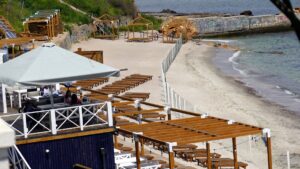
The head of the Odessa regional military administration Oleg Kiper and the commander of the operational strategic grouping of troops “Odessa” jointly signed an order on civilian access to the sea.
“From today, the first open zone is the beach ‘Kaleton’ in Odessa,” Kiper wrote in his Telegram channel on Saturday.
He noted that the list will be supplemented as the inspections are passed.
“We expect to open about 20 beaches in Odessa and the area, as well as one lagoon in the Izmail district,” Kiper said.
At the same time, he reminded that during the air alert, in the detection of suspicious objects, during a storm of 2 points from 2 – the stay of people near the sea is prohibited.

The Italian Development Cooperation Agency in Kyiv, together with the Embassy of Italy in Ukraine and the Italian Institute of Culture, announce a new work by street artist Manu Invisible in Bucha.
Manu Invisible, recognizable by his glossy black mask with geometric shapes and black clothes decorated with traces of paint, has a career that ranges from graffiti to traditional mural techniques and is known for his urban interventions that combine words of high symbolic value with cityscapes.
These days, he has created an impressive mural measuring over 12 meters by 6 meters on a building opposite the Bucha City Council called “TRY-FLY”, depicting a dove that emits light as it takes off, wrapped in a Ukrainian flag. In the background, you can see the rainbow refraction of light, reminiscent of the colors of the Italian flag.
“Try-Fly” depicts a dove striving to fly over the world, bringing hope for peace,” the artist explained, ”It does so by spreading its wings, despite being wrapped in a torn and mangled Ukrainian flag. Glimpses of light in the void emanating from the chest irradiate the composition, myriads of rainbow effects frame this special attempt to rise and then fly. Above, on the right, is a radiance that reflects familiar colors: it is Italian solidarity that illuminates this attempt.”
The choice of Bucha as a place for this art project is not accidental. After 90 days of terror during the occupation, the city has become a symbolic place where solidarity can play a key role in recovery and collective healing.
“Bucha was the scene of horrific crimes. The Italian Cooperation Agency has already funded several projects to support the population immediately after the Russian occupation. We are proud to have contributed to transforming the walls of this city into canvases that tell stories of rebirth and hope. Thanks to the efforts of the city authorities and artists from all over the world, Bucha is gradually turning into an open-air museum, a symbol of resistance to barbarism. The presence of Manu Invisible and his work embody support for the local community. The pigeon, freeing itself from the bandages wrapped around its legs, gets rid of the wounds received during the occupation and wraps itself in the flag of freedom. In this act of liberation, the inner light gives him the strength and ability to fly. This scene represents for us a community that, despite incalculable losses, managed to liberate itself and regain its freedom, both yesterday and today,” said Pietro Pipi, Head of the Italian Development Cooperation Agency in Kyiv.
On Saturday, May 25, the street artist will continue his work as part of the “Day of Italian Culture in Bucha”. The event, organized by the local authorities, involves the entire Italian system in Ukraine and various NGOs, and will include a performance by Manu Invisible accompanied by Ukrainian musicians playing opera arias and Italian songs, as well as numerous other activities to celebrate the friendship between the two nations and Italy’s unconditional support for Bucha and Ukraine.
Photo: Enrico Monni, photographer
Link to download the photo: https://we.tl/t-bhMI2zfCt1

Ukrainian agrarians have completed the spring sowing season, during which 7.2 million hectares were sown with oilseeds, and about 5.6 million hectares with cereals and legumes, which is 22.6% above the forecast, the press service of the Ministry of Agrarian Policy and Food reported.
According to the report, agrarians have sown more than 99% of the projected areas of spring cereals and legumes. They allocated 3.93 million hectares for corn, which amounted to 100.4% of the projected area, barley – 783 thousand hectares (95.7%), wheat – 252.7 thousand hectares (102.6%), oats – 163.7 thousand hectares (100.7%), peas – 162.5 thousand hectares (101.6%), buckwheat – 100.8 thousand hectares (80.7%), millet – 69.7 thousand hectares (81.8%).
5.19 million hectares (98%) have been allocated for sunflowers, 2.03 million hectares (102%) for soybeans.
Sugar beet is sown on 250.1 thousand hectares (97%).
As reported, the Ministry of Agrarian Policy in April forecasted the sown area of grain and leguminous crops in 2024 at the level of 10.6 million hectares, which is 395 thousand hectares lower than in 2023.
The Ministry of Agrarian Policy expects gross production of grain and oilseeds in 2024 at the level of 74 million tons, of which about 52.4 million tons – grains, 21.7 million tons – oilseeds.
Agrarians in 2024 will be able to harvest 19.2 million tons of wheat (22.2 million tons were harvested in 2023), 4.9 million tons of barley (5.7 million tons), 26.7 million tons of corn (30.5 million tons), 5.2 million tons of soybeans (4.7 million tons), 12.4 million tons of sunflower (12.9 million tons), 4.1 million tons of rapeseed (4.7 million tons).
This summer, more than ever since Russian troops crossed the border in February 2022, Ukraine is in dire need of the strongest possible reaffirmation of Western diplomatic, economic, and security support.
Military aid from the United States and European allies is increasing again, but wars are not won on the battlefield alone. Political and diplomatic support for Ukraine also needs to be strengthened. The twin events of this summer Ukraine Peace Summit in Switzerland in June and the NATO 75th Anniversary Summit in Washington, DC, in July provide an unprecedented opportunity to do so.
The summit on June 15-16, organized by the Swiss government, may be the last opportunity this year to draw the attention of the broader international community to the global implications of the conflict in Ukraine. As it did before and after the war broke out, the Biden administration could provide momentum both for more urgent diplomatic work to achieve peace and for consolidating military support for Ukraine by allies a few weeks later at the NATO summit.
The situation in Switzerland has been complicated. In recent months, the main goal of Washington and European capitals has been to provide financial and military support for Ukraine’s military operations. It took the White House seven months to overcome a blocking House of Representatives proposal to provide $60 billion in military aid to Ukraine. In Europe, Hungary withheld a €50 billion aid package for almost two months before agreeing to release it.
The lost time affected the course of the conflict. Russia used the winter months to prepare for a new offensive while the West debated and Ukraine’s weapons stockpile was depleted. There are now more than 400,000 troops on the ground in Ukraine, and Ukraine’s energy infrastructure and second largest city, Kharkiv, are under serious threat. On the international level, the diplomatic agenda has become overloaded, with the crisis in Israel and Gaza consuming the attention of the White House and other governments. The presidential and parliamentary elections in the US and Europe may lead to an atmosphere less favorable to providing assistance to Ukraine.
But it is at times like these that diplomacy and symbolism are essential and can remind us of what is at stake – and not just for Ukraine.
The conference in Switzerland is the most ambitious attempt to date to engage the world – not just Ukraine’s Western allies – in supporting an end to a conflict that has disrupted global energy and food supplies, threatened nuclear conflict, led to the world’s second largest refugee flow and resulted in hundreds of thousands of casualties.
To date, according to some reports, more than 100 countries and international organizations have committed to attend the conference, although Russia has not been invited to participate. Many countries may have different views on how this conflict can be resolved; many countries are eager to maintain ties with both Russia and Ukraine, despite the fact that they voted at the UN General Assembly to condemn the initial invasion. Ukraine, however, is aware of all the nuances.
In his June 2 speech at the Shangri-La Dialogue in Singapore, which brings together defense and other officials from the Asia-Pacific region, President Zelenskyy made it clear that Ukraine is “ready to listen to various proposals and opinions that will lead us…to ending the war and establishing a sustainable and just peace.” The Ukrainian government, together with Switzerland, has been working diligently on an agenda that can unite rather than divide international opinion.
This did not prevent Russia and its allies from perceiving the summit as a threat. At a meeting with the leaders of Indonesia, Singapore, the Philippines, and other Asian states, Zelenskyy in Singapore drew special attention to China’s efforts to dissuade countries from participating in the summit. China, along with Brazil, also proposed holding an alternative conference at a later date. Therefore, a strong position of Washington and key European allies is needed to strengthen international resolve at the summit.
Now we can draw parallels with February 2022. At the beginning of the war, visits to Kyiv by the president and cabinet of ministers, as well as President Zelenskyy to Washington played a crucial role in strengthening the US commitment to Ukraine in the popular imagination and in the eyes of allies and adversaries alike. They also sent an unequivocal message of political and diplomatic support for Ukrainians as they confronted and defeated an all-out Russian invasion to overthrow their government.
In June 2024, Ukraine will need that reaffirmation again, as Russia is once again confident in its goals. The stakes are still high: Ukraine, at least for the rules-based order that has endured for 70 years since World War II and the end of the Cold War, is the defining conflict of our era. A Russian victory would undermine all calculations by the United States and Europe about their own future security and prosperity and destroy the limits to violence between states around the world.
We have not yet reached that point, but Russia, China, and other countries that question the resilience of the United States are seeking to undermine international commitments to Ukraine. Ukrainians will regret that President Biden will not attend the summit in Switzerland, but he will meet with Zelenskiy in France on the sidelines of the 80th anniversary of D-Day in France. In addition, Vice President Kamala Harris, who will represent the administration, can work with German Chancellor Olaf Scholz, French President Emmanuel Macron, Canadian Prime Minister Justin Trudeau, and other world leaders in attendance to rally participants and send an unmistakable message at this critical moment: Ukraine is not alone.
P. Michael McKinley is a non-resident Senior Advisor at CSIS and former U.S. Ambassador to Afghanistan, Brazil, Colombia and Peru.



