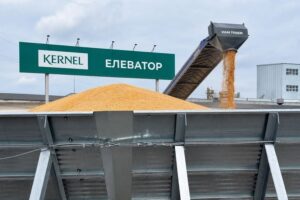
Kernel, one of Ukraine’s largest agricultural holdings, reported EBITDA of $103 million in October-December 2026 fiscal year (FY, July 2025-June 2026), down 13% from the same period last year, according to a report on Friday.
According to the report, consolidated revenue in the second quarter of FY 2026 amounted to $1 billion 98 million, which is 4% less than in the second quarter of FY 2025, but compared to the previous quarter, revenue grew by 33% thanks to an increase in sales of grain, vegetable oils, and meal as the harvest campaign gained momentum and export activity accelerated.
Kernel noted that the loss from changes in the fair value of biological assets in the second quarter of FY 2026 amounted to $43 million, compared to $33 million in the second quarter of FY 2025.
The cost of goods sold increased by 28% compared to the previous quarter, mainly reflecting higher costs of goods for resale and raw materials used, as well as a 55% increase in delivery and handling costs due to higher insurance premiums amid increased Russian attacks on civilian vessels during the reporting period.
As a result, gross profit decreased by 20% year-on-year to $126 million, reflecting lower profitability in the infrastructure, trading, and oilseed processing segments.
At the same time, Kernel managed to reduce general and administrative expenses by 26% to $55 million, reflecting a decrease in payroll-related expenses.
The company’s net profit for October-December 2025 amounted to $13 million, which is 2.3 times less than in October-December 2025. It is noted that the group incurred financial expenses of $21 million, which is 21% more than in the previous quarter, mainly due to an increase in expenses related to the extension and modification of lease agreements, while other expenses in the second quarter of FY 2026 reached $20 million, mainly due to an increase in the Group’s social expenses.
It is noted that Kernel received an operating profit before working capital changes of $113 million in the second quarter of FY 2026, which is 2.3 times more than in the previous year. The strong growth mainly reflects a low comparative base, as the previous year’s result was significantly affected by non-cash trading gains recognized by Avere.
According to the report, changes in working capital resulted in a cash outflow of $249 million in the second quarter of FY 2026, to $331 million, primarily due to an increase in inventories of $209 million, to $644 million, as well as the temporary allocation of a portion of liquidity to liquid securities.
“This reflects a normalization of seasonal purchasing patterns as the company resumed its typical inventory build following the harvest in the first half of the fiscal year. The previous season was atypical due to slower sales by farmers and a smaller grain harvest, which limited inventory accumulation and distorted the normal working capital cycle,” the document says.
It is specified that stocks related to the oilseed processing segment increased by 23% compared to the previous quarter, to $348 million, thanks to growth in sunflower seed and vegetable oil stocks. Grain stocks grew more sharply, 2.3 times compared to the previous quarter, to $296 million, as the group accumulated corn and other grains during the peak harvest season.
In physical terms, edible oil volumes by weight increased by 8% compared to the previous quarter, to 106,000 tons, while sunflower seed stocks reached 334,000 tons. Grain stocks, mainly corn, wheat, and soybeans, increased 2.6 times compared to the previous quarter, to 1.6 million tons.
Net cash flow used in investing activities amounted to $145 million during October-December 2025: the outflow consisted mainly of $120 million invested in financial assets as part of the group’s liquidity management strategy and $25 million in capital expenditures, mainly related to the reconstruction of the transshipment terminal in Chornomorsk, agricultural equipment, backup power equipment, and grain railcars.
As of the end of 2025, Kernel’s total debt amounted to $782 million, up 8% from the previous quarter. The increase was mainly due to more active use of credit lines to finance seasonal working capital requirements.
Net debt increased 3.4 times compared to the previous quarter to $451 million, while the leverage ratio as of December 31, 2025, decreased to 1.1 times net debt to EBITDA.
Overall, in the first half of FY 2026, consolidated revenue decreased by 1% compared to the same period in FY 2025, to $1 billion 924 million, EBITDA decreased by 14%, to $247 million, and net profit decreased by 33%, to $119 million.