
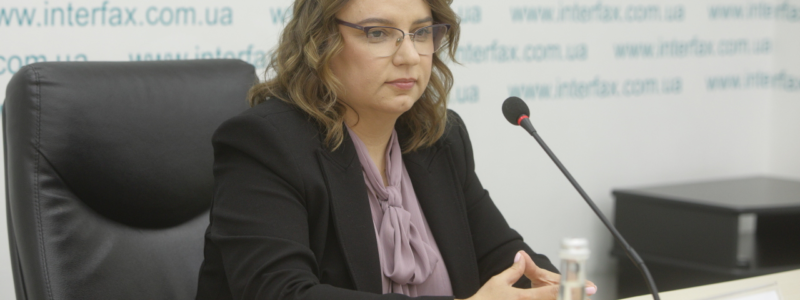
The automation of financial monitoring processes will become as standard for financial companies in the coming years as accounting systems or CRM solutions, according to AML.point CEO and adviser on RegTech projects at AI FINTECH, Oksana Hubina.
“We are convinced that in the coming years AML automation will become as standard for financial companies as accounting systems or CRM systems for sales, customer communications, and so on. Our goal is to make such technological solutions not an exception for certain large players, but an accessible working tool for the widest possible range of financial institutions,” she added at a press conference at the Interfax-Ukraine agency on Friday.
According to Hubina, the AML.point platform was created as a technological solution for automating financial monitoring processes in non-bank financial institutions, and was later adapted for a broader range of primary financial monitoring entities, including notaries, lawyers, accountants, and sellers of real estate and precious goods. She noted that the product idea emerged after the change in the market regulation architecture, when the National Bank of Ukraine became the mega-regulator for most financial institutions.
“Over the past years, the regulatory environment has changed very significantly. And while previously one could speak about separate standards for banks and non-bank financial institutions, now this boundary is gradually disappearing. What yesterday was common practice for the banking sector is today becoming mandatory or, at least, an expected standard for the non-bank market,” Hubina said.
She emphasized that today the requirements for non-bank institutions, in terms of responsibility and regulatory expectations, have already moved closer to banking standards, while key AML processes require systematic management and automation. This concerns, in particular, transaction recording, detection of suspicious activity, maintenance of financial monitoring registers, and reporting to authorized bodies.
Separately, the AML.point CEO drew attention to the platform’s functionality for generating and submitting reports to the State Financial Monitoring Service. According to her, when submitting information on a suspicious transaction, institutions currently need to enter more than 100 parameters in the electronic cabinet, whereas in the AML.point system most of them can be filled in automatically on the basis of already available data and then transmitted through API integration.
“As a result, the reporting process becomes much faster, more convenient, and less dependent on manual operations. This is not just an additional option, but a tool that significantly simplifies the daily work of responsible employees and helps reduce the risks of reporting errors,” Oksana Hubina added..

Among the platform’s other capabilities, the speaker named automated screening of clients and transactions against the sanctions lists of the National Security and Defense Council of Ukraine and international sanctions lists, lists of persons linked to terrorist activity, as well as databases of politically exposed persons. In addition, the system, according to her, allows the integration of data from registration aggregators and tracking of changes concerning companies and sole proprietors.
“A financial institution can not only comply with regulatory requirements, but do so systematically, accurately, and with lower resource costs,” the financial expert stressed.
At the same time, she emphasized that a technological solution cannot fully replace the responsible financial monitoring officer and is not a “panacea against fines,” since the result depends on the quality and consistency of the use of the tool.
Commenting on implementation, the AML.point CEO noted that for small companies the start of work with the system is simple and fast, while for large financial institutions with significant volumes of client data and transactions, deeper integration with internal IT systems may be required. At the same time, according to her, the SaaS delivery model makes it possible to plan automation costs flexibly.
Hubina also stated that the system is built in accordance with the requirements of the National Bank of Ukraine, while the company undergoes annual certification under the ISO 27001 standard and, when working with card data, complies with the PCI DSS standard. She separately emphasized that no state body has direct access to user data in the system, and information is transferred only in cases предусмотренных отчетностью и подачей уведомлений о подозрительных операциях.
According to the speaker, provided that suspicious activity indicators are configured correctly, the platform can also detect anomalous behavioral patterns in financial transactions and help specialists identify potentially risky activity within the scope of the data recorded in the system.




