More than half of Ukrainians believe that the military should remain outside politics during the war; however, a significant part of society allows their limited participation in public processes, primarily in defense-related issues, according to the results of the study “Military and Politics: the Balance of Media Presence, Influence and State Unity,” presented by Active Group.
According to the presentation, 23.1% of respondents “definitely” support the apolitical nature of the military, another 27.3% “rather support” it, while 37.6% (23.1% “rather no” and 14.5% “definitely no”) allow their participation in politics, and another 12% were undecided.
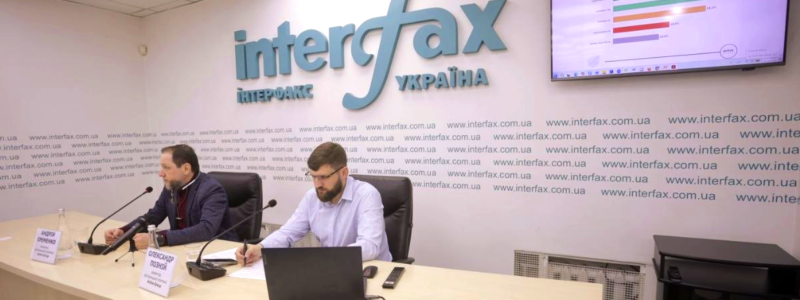
“We saw that there are two simultaneous demands in society – that the military stay out of politics and that they have influence. And there is no contradiction in this: the majority want the military to remain military during the war, but at the same time allow their participation in processes directly related to state defense. This is more about balance than extremes,” said Active Group director Oleksandr Poznyi at a press conference at the Interfax-Ukraine agency on Thursday.

At the same time, an absolute majority of Ukrainians support a strict system of army management: 41% consider a unified chain of command very important, another 31.5% consider it rather important (a total of 72.5%), while only about 10% do not share this position.
On the issue of decision-making during the war, public opinion is distributed among key centers of authority: 22.4% believe that decisions should be made by the president as Supreme Commander-in-Chief, 25.6% by the Commander-in-Chief, 25.4% by the General Staff, about 14% by lower-level commanders, and 12.9% were undecided.
“These figures show that society trusts the vertical chain of command and expects that strategic decisions are made at the highest level. At the same time, people do not always clearly distinguish the functions of different levels of military leadership. Therefore, we see a certain distribution of answers between the president, the Commander-in-Chief and the General Staff,” explained Active Group founder Andriy Yeremenko.
The study also recorded a demand for a combination of centralization and flexibility: 40.1% of respondents support mainly a vertical management model (16% – exclusively vertical, 24.1% – rather vertical), while 37% support the autonomy of units (29.5% – more autonomy, 7.5% – full autonomy), and another 22.9% were undecided.

“Society is essentially saying: strategy should be formed at the top, but at the level of units there should be freedom of action. This means rejecting micromanagement and at the same time the need for high-quality feedback. People expect that decisions take into account the real situation on the ground,” Yeremenko added.
The most acceptable forms of military participation in public life, according to Ukrainians, are calls to politicians to make decisions in the field of defense (37.3% support), public positions on draft laws (26.3%), and the creation of veteran and public organizations (24.6%). At the same time, the greatest rejection is caused by the use of military authority to influence voters (–30.4% balance), as well as participation in the formation of political decisions or commenting on political processes.
“There is a clear boundary: the military may influence defense decisions, but should not interfere in electoral processes. Attempts to use military authority in political competition are perceived very negatively. This is an important signal for future political campaigns,” Poznyi emphasized.
Among the key qualities of a modern commander, respondents named responsibility for subordinates (64.9%), strategic thinking (59.9%), as well as the ability to execute tasks (37.1%), discipline (35.4%) and interaction with command (33.4%), while media activity received only 2.4% support.
Among the factors that harm the effectiveness of the army, corruption risks dominate: 53.9% pointed to abuses in procurement, 46.1% to abuses in operational planning. Respondents also named fatigue of personnel and insufficient rotation (42.7%), outdated training approaches (35.3%), low motivation (35.1%) and bureaucratic procedures (34%).
“Corruption is traditionally perceived as the main problem in any sphere. But alongside this, we see systemic issues – rotation, motivation, quality of management. This is a set of factors that shape the effectiveness of the army and require systemic solutions,” Yeremenko noted.
At the same time, 76.5% of Ukrainians (47.8% positive, 28.7% rather positive) have a favorable attitude toward units that combine discipline, state subordination and modern approaches to warfare.
In the ranking of units by perceived discipline and effectiveness, the Special Operations Center “A” of the Security Service of Ukraine (“Alpha”) leads with 17.9%, followed by the 3rd Army Corps (14.5%) and “Azov” (13.2%). In terms of trust in fulfilling state tasks, “Azov” ranks first (15.2%), followed by the Special Operations Forces of the Armed Forces of Ukraine (14.7%) and “Alpha” (13.4%).
At the same time, more than 40% of respondents were unable to name specific units, indicating limited public awareness and the significant influence of media presence on the formation of public opinion.
Overall, the study demonstrates a demand in Ukrainian society for the depoliticization of the military, the preservation of a strict chain of command, and at the same time flexibility at the unit level, as well as a clear distinction between influence in the field of defense and participation in political competition.
ACTIVE GROUP, Poznyi, Єременко

Related: