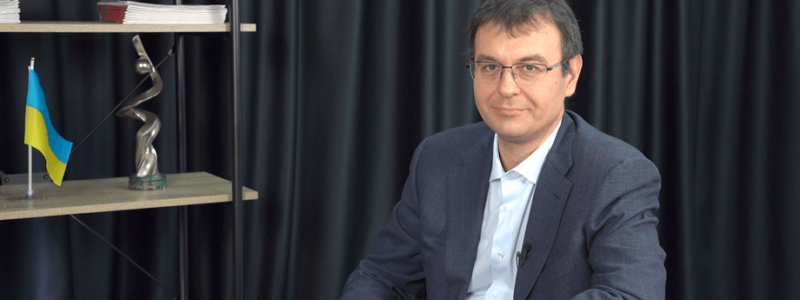
The existence of two value-added tax (VAT) exemption thresholds within a single VAT system is an anomaly that must be eliminated, but this decision will have to be made immediately after martial law ends, according to Danylo Getmantsev, head of the parliamentary committee on finance, tax, and customs policy.
“I promised the people that I would not change the single tax system until the end of the war. And I am keeping that promise. As you can see, the law has not been adopted. You have not heard me support it in the version proposed by the Ministry of Finance,” he said in an interview with the “Interfax-Ukraine” news agency.
According to the committee chair, the next session of the Verkhovna Rada will decide on a single tax limit, and for them, there will be no alternative.
Getmantsev emphasized that, overall, Ukraine needs to implement a reform of personal income taxation, part of which is the reform of the single tax, and noted that this is provided for in the National Revenue Strategy for 2024–2030.
“We must implement the Polish flat-rate tax model: cash registers from the start, turnover limits of up to EUR2 million, and a single VAT threshold for both sole proprietors and others. The specific amount can be discussed, but it must be uniform. And within the framework of the flat-rate tax, there should be different rates for different types of activities,” the committee chair noted.
In Poland, the VAT exemption threshold was raised this year from 200,000 to 240,000 zlotys, which is approximately EUR56,600, or nearly 3 million hryvnias.
According to Getmantsev, the rate is 3% for retail trade and 10% or higher for services.
“We simply need to follow Poland’s example and make such a serious, correct decision once and for all. But that will have to wait until after the war,” he added.
The committee chair also believes that all these changes must be implemented at once, rather than gradually “chipping away at the problem piece by piece,” because that is an entirely unproductive approach.
“I cannot support any half-measures, because in reality they generate just as much negativity and backlash as major decisions and reforms, but with far less impact. Therefore, after the war, there must be a major reform of personal income taxation, including the flat tax. Incidentally, a progressive tax scale is also provided for there. This is the right decision, and I strongly support it,” Getmantsev noted.
At the same time, he supported the adoption this year of a law to simplify VAT administration, the text of which is currently expected from the Ministry of Finance.
“I believe that until the threshold for sole proprietors is reached—for example, EUR2 million based on the Polish model—tax invoices should not be blocked at all, even if VAT is paid. In other words, the rules for blocking tax invoices should not apply to sole proprietors until they reach the single tax threshold. And there are many other measures that simplify administration,” said the head of the relevant parliamentary committee, among other things.
As previously reported, the adoption by the end of March of this year of a law abolishing the VAT exemption under the simplified tax system was a condition of the new program with the International Monetary Fund (IMF), launched at the end of February of this year. It was later reported that the deadline for fulfilling this requirement had been postponed by approximately one year.
In addition, at the end of May, the Verkhovna Rada ratified the terms for providing Ukraine with macro-financial assistance as part of a loan from the European Union to support Ukraine. Under these terms, a bill containing measures to reform the preferential tax regime must be submitted to parliament by the end of the year, which will generate additional revenue of at least 70 billion hryvnia per year.
Getmantsev, TAX, WAR