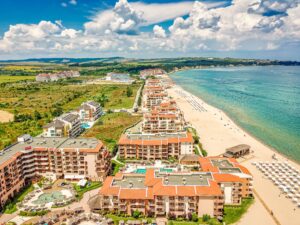
The housing crisis in Spain continues to deepen amid a long-standing shortage of new construction, a rise in the number of households, and a record increase in population—a significant portion of which is due to migration. The structural housing shortage in the country is estimated at approximately 700,000–750,000 units, according to data from the Funcas analytical center.
The current situation should not be compared to the housing bubble of the 2000s. At that time, significantly more housing was being built in Spain, and market growth was fueled by lending. Now the problem is the opposite—supply consistently lags behind demand.
In recent years, approximately 100,000 new homes have been completed annually in Spain, while about 230,000 new households have been formed. The gap that has accumulated since 2020 has reached nearly 700,000 units.
As a result, both home purchase prices and rental rates are rising. The problem is particularly acute in Madrid, Barcelona, the Balearic Islands, Valencia, and popular coastal areas. At the same time, the shortage is gradually spreading from the largest cities to their suburbs and medium-sized cities. Funcas notes that rents have been rising faster than wages in recent years, and young renters spend an average of about 35% of their budget on housing and utilities.
Experts believe that some of the measures taken by the authorities can only temporarily curb prices but cannot eliminate the root cause of the crisis. Rent controls may lower housing costs for some current tenants, but at the same time reduce the number of apartments that landlords are willing to put on the market. Subsidies for buyers, given limited supply, may also lead to further price increases.
Among the long-term solutions, Funcas cites increasing the supply of land parcels, expediting the issuance of building permits, enhancing legal certainty for developers and property owners, and expanding the stock of affordable rental housing. Social rental housing in Spain accounts for only about 2–3% of the housing stock, which is significantly below the EU average.
Spain’s rapid population growth is placing additional pressure on the market. As of July 1, 2026, the country’s population stood at a record 49.80 million, an increase of 444,200 from the previous year. At the same time, Spain’s National Institute of Statistics (INE) explicitly states that the population increase is driven by people born abroad, while the number of residents born in Spain is declining.
The number of residents in Spain born abroad reached 10.29 million by mid-year, accounting for more than one-fifth of the country’s population. The number of residents with foreign citizenship stood at 7.44 million, having increased by 87,200 in the second quarter alone.
According to the latest comprehensive breakdown from the INE, the largest foreign communities consist of citizens of Morocco—about 969,000,
Colombia—677,000, Romania—609,000, Venezuela—378,000, Italy—346,000, and the United Kingdom—266,000. There are also significant communities of people from Peru, China, Ukraine, and Latin American countries.
The influx continues in 2026. In the second quarter alone, approximately 34,000 Colombian citizens, 23,300 Venezuelans, and 21,100 Moroccans arrived in Spain. In the first quarter, Ukrainians were among the largest groups of new arrivals—about 25,700 people.
Separate statistics from Spain’s Ministry of Migration show that as of the end of June 2026, 353,000 Ukrainian citizens already held valid residence permits, mainly thanks to the temporary protection mechanism.
The growth of the foreign population cannot be considered the sole cause of the housing crisis; experts attribute it primarily to a decade of insufficient construction. However, migration significantly increases the number of households and the demand for rentals, especially in large cities and economically active coastal regions. Given the construction of approximately 100,000 units per year, the additional population growth of hundreds of thousands of people becomes a significant factor in the further rise in housing costs.
Thus, the housing crisis in Spain is driven by several factors: a chronic shortage of new construction, an increase in the number of households, a limited supply of affordable rental housing, internal migration to major cities, foreign buyers, and the tourism sector. Rapid population growth due to immigration exacerbates the existing shortage, but is not its root cause.