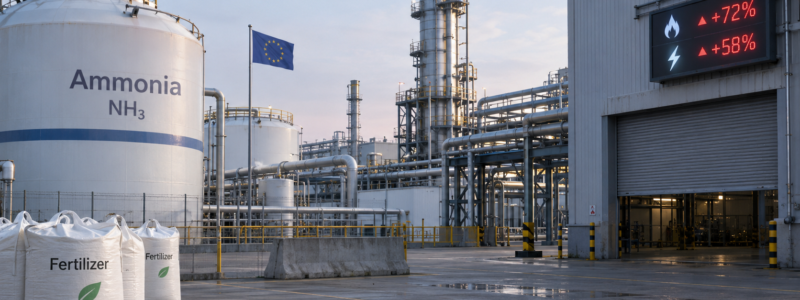
European mineral fertilizer producers are cutting production and shutting down individual plants due to a sharp increase in the cost of natural gas and electricity. Ammonia production capacity of at least 5 million tonnes per year has currently been taken out of operation in Europe, equivalent to 28% of the region’s production capacity, the Financial Times reports, citing data from the price reporting agency Argus.
According to the FT publication dated November 24, 2026, the actual share of idle capacity may reach 35%, since official statistics do not account for some enterprises that have temporarily ceased operations or significantly reduced capacity utilization. Rising energy costs are making ammonia production in Europe less competitive compared with imported products from countries with cheaper natural gas.
Ammonia is the main raw material for the production of nitrogen fertilizers, including urea, ammonium nitrate and other types of products used in agriculture. Natural gas serves both as a raw material and as the most important source of energy in its production, which is why changes in gas prices directly affect fertilizer production costs.
Norway’s Yara International, Europe’s largest mineral fertilizer producer, has reduced ammonia output at its European plants by 27%. The company’s CEO, Svein Tore Holsether, told the Financial Times. AGF Nitrogen, Europe’s second-largest producer of ammonia and mineral fertilizers, is also cutting production. The company has shut down some production lines located near seaports and has begun replacing its own output with cheaper imported ammonia.
Earlier, on November 4, AGF Nitrogen CEO Petr Cingr told Reuters that the company had already shut down one production line in France, while another was operating with periodic shutdowns. At the remaining plants, capacity utilization at nitrogen production facilities had been reduced to the minimum technologically permissible level.
AGF Nitrogen has eight ammonia production lines in France, Germany, Slovakia and Austria. The company’s combined capacity amounts to approximately 3.5 million tonnes of ammonia and 7 million tonnes of fertilizers per year. According to its management’s estimates, the company accounts for approximately 20% of the European fertilizer market.
Cingr warned that additional plant shutdowns might be necessary if weak demand and high gas prices persisted. In particular, producers are facing a reduction in fertilizer purchases by farmers, for whom the cost of these products is becoming too high.
According to the FT, European producers are increasingly using imported ammonia from North Africa, the United States, Trinidad and Tobago and other regions where natural gas costs are significantly lower. In September, ammonia imports into Europe reached their highest level in four years. At the same time, the cost of imported raw materials proved to be significantly lower than the cost of producing them at European plants.
According to estimates cited by the publication, the cost of producing ammonia in Europe increased to approximately $1,100 per tonne as a result of rising energy costs, while imported ammonia was priced at approximately $760 per tonne.
AGF Nitrogen’s management notes that the cost difference between in-house production and imported products reaches approximately EUR300 per tonne. Under these conditions, it is more economically advantageous for companies to purchase raw materials abroad than to continue producing them at individual European sites.
In early November, European natural gas prices exceeded EUR100 per MWh, after which they fell to approximately EUR90 per MWh. However, even this level remained approximately three times higher than the prices observed before the latest escalation of the energy crisis amid the conflict in the Middle East.
The reduction in European production capacity has been ongoing for several years. In the United Kingdom, ammonia production effectively ceased following the closure of the CF Fertilisers plant in Billingham in 2023 and the shutdown of Yara’s production in Hull in early 2025.
According to market participants, a further decline in European production creates risks of increasing the region’s dependence on imported supplies and international logistics. At the same time, the replacement of domestic capacity with imports is limited by the throughput capacity of ports, railway infrastructure and the ability to deliver raw materials to plants located inland.
Fertilizer producers and consumers in Central Europe may be particularly vulnerable, as deliveries by sea require additional logistical operations and expenditure.
A separate risk is a possible reduction in investment in the European chemical industry. High energy price volatility complicates long-term planning and reduces the attractiveness of building new production capacity.
The European Commission previously acknowledged the industry’s high dependence on the cost of natural gas. The fertilizer sector action plan published on May 19, 2026, noted that gas accounts for 70–80% of nitrogen fertilizer production costs. The document provides for measures to improve fertilizer affordability for agricultural producers, strengthen domestic production and reduce the European market’s dependence on imports.
In July, the European Commission also allocated EUR540 million to support farmers affected by rising fertilizer and energy prices amid the crisis in the Middle East. However, industry representatives believe that more systemic solutions are needed to maintain production, including reducing energy costs for industry and reviewing certain carbon emissions regulation mechanisms.
For Ukraine, a further decline in European nitrogen fertilizer production may be significant in terms of the availability of imported products and the formation of regional prices. The EU’s growing dependence on external supplies could increase competition for raw materials and finished fertilizers, particularly during periods of seasonal growth in demand from agricultural producers.
At the same time, the actual impact on the Ukrainian market will depend on global gas prices, the structure of imports, domestic fertilizer production volumes and logistics costs. The FT publication does not provide direct quantitative estimates of the consequences for Ukrainian farmers.
Yara International is a Norwegian multinational chemical company and one of the world’s largest producers of mineral fertilizers and industrial nitrogen products. AGF Nitrogen is part of the Czech Agrofert group and specializes in the production of ammonia, nitrogen fertilizers and chemical products at European plants.
Sources: Financial Times