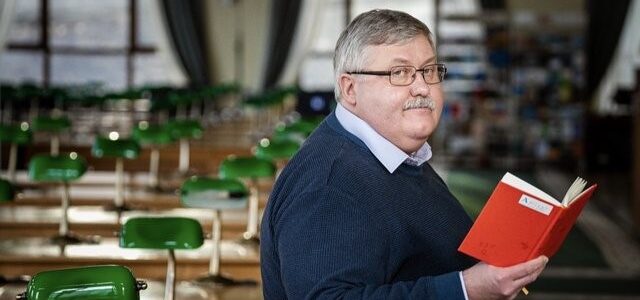
According to the Interfax-Ukraine Culture project, artificial intelligence can be a useful assistant for authors, students, and researchers, but it cannot replace a writer because it lacks its own life experience, according to Rostyslav Semkiv, director of the Smoloskyp publishing house, who stated this in an interview with the “Interfax-Ukraine” agency.
“I view artificial intelligence much the same way I view nuclear energy. It can be used for good, or it can be used for harm. It all depends on how a person uses this tool,” Semkiv said.
According to him, AI can help find sources, organize information, select relevant literature, and improve the logic of texts—just as professors, editors, or academic advisors used to do.
At the same time, he cautioned against completely delegating creative and intellectual work to algorithms.
“As an assistant, it’s a wonderful tool. As a substitute for one’s own thinking, it’s a bad idea,” Semkiv emphasized.
He also noted that artificial intelligence still often makes mistakes, especially when it comes to Ukrainian literature or highly specialized topics, and in some cases may even invent facts that do not exist.
Commenting on the emergence of books written with the help of AI, Semkiv noted that it is becoming increasingly difficult to distinguish such texts based solely on formal characteristics. However, the main difference, in his opinion, lies elsewhere.
“Literature is, first and foremost, the transmission of experience. A person writes based on their own life, observations, and experiences. Artificial intelligence does not have such experience,” he said.
According to Semkiv, a writer always brings their own life context, emotions, and observations into the text, whereas artificial intelligence merely generalizes a vast number of already existing texts.
“True literature is always an attempt to express oneself, one’s environment, one’s context, and one’s own story. And this is precisely where artificial intelligence has very serious limitations,” Semkiv concluded.
As previously reported, Rostyslav Semkiv, director of the “Smoloskyp” publishing house, believes that Ukrainian libraries should be transformed into modern community cultural centers, and the world is becoming increasingly interested in Ukraine through literature, while the full-scale war has already shaped a new generation of Ukrainian writers. He also stated that Ukraine’s book market continues to grow despite the war, and audiobooks could become one of the drivers of its development. Additionally, in June, due to an accident on the heating network, the Smoloskyp publishing house building in Kyiv was flooded, resulting in damage to about 30% of the book collection.