
Coca-Cola Beverages Ukraine, the official bottler of Coca-Cola in Ukraine, is close to reaching its pre-war production and distribution volume in 2023, Coca-Cola HBS Director of Logistics Vladimir Choban said.
“In 2021 it was 120 million unit cases (all products, including imported products). In 2023, we expect 115 million unit cases (1 unit case equals 6 liters – IF) … We are so confidently moving towards this bar, realizing that it is the middle of the year …”, – said Choban at the logistics exhibition XXVIII Day of Logistics in Kiev on Friday.
According to him, the company resumed production at its plant in Bolshaya Dymerka in the Kiev region last May. However, due to problems with the ingredients, it produced only one fifth of the items in the assortment portfolio. Now it has already fully restored it, reaching 190 positions.
“I can say that we started producing 40 SKU (positions) in 2022. We were only putting on the shelf and distributing products that rotate quickly. As of today, we are producing almost 190 items… (full range – IF)”, – said Choban.
He noted that before the war, the company formed buffer stocks and dispersed them throughout the country, which allowed for a quick recovery in distribution. “That’s something we did ahead of time as a company, understanding the risks that there could be an escalation in 2022, and we did take almost everything we could take out to the regions and kept it there until a certain time. And that allowed us to resume distribution almost immediately after we de-occupied the region,” the director of logistics for Coca-Cola HBS pointed out.
The company continues to import carbon dioxide (CO2) used to make carbonated beverages from abroad, as its own combined heat and power (CHP) production is still in the process of recovery, the company said in a presentation.
“In May 2022, the lines at the plant were restarted, we started doing distribution, but there was nowhere to get CO2, we were importing CO2 from overseas. And now we continue to import. Now it is cheaper to bring it from abroad than to produce it in Ukraine,” said Choban.
According to him, the company employs 1.6 thousand people, and there have been no layoffs since 2022.
As reported, in connection with the Russian aggression against Ukraine, March 8, Coca-Cola announced the suspension of business in Russia, where it owns ten plants for the production of soft drinks and juices.
Coca-Cola Beverages Ukraine, Coca-Cola’s official bottler in Ukraine, produces a wide range of soft drinks in different categories – sweet fizzy drinks, juices, water, energy drinks and iced teas.
The company’s first factory in Ukraine was opened in Lviv. Now the company owns one plant in the village Bolshaya Dymerka, Kyiv region, which began operation in 1998 and was damaged by Russian occupation troops on March 10, 2022. Production at it was temporarily suspended.
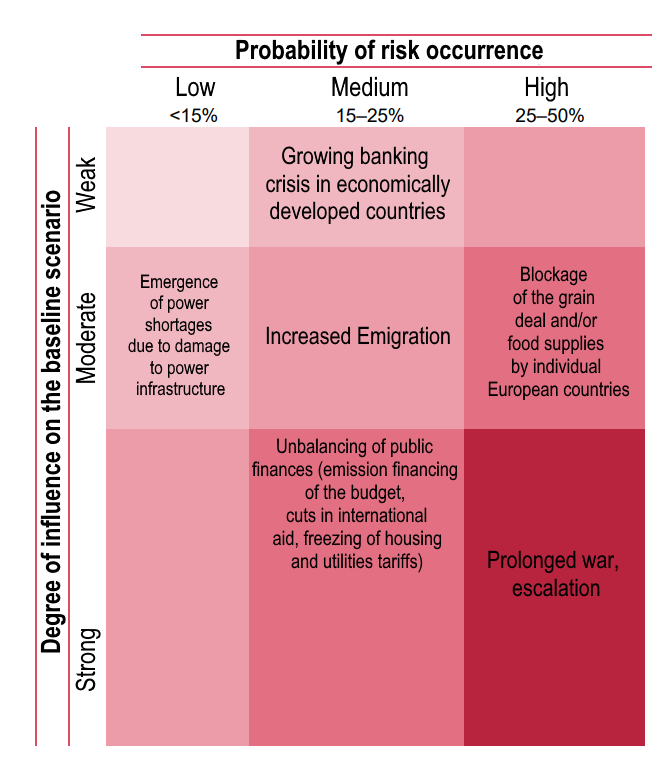
Consensus forecast of risks for economy of Ukraine from NBU
Source: Open4Business.com.ua and experts.news
Metallurgical enterprises of Ukraine in January-May of this year reduced revenues from exports of ferrous metals by 60.7% compared to the same period last year – to $ 1 billion 136.465 million.
According to the statistics, promulgated by the State Customs Service (SCC), during this period, ferrous metals accounted for 6.91% of total revenues from the export of goods against 14.8% in January-May 2022.
In May, the proceeds from the export of ferrous metals amounted to $313.168 million, while in the previous month – $239.718 million.
At the same time, Ukraine increased imports of similar products for five months of this year by 46.3% – to $485.619 million. In May, Ukraine imported products for $124.560 million.
In addition, in January-May, Ukraine has practically kept the export of metal products at the level of five months of the previous year – $424.450 million. In May, they exported by $90.854 million.
At the same time, imports of metal products in the first five months of the year rose by 21.4% – to $285.893 million. In May, Ukraine exported these goods for $64.168 million.
As reported, metallurgical enterprises of Ukraine in January-April 2023 decreased export revenues of ferrous metals in 3.2 times compared to the same period last year – up to $ 823.406 million. At the same time, the country increased imports of similar products by 27.4% – to $ 360.802 million. In addition, Ukraine reduced exports of metal products by 0.6% to $334.065 million in January-April, while imports of metal products in the first four months of the year rose by 11.1% – to $221.719 million.
Metal companies in Ukraine in 2022, revenues from exports of ferrous metals decreased by 67.5% compared to 2021 – up to $4 billion 533.088 million – the ferrous metals accounted for 10.26% of total revenues from the export of goods during this period against 20.49% in 2021. At the same time, Ukraine has reduced imports of similar products last year by 38.3% – to $954.387 million.
In addition, in 2022, Ukraine reduced exports of metal products by 18.6% – to $ 1 billion 52.512 million. Imports of metal products for the year fell by 42.9% – to $ 643.162 million.
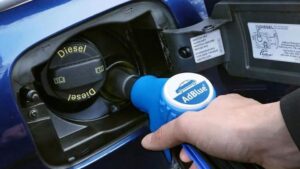
Production of AdBlue, a special additive for diesel engines used to reduce NO (nitrogen oxide) emissions, was launched by Ostchem on the basis of Cherkassy Azot
“Today, Cherkassy Azot is capable of producing volume that provides 80% of the Ukrainian market and, if necessary, can ramp up production to cover all domestic consumption and for export to EU markets,” the company said in a press release on Friday.
It is specified that the market volume in Ukraine in 2022 was 23.4 thousand tons, and it decreased by more than 10 thousand tons due to military actions. Growth potential of Ukrainian market after introduction of standard Euro-4, Euro-5, Euro-6 exceeds 250 thousand tons, as the company believes.
Project on AdBlue production at Cherkassy “Azot” was announced in February 2022, in May 2022 the plant began to produce the first batches of product, and today the volume of urea solution production accounts for 30% of Ukrainian market needs.
“We are capable of becoming a major national player and gradually displacing imports. Our plans are to become a strong player in the EU markets, where demand for AdBlue is at a high level,” said Sergey Pavlyuchuk, head of Ostchem’s nitrogen business.
According to the release, the new production facility passed an international audit and this week received all required certificates confirming the quality of the product and allowing to use the AdBlue trademark and enter the EU markets, where, according to Ostchem, Ukrainian AdBlue has good prospects.
It is stated that at the first stage the company intends to fill the Ukrainian market by planning wholesale sales of AdBlue directly from the facility, as well as sales through retail chains, service stations and petrol stations and is already negotiating with a number of petrol stations to install their own AdBlue stations.
According to Ostchem, a large consumer of AdBlue will also be the agro-industrial complex, which uses modern machinery of the new generation.
A separate direction will be sales of the product in small containers of 10 and 20 liters.
The second stage will involve export to the neighbouring EU countries – Lithuania, Latvia, Romania, Hungary and Poland, as well as major AdBlue consumers – Germany (consumption level of 2.4 m t/year), France (2.1 m t/year), Italy (1.3 m t/year) and Turkey (726,000 t/year). According to Group DF estimates, the European market volume exceeds 7.2 million tons per year.
It is also stated that Cherkasy Azot will be the only Ukrainian producer of AdBlue by “direct method”, i.e. method of urea melt production, while the other producers use so called “blending” method, i.e. technology of mixing granulated urea with water. According to the company, its method ensures very high and stable quality at a low price, and in order to distinguish its AdBlue reagent on the Ukrainian and European markets, Ostchem has already registered its own trademark “Ukrblue”.
The use of the reagent is stipulated by EURO 6 standards and is aimed to reduce emissions of harmful substances. VDA (Verband der Automobilindustrie e.V., German Automotive Industry Association) owns the rights to the AdBlue trademark.
Group DF consolidates assets in the gas distribution, chemical, titanium and port industries, as well as in agriculture and media. The founder and owner of Group DF is Ukrainian businessman Dmitry Firtash.
Ostchem is the nitrogen holding of Group DF. It includes Rivneazot, Cherkasy Azot, as well as Severodonetsk Azot and Stirol (not operating and located in the occupied territories).
Cherkasy Azot PJSC has been a part of Group DF since 2011. The design production capacity of PJSC “Azot” is 962.7 thousand tons of ammonia per year, ammonium nitrate – 970 thousand tons per year, urea – 891.6 thousand tons, UAN – 1 million tons per year.
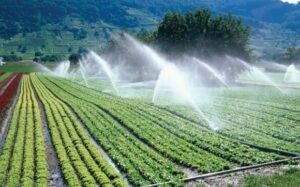
Agro-industrial holding Astarta, the largest sugar producer in the country, has expanded its irrigated area up to 1 thousand hectares and purchased five sprinklers, the company said on Facebook.
“The project is implemented in the IPK “Poltavazernoprodukt” Astarta-Kyiv Ltd. To the three sprinkler machines were added five more. For this purpose, we purchased four more frontal machines and one circular machine, in order to maximally cover the planned area with irrigation”, – said the agricultural holding.
The new sprinklers have already been put to work on the fields with sugar beets and hybrid corn. There are 14 hydro technicians working in shifts to maintain the machines. Water for irrigation is supplied by Poltava Regional Water Resources Office. To supply it to the fields, the agricultural holding restored and additionally laid about 10 km of communications, explained in “Astarta”.
Restoration of the irrigation system in the agrofirm began back in 2015 on an area of 300 hectares with drip irrigation.
“Currently, the project has been successfully implemented, despite all the economic difficulties and the war,” summarized in the agricultural holding.
“Astarta” is a vertically integrated agro-industrial holding operating in eight regions of Ukraine. It consists of six sugar factories, farms with land bank of 220 thousand hectares, dairy farms with 22 thousand cattle, oil extraction plant in Globino (Poltava region), seven elevators and biogas complex.
Agricultural holding in 2021 increased net profit 14 times compared with 2020 – up to EUR 122.5 mln, EBITDA – 1.8 times, up to EUR 201.5 mln. Its revenue increased by 18.2% – to EUR 491.35 mln, one third of which (EUR 170 mln) was generated by sugar production and sales.
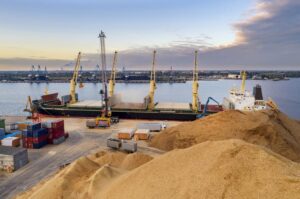
“Grain Initiative” is already operating at less than 20% of its normal throughput capacity because of the Russian Federation’s position in the joint coordination center and the situation is getting worse every day, Deputy Infrastructure Minister Yuriy Vaskov told Interfax-Ukraine in a commentary on Thursday.
“We have had only 43 vessels inspected for entry since May 1 until today. Accordingly, on average, since May 1, the Russian Federation has let in a little more than one vessel per day for inspection. Fifty-four vessels are currently awaiting inspection, some of which have been awaiting inspection for more than three months. The port of Pivdenny is not fully operational. If we talk in numbers, the initiative is already working at less than 20% of its normal capacity. And the situation is deteriorating day by day, solely because of Russia’s position in the joint coordinating center,” said Vaskov.
The deputy minister pointed out that the UN and Turkey are informed of the situation and negotiations are being conducted through them. “Negotiations are being conducted through the UN and Turkey. They are aware of the situation. Every day we communicate. At this time, we have no information that the situation can improve,” Vaskov said.
Answering the question about the prospects for Russian ammonia transit in exchange for guarantees of normal functioning of the secure grain export agreement, he recalled that the ammonia pipeline is currently non-operational. “The ammonia pipeline has been damaged twice in the last three days by Russian shelling. At the moment it is inoperable. To say how long it can be repaired, only the relevant specialists will be able to say when they get access and it is safe,” Vaskov said.
“The Black Sea Grain Initiative was adopted in Istanbul on July 22, 2022 with the participation of the UN, Ukraine, Turkey and Russia. Its essence is to create a corridor for the export of grain from the three Ukrainian ports “Chernomorsk”, “Odessa” and “Pivdenniy” in the conditions of Russia’s ongoing war against Ukraine. The initiative was concluded for 120 days and was extended twice, most recently on March 18. However, while Ukraine claimed it had been extended for 120 days, Russia claimed only 60, until May 18, and insisted on unblocking the operation of the Tolyatti-Odessa ammonia pipeline and lifting all sanctions on trade in Russian agricultural products and fertilizers.
On May 17, Turkey’s president said that the Grain Initiative would continue for two more months, which was later confirmed by UN Secretary General Antonio Gutteres. However, the head of the UN said that there were still unresolved issues.
The port of Pivdenniy is operated by the Odessa Port Plant, which is engaged in the transshipment of ammonia from the Tolyatti-Odessa ammonia pipeline.



