

On October 21, Groshik LLC (Kyiv) won the right to privatize the unified property complex (UIC) of the Zalozetsky distillery (the village of Kabarovtsy and the village of Zaliztsi, Ternopil region), which is part of the state enterprise Ukrspirt, for UAH 120 million 500 , which is 3.9 times higher than its starting cost of UAH 30.82 million.
The corresponding results of trading between eight participants were made public on the website of the Prozorro.Sales online platform on Friday.
In addition to Groshik, OOO TD Griner (Kharkiv) offered UAH 120 million 18 for the asset (482 UAH less than the final price of the lot), and OOO Wind Dance (Novomoskovsk, Dnepropetrovsk region) and OOO Agro Fund ( village of Zvinyache, Volyn region) made bids for UAH 115 million.
According to the Unified State Register of Legal Entities and Individual Entrepreneurs, the ultimate beneficiary of the winning company Groshik with an authorized capital of UAH 4 million is Volodymyr Matyash.
According to the state register, LLC is engaged in retail trade in non-specialized stores with food, drinks and tobacco products.
The real estate of the enterprise subject to privatization is located on four land plots in Kabarovtsy and with. Zaliztsakh (Ternopil region). The asset was put up for sale by the State Property Fund on 7 September.
The enterprise includes the main, administrative and production buildings, a bardon pumping station, a silo, a barn, a workshop, an alcohol depot, a gas station, a cowshed, a greenhouse, a transformer room, an alcohol store, hangars, pumping stations, and other facilities, as well as technological equipment and necessary communications .
Dynamics of gold and foreign reserves of Ukraine from 2012 to 2022
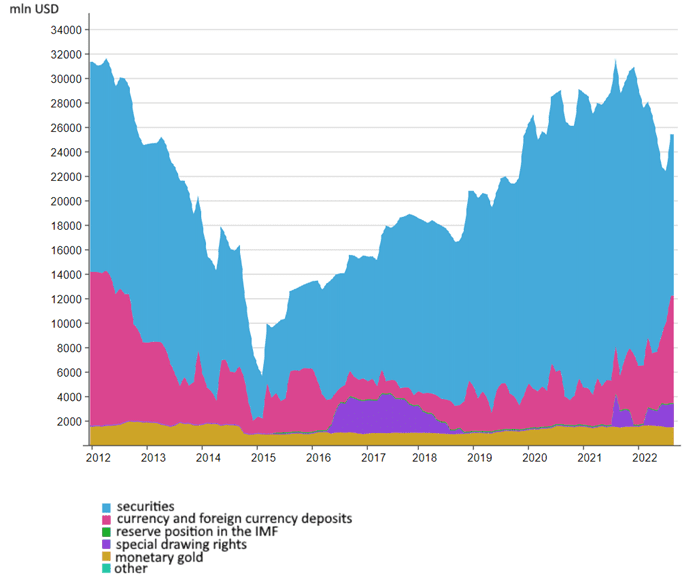
http://www.minfin.gov.ua , graphics of the Club of Experts
Stock indices of the largest countries of Western Europe at the beginning of trading on Friday demonstrate negative dynamics, including due to weak quarterly reports of companies.
In addition, investors are worried about the possibility of a deterioration in the state of the world economy against the background of aggressive actions of a number of the largest central banks to curb inflation, reports Trading Economics. The unstable political situation in Great Britain is also negative for the markets.
The composite index of the largest companies in the Stoxx Europe 600 region decreased by 1.5% and amounted to 392.81 points by 11:31 CST.
Since the opening of the market, the German DAX indicator has decreased by 1.6%, the British FTSE 100 – by 0.7%, the French CAC 40 – by 1.7%. The Italian FTSE MIB fell by 1.6%, the Spanish IBEX 35 – by 1.9%.
One of the world’s leading manufacturers of sports goods, adidas AG, for the third time since the beginning of the year, has worsened forecasts of financial indicators for 2022 due to growing stocks of unsold goods and coronavirus restrictions in China. Also, the German company presented preliminary reporting for the third quarter, according to which profit from continuing operations fell 2.7 times, mainly due to a one-time write-off due to the curtailment of operations in the Russian Federation.
Adidas shares fell in price by 8.5% and are the leader of the decline among the components of the Stoxx 600. Quotations of shares of competitors Puma and JD Sports Fashion also decrease – respectively by 5.6% and 5.3%.
The Swedish telecommunications operator Telia in July-September increased its net profit by 8% – up to 1.71 billion crowns ($151.8 million). However, the result did not justify the analysts’ expectation of 2.1 billion euros. The company’s stock price fell by 8.2%.
Quotations of Vivendi shares fall by 4.2%. French media conglomerate Vivendi SA in the third quarter increased revenue by 4.1% to 2.578 billion euros. At the same time, the revenues of the television division of Canal+ Group decreased by 3.3% – to 1.419 billion euros. It turned out to be worse than the consensus forecast.
The value of French L’Oreal, one of the world’s largest cosmetics manufacturers, and Kering SA, which owns well-known fashion brands, decreased by 4.3% and 4.4%, respectively, despite good reporting for the last quarter.
Renault shares fell by 2.2%, although the French automaker also increased revenue in July-September stronger than forecast.
At the same time, the shares of the British food delivery service Deliveroo Plc added 3.2% in price. Gross transaction volume (GTV) in the third quarter increased by 8% and reached 1.7 billion pounds ($1.91 billion).
Retail sales in Great Britain in September fell by 1.4% compared to the previous month, the country’s National Statistics Office reported on Friday. Experts on average expected a decrease of only 0.5%, reports Trading Economics.
Meanwhile, the British consumer confidence index in October increased by 2 points and amounted to minus 47 points, reports GfK NOP Ltd. This is the first increase in the indicator in almost an hour. Prior to that, he had been updating record lows for several months in a row since the beginning of counting, that is, since 1974. At the same time, analysts expected further deterioration of the indicator – on average to minus 52 points.

Ukraine in January-August 2022 imported fruits and nuts for a total of $398 million, which is 16% less than in the same period in 2021, according to the website of the National Research Center “Institute of Agrarian Economics” (IAE) on Friday.
At the same time, deliveries to Ukraine of products of the “fruits and nuts” commodity group accounted for the largest share among other types of agricultural products imported into Ukraine – 10%, mainly citrus fruits, bananas and exotic fruits were imported.
According to the IAE, Turkey has been the main supplier of fruits and nuts to Ukraine for more than 10 years, from which over 126 thousand tons of these products were imported during the eight months of this year. Its share in the cost of domestic fruit imports amounted to 27.1%.
Ukrainian companies also made significant purchases of fruits and nuts in Ecuador (15.3%), Egypt (6.8%), Greece (6.0%), Colombia (5.5%), Spain (4.9%) and Costa Rica (4.1%). Together, these seven countries formed almost 70% of the value of imports of this group of products to Ukraine.
“The greatest demand among fruit and berry products in our country is traditionally enjoyed by citrus fruits and bananas, which formed almost 3/5 of the value of imports in January-August 2022. If more than half of the volumes of citrus imports consistently belong to Turkey, then Ukraine purchases bananas mainly in countries Latin America, in particular in Ecuador, Colombia and Costa Rica, which this year provided 95% of the value of supplies,” said Bohdan Dukhnitsky, senior researcher at the Department of Economics, whose words are quoted in the message.

Most Asian stock indices are falling on Friday following similar dynamics in the US stock market a day earlier.
Investors are concerned that the Federal Reserve will continue aggressive tightening of monetary policy for the foreseeable future due to persistently high inflation, which could negatively affect the US economy.
Traders are waiting for the Fed to raise its base interest rate to 5% per annum next year. Last week, prior to the publication of fresh data on inflation in the US, they assumed a rise to 4.6%, according to futures on the size of the rate.
Consumer prices in Japan rose 3% in September from the same month a year earlier, the country’s Ministry of Interior and Communications said on Friday. Similar rates of increase were recorded in August. They are the highest since September 2014, while the rise in prices was noted for the thirteenth month in a row.
Consumer prices excluding fresh food, a key indicator monitored by the Bank of Japan, rose 3% year-on-year last month after rising 2.8% in August. The indicator exceeded the central bank’s 2% target for the sixth month in a row. At the same time, growth rates were the highest since September 2014.
The value of the Japanese index Nikkei 225 to 8:17 KSK fell by 0.4%.
Including the shares of such large companies as Fast Retailing (-0.9%), Toyota Motor (-0.4%) and Sony Group (-0.8%) become cheaper.
China’s Shanghai Composite rose 0.3% by 8:22 am KST, while Hong Kong’s Hang Seng shed 0.5%.
Shares of Shenzhou International Group Holdings Ltd., which is engaged in the production and sale of knitwear, are the leaders of the decline in quotations on the Hong Kong Stock Exchange. They fell in price by 6.3%.
In addition, the value of Budweiser Brewing Co. APAC (-3.7%), Chow Tai Fook Jewelery Group (-3.4%), sporting goods manufacturer Li Ning Co. (-3.4%).
Casino operator Sands China reported an 11.6% increase in net loss in the third quarter due to anti-coronavirus restrictions in Macau. The company’s shares lose 3.2% in price.
Meanwhile, stock quotes of online retailers Alibaba Group and JD.com Inc. rise respectively by 0.4% and 1.4%, the Internet giant Tencent Holdings Ltd. – by 0.9%.
The South Korean Kospi index decreased by 0.35% by 8:17 am KSK.
Quotes of securities of one of the world’s largest manufacturers of chips and electronics Samsung Electronics Co. rise by 0.9%, while the cost of automaker Hyundai Motor fell by 1.2%.
Share price of Samsung SDI Co. soared 5.9% on the news that the company has completed the construction of an enterprise for the production of components for the production of car batteries. It is expected that production on it will begin in the first quarter of 2023.
The Australian S&P/ASX 200 fell 0.8%. According to the results of the whole last week, it lost more than 1%.
Capitalization of the world’s largest mining companies BHP and Rio Tinto decreased on Friday by 0.7% and 0.8% respectively.
In addition, the shares of all four largest banks in the country fell in price: Commonwealth Bank – by 1.5%, ANZ Bank – by 1.1%, Westpac Banking – by 0.8% and National Australia Bank – by 1.5%.

Oil prices are rising on Friday morning due to rumors about a possible easing of anti-COVID restrictions in China.
The price of December futures for Brent on the London ICE Futures exchange by 8:13 am CST is $92.90 per barrel, which is $0.42 (0.45%) higher than the closing price of the previous session. As a result of trading on Thursday, these contracts fell by 3 cents to $92.38 per barrel.
The price of futures for WTI oil for December in electronic trading on the New York Mercantile Exchange (NYMEX) is $84.98 per barrel by this time, which is $0.47 (0.56%) higher than the final value of the previous session. By the close of the last session, the contract fell 1 cent to $84.51 per barrel.
A positive factor for the oil market was the news about a possible easing of quarantine regulations for tourists in China. The quarantine period could be reduced to 7 days from the current 10, Bloomberg wrote.
Rumors of an easing of restrictive measures in China were perceived by investors as a signal of a potential curtailment of the policy of “zero tolerance” for the coronavirus, which in turn could spur economic growth and increase demand for fuel in the country, writes The Wall Street Journal.
“China was expected to increase oil imports, but there is no increase in spot market activity from the world’s second largest economy,” said StoneX Group analyst Harry Altham. “Such measures could revive the economy, suffering from anti-COVID restrictions, and become a lifeline for struggling air carriers.
Earlier, US President Joe Biden decided to release 15 million barrels from the strategic reserve (SPR) in December.
“Given that this is part of a previously announced large-scale release, the impact on the market is minimal. Such a measure is unlikely to offset the effect of OPEC+ supply cuts,” ING analyst Warren Patterson wrote.



