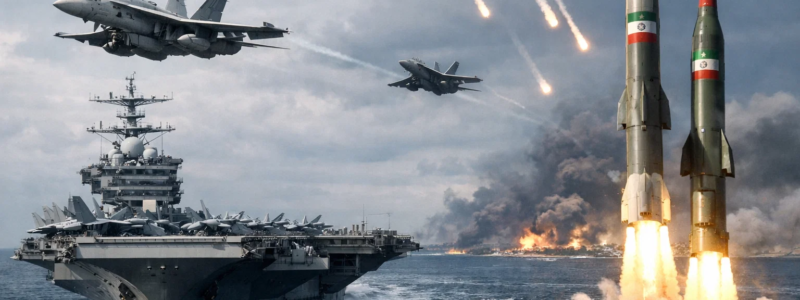
The gap in defense spending is extremely large: in 2024, the US spent about $997 billion, Israel about $46.5 billion, and Iran about $7.9 billion (SIPRI estimate).
The picture is different when it comes to human resources: the US has an active armed forces strength of around 1.32 million (estimate for 2025), Israel has regular forces of around 169,000 with extensive reliance on reserves, and Iran has around 610,000 active personnel (estimates citing IISS).
The key difference lies in “projection of force” and technological structure. The US remains the only country with a comparable set of tools for a long-term campaign far from its own territory, including a fleet of 11 nuclear aircraft carriers and supply, intelligence, and refueling infrastructure.
Israel, with significantly fewer resources, compensates for this with the quality of its air force and layered air defense and missile defense systems. In particular, Israel operates and is expanding its fleet of F-35Is (Adir), and its defense architecture includes Iron Dome, David’s Sling, and the upper echelon Arrow (Arrow-3).
Iran, in turn, is betting on asymmetric responses: missile and drone capabilities, distributed infrastructure, IRGC forces, and pressure through a network of allied non-state actors. According to US estimates, Iran has the largest arsenal of ballistic missiles in the Middle East; some reports also note long-term plans to develop long-range systems.
Finally, the “nuclear factor” works differently for the participants. SIPRI lists Israel as one of nine states possessing nuclear weapons (in the absence of official confirmation from Tel Aviv), while Iran does not officially possess nuclear weapons, and there is controversy over the scope and control regime of its nuclear program.

Personnel
Iran: approximately 610,000 active personnel, approximately 350,000 reservists (IISS estimate, Military Balance 2025).
Israel: 169,500 active personnel and 465,000 reservists (IISS, Military Balance 2023, according to Al Jazeera).
United States: total “authorized strength” for FY2026 – over 1.3 million (Army 454,000, Navy 334,600, Air Force 320,000, Marine Corps 172,300, Space Force 10,400, Coast Guard 50,000).
Conclusion based on “simple arithmetic”: the US has approximately 2.2 times more active personnel than Iran, and the US plus Israel have approximately 2.5 times more (but it is important to note that the US “theatrically available” force in the region is usually significantly smaller than the total number).

Land forces: tanks and artillery
Tanks: Iran – more than 1,500 main battle tanks; Israel – 2,200+ tanks.
The ratio of Israel to Iran is about 1.5:1 in terms of numbers.
Artillery systems: Iran – nearly 7,000 artillery systems (from towed guns to MLRS); Israel – 530 artillery systems (including self-propelled, towed, MLRS, and mortars in one summary).
In terms of the number of artillery systems, Iran appears to be significantly “heavier” (about 13:1), but this does not equate to an advantage in accuracy, reconnaissance, and counter-battery warfare.
In public reports, the US often cites not “all tanks in storage” but the structure of combat brigades: the US Army has 11 armored brigades (ABCT) in active service and 5 in the National Guard; each ABCT has 87 Abrams tanks. This gives a total of 1,392 Abrams tanks in the ABCT (not counting other places of service and reserves).

Aviation: a key advantage for the US
Iran: about 250 combat-ready aircraft (IISS).
Israel: 339 combat-ready aircraft, including 309 fighters/attack aircraft (the summary also provides the structure of the F-16, F-15, and F-35 fleet).
US: US Air Force alone (excluding Navy carrier-based aircraft and Marine Corps aircraft) – 2,027 fighter/attack aircraft in Total Force and 1,430 in Active Force; total Air Force fleet (Total Force) – 5,003 aircraft as of the end of FY2024.
In terms of combat aircraft, this means that the US Air Force’s fighter/attack class is approximately eight times greater than Iran’s estimated combat-capable aircraft, and Israel’s is approximately 35-40% greater than Iran’s in the same combat-capable category.

Navy: US – ocean power, Iran – betting on asymmetry
According to IISS estimates, Iran is building its maritime strategy around asymmetry – mines, anti-ship missiles, speedboats, and small submarines. It is separately noted that the Iranian Navy has more than 100 small high-speed attack boats.
The US has a different “base”: the size of its battle force is 293 ships as of October 1, 2025, and the minimum number of “at least 11 active aircraft carriers” is enshrined in law.
The US submarine component (official Navy fact files): approximately 24 Los Angeles-class submarines in service, 3 Seawolf-class and 24 Virginia-class, plus 14 Ohio-class strategic SSBNs; it is separately noted that 4 SSBNs have been converted to SSGNs.