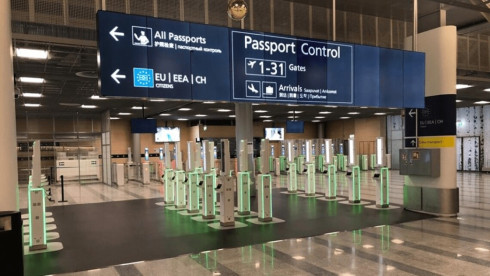
Major European airports have begun periodically suspending biometric checks under the new Entry/Exit System (EES) when its operation leads to excessive lines at passport control and creates the risk of flight delays.
The current EU transitional mechanism, in effect until September 6, 2026, allows for the temporary suspension of fingerprinting and photographing passengers under exceptional circumstances.
Nine European countries have already called for this option to remain in place after September 6. A joint appeal was submitted by Belgium, France, Germany, Greece, Italy, Malta, the Netherlands, Portugal, and Switzerland. They support the continued use of the EES but warn that the system creates serious operational problems during peak passenger traffic.
Disruptions are particularly noticeable at major tourist airports during the summer season. In some cases, border control authorities temporarily suspend certain biometric procedures to process passengers more quickly and prevent flight schedules from being disrupted.
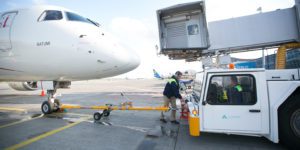
One of the most telling incidents occurred at Milan-Linate Airport. On April 12, due to hours-long lines at border control, 122 passengers on an easyJet flight to Manchester missed their boarding. Of the 156 registered passengers, the plane was able to depart with only 34.
The EES began to be phased in on October 12, 2025, and has been fully operational at the external borders of 29 European countries since April 10, 2026. Instead of a stamp in the passport, the system records the date and place of entry and exit, document details, a facial image, and travelers’ fingerprints.
The system applies to citizens of non-EU countries visiting EES member states for a short stay—up to 90 days within any 180-day period. It applies to both travelers who require a Schengen visa and citizens of countries with visa-free travel.
In particular, citizens of Ukraine, Georgia, Moldova, Serbia, Montenegro, Bosnia and Herzegovina, North Macedonia, and Albania are subject to the EES; the rules also apply to British, American, Canadian, Australian, and other third-country nationals.
There is a significant exception for Ukrainians. Those who hold a valid residence permit, a long-term visa, or a document granting the right to reside in one of the countries using the EES are not registered in the system as ordinary short-term travelers. Therefore, most Ukrainians who are permanently residing in the EU based on the relevant residence status do not have to go through the EES on every trip.
Ukrainians entering the EU visa-free specifically for a short stay, on the other hand, are subject to the system.
The greatest practical impact is currently felt by UK citizens due to the massive passenger traffic between British and European airports. Following Brexit, British citizens on short-term trips are considered third-country nationals under the EES. It is precisely on routes between the EU and the UK that there have already been instances where long lines at passport control have led to missed flights.
At the same time, the European Commission has no intention of abandoning the EES. Brussels considers the system an important tool for controlling external borders: it allows for the automatic tracking of third-country nationals’ length of stay, the detection of the use of stolen or forged documents, and the recording of previous refusals of entry.
September 6 will now be a key date. If the current flexibility mechanism is not extended, it will become more difficult for border services to temporarily suspend biometric procedures when queues grow sharply. Nine EU and Schengen Area countries are pushing to retain this option, fearing further disruptions at Europe’s largest airports.