
The Verkhovna Rada adopted Bill No. 15111-d on the automatic exchange of information regarding income earned through digital platforms in its second reading and as a whole. The bill was supported by 241 members of parliament.
If the president signs the law, the rules for taxing the income of citizens who earn money through online platforms will change in Ukraine. This includes the sale of goods, property rentals, the provision of personal services, vehicle rentals, and other transactions conducted through digital services.
In practice, the law may affect users of marketplaces, classified ad services, delivery platforms, taxi services, housing rentals, freelance services, and other platforms through which individuals earn income.
The main change is that platforms will be required to provide tax authorities with information about users’ income and, in some cases, act as tax agents. This means that tax may be withheld automatically, without the need for a separate tax return from the individual.
For users, this means bringing part of their income out of the “gray zone.” Whereas previously, the sale of goods or services online was often not declared, after the new mechanism is launched, information about such income will be reported to the tax authorities.
In the final version of the bill, some of the controversial provisions were softened. The requirement for sellers to open special accounts and provisions regarding the disclosure of bank secrecy were removed from the text. The final version also provides for a preferential 5% personal income tax rate on income earned through digital platforms. However, taking into account the military levy, the actual tax burden for citizens could amount to about 10% of their income.
This means that for income of 1,000 UAH earned through the platform, the tax burden could be about 100 UAH; for 5,000 UAH, about 500 UAH; for 10,000 UAH, about 1,000 UAH; and for 20,000 UAH, about 2,000 UAH.
As noted by the Experts Club Information and Analytical Center, if a person earns 30,000 UAH per month through the platform, their additional tax expenses could amount to about 3,000 UAH per month, or 36,000 UAH per year. With an income of 50,000 UAH per month—about 5,000 UAH per month, or 60,000 UAH per year.
For citizens who sell personal items on an irregular basis, the impact may be limited, but for those who are effectively engaged in ongoing commercial activity through marketplaces or classified ad services, expenses will increase significantly.
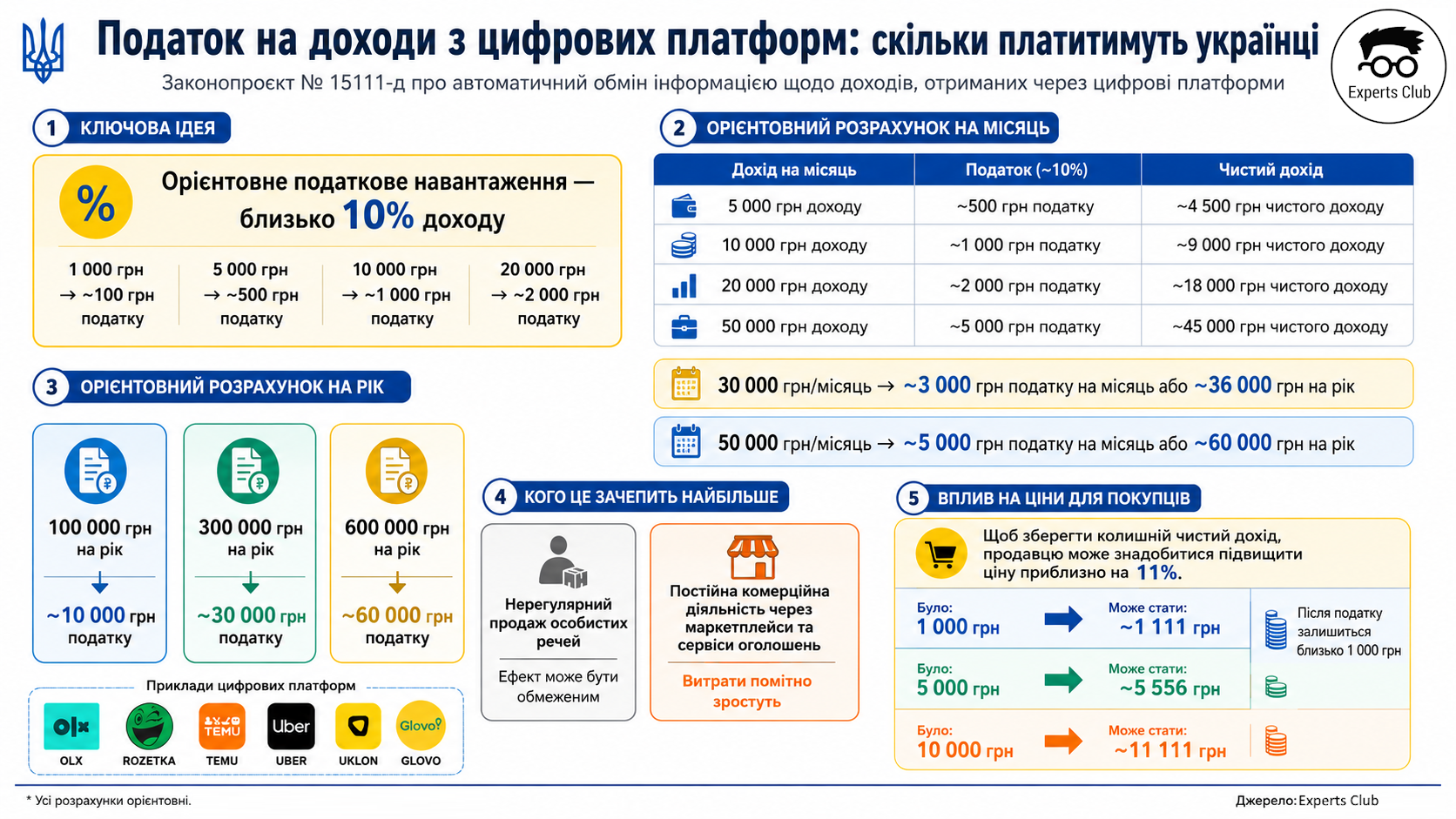
Estimated calculation:
Income via the platform of 5,000 UAH per month — tax of about 500 UAH, net income of about 4,500 UAH.
Income of 10,000 UAH per month — tax of about 1,000 UAH, net income of about 9,000 UAH.
Income of 20,000 UAH per month — tax of about 2,000 UAH, net income of about 18,000 UAH.
Income of 50,000 UAH per month — tax of about 5,000 UAH, net income of about 45,000 UAH.
Income of 100,000 UAH per year — tax of about 10,000 UAH.
Annual income of 300,000 UAH — tax of about 30,000 UAH.
Annual income of 600,000 UAH — tax of about 60,000 UAH.
For buyers, a second effect is possible: some sellers may try to pass the tax on to the price of the goods or services. To maintain their previous net income, the seller will have to raise the price by approximately 11%.
For example, if a seller previously wanted to earn a “net” 1,000 UAH, then with a 10% withholding, they would need to set the price at around 1,111 UAH. Then, after taxes, approximately 1,000 UAH would remain.
If the previous price of a service was 5,000 UAH, then to maintain the same net income, the price may rise to approximately 5,556 UAH. For a good or service priced at 10,000 UAH—to approximately 11,111 UAH.
However, an automatic increase in all prices should not be expected. In competitive categories, some sellers may absorb the tax burden themselves to avoid losing customers. In less competitive segments, the tax is more likely to be partially factored into the price.
For the state, the law is important not only as a tax tool. Its adoption is part of Ukraine’s commitments to international partners, including the IMF and the EU. The document is linked to the implementation of international automatic exchange of tax information on income via digital platforms.
For the market, this means increased transparency in online commerce and services. For citizens, it means the need to recognize that income generated through platforms is gradually ceasing to be “invisible” to the tax authorities.
Key takeaway: The law does not impose a tax on the mere use of platforms, but it does make income generated through them subject to oversight. For those who sell goods or provide services on a regular basis, additional costs could amount to about 10% of turnover, taking into account personal income tax and the military levy. If sellers pass these costs on to customers, final prices could rise by approximately 10–11%.