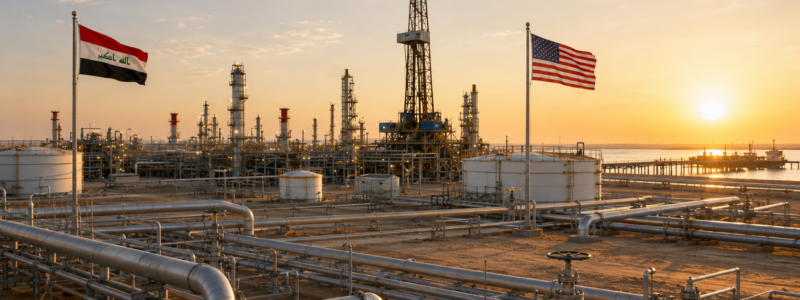
Iraq has estimated the total value of contracts and agreements concluded with American energy companies during Prime Minister Ali al-Zaidi’s July visit to the United States at approximately $200 billion.
Iraqi Oil Minister Basim Mohammed Khudair announced this on July 21. According to him, the projects are expected to increase the country’s production capacity, expand associated gas processing and bring American technologies into the oil and gas industry. The minister estimated Iraq’s current production capacity at 4.8 million barrels of oil per day.
The announced package includes seven key arrangements related to field development, oil and gas asset management, energy infrastructure modernisation and the search for new export routes.
At the same time, the $200 billion estimate does not yet mean that the entire amount has already been formalised as binding capital investment. The package includes contracts, framework agreements, memoranda and preliminary arrangements. The final volume of investment will depend on the results of technical studies, commercial negotiations, the agreement of financing terms and the receipt of regulatory approvals.
Chevron expands its presence in Iraq
The American company Chevron has become one of the central participants in the new energy cooperation.
The company is negotiating its participation in the operation of the West Qurna-2 field, one of Iraq’s largest oil assets, as well as the development of the Nasiriyah field. The parties previously signed preliminary documents concerning Nasiriyah, the Balad field and several exploration blocks in Dhi Qar Province.
During a meeting with Chevron’s management, the Iraqi prime minister called on the company to accelerate investment in oil and gas production and the construction of oil refineries, petrochemical plants, pipelines and storage facilities.
The Iraqi side stated that it was prepared to allocate land plots and expedite administrative approvals for major energy projects. Chevron, in turn, expressed interest in fields in the south of the country and in developing infrastructure for the storage and export of raw materials.
The agreements concerning West Qurna-2 and Nasiriyah remain predominantly preliminary. Before final contracts are concluded, Chevron must examine the projects’ geological, technical and commercial data.
Halliburton to manage the Bin Umar and Sindbad fields
The American oilfield services company Halliburton has received a contract from the state-owned Basra Oil Company for the comprehensive management of the development of the Bin Umar and Sindbad oil and gas fields in southern Iraq.
The contract provides for integrated field management services, as well as support for the design, procurement and construction of the necessary infrastructure.
The involvement of Halliburton is expected to help Iraq increase oil and gas recovery from existing assets, introduce modern reservoir management methods and reduce technological losses.
Another agreement has been concluded with the American company HKN Energy for the development of the Himrin field in the north of the country. The Iraqi government approved the project as part of a broader programme to attract American companies to the oil and gas and electric power sectors.
Iraq seeks alternative oil export routes
One of Baghdad’s strategic objectives is to reduce its dependence on routes through the Persian Gulf and the Strait of Hormuz.
Recent regional crises have demonstrated the vulnerability of Iraq, most of whose oil exports pass through southern terminals. Shipping restrictions and export disruptions have a direct impact on production, budget revenues and the state’s ability to finance infrastructure projects.
Iraq is considering expanding supplies through the Turkish port of Ceyhan and creating a route to the Mediterranean Sea through Syria. The Iraqi and Syrian sides previously discussed transporting oil to the port of Baniyas, including the possibility of restoring existing infrastructure or constructing a new pipeline system.
Chevron is also exploring the possibility of participating in export pipeline and storage projects. If implemented, they would connect the oil fields of southern and northern Iraq with alternative maritime terminals and reduce the country’s dependence on the Strait of Hormuz.
However, such projects will require interstate agreements, large-scale investment and security guarantees. The restoration of pipelines through Syria is complicated by the condition of the infrastructure and the need to ensure the protection of the route along its entire length.
Baghdad turns towards American capital
The current arrangements reflect a broader shift in Iraq’s energy policy towards the United States.
In recent years, Chinese companies have secured a significant share of the country’s new oil and gas projects. Major assets have also been managed by Russian and European operators.
Ali al-Zaidi’s government has announced its intention to give priority to reputable American companies in the energy, telecommunications and technology sectors. To facilitate their entry into the market, the authorities have begun reviewing certain administrative requirements and strengthening the security of oil facilities.
For Iraq, such cooperation is expected to provide access to investment, technologies, oilfield services equipment and political support from Washington. For American companies, the country is attractive because of its large oil reserves, underdeveloped gas sector and need to modernise its infrastructure.
Production growth constrained by OPEC+ agreements
Iraq intends to increase its oil production capacity, but actual production volumes depend on more than investment alone.
The country participates in OPEC+ agreements and is required to comply with the established restrictions. In July, the group’s countries again reaffirmed their commitment to the current arrangements, including the need to compensate for previously exceeding production quotas.
The Iraqi Ministry of Oil previously announced plans to increase production capacity to more than 6 million barrels per day by 2028–2029. Achieving this goal will require the development of new fields, the rehabilitation of existing assets, the expansion of export infrastructure and agreement on a higher quota within OPEC+.
The development of the gas industry remains a separate priority. Iraq is seeking to expand the processing of associated gas, which continues to be flared at fields, and reduce the electric power sector’s dependence on imported fuel.
The authorities plan to increase the utilisation of produced gas to the highest possible level and virtually eliminate its flaring by the end of the decade.
Implementation of agreements will take several years
The package of projects with American companies could become one of the largest investment shifts in the history of Iraq’s oil and gas industry.
However, a significant share of the arrangements remains at a preliminary stage. To proceed to full implementation, the parties must determine the commercial terms, allocation of risks, investment payback periods and security guarantees.
OPEC+ quotas, bureaucratic procedures, the condition of pipeline infrastructure and regional instability remain additional constraints.
If even part of the announced projects is implemented, Iraq will be able to increase oil and gas production, expand processing, reduce its dependence on a single export route and strengthen its position as one of the largest energy producers in the Middle East.
ENERGY, INVESTMENT, IRAQ, OIL, USA