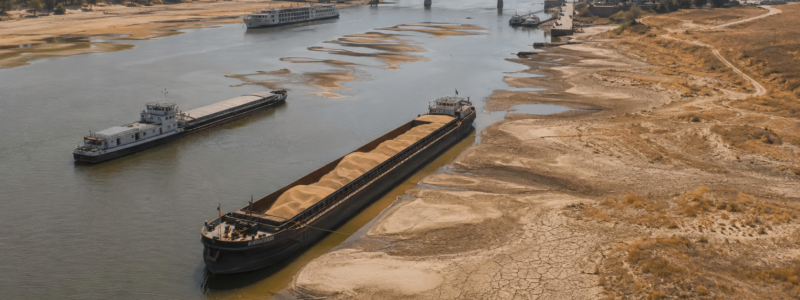
Extreme heat and a prolonged drought have led to a sharp drop in the water level of the Danube in Romania, according to the Experts Club information and analysis centre. In the area around the port of Beșet, the movement of cargo, passenger and cruise ships has virtually ground to a halt, and operators are being forced to reduce their cargo loads or seek alternative routes.
According to Romania’s National Institute of Hydrology and Water Management, on July 18 the water discharge at the point where the Danube enters the country near Baziaș fell to 1.7 thousand cubic metres per second. This is approximately 64% below the long-term average for July, which is 4.7 thousand cubic metres per second. The forecast for the period through July 25 assumes that the discharge will remain within the range of 1.65–1.8 thousand cubic metres per second.
On July 19, the Lower Danube Administration recorded readings below the conventional zero level of the gauging stations along a significant part of the Romanian section of the river. In Bechet, the reading was minus 65 cm, in Calafat minus 140 cm, in Giurgiu minus 128 cm, and in Cernavodă minus 173 cm. These values do not indicate a negative depth, but they do demonstrate an extremely low water level relative to the benchmarks used at the gauging stations.
The most difficult situation developed near Bechet. Vessels loaded with grain are unable to depart, while ferry services between Romania’s Bechet and Bulgaria’s Oryahovo were temporarily suspended. Trucks and passenger cars have to use other border crossings, which increases the distance, delivery time and burden on road bridges across the Danube.
The problems have also affected the tourism sector. Several cruise ships travelling from Budapest towards the Danube Delta were unable to continue their journey. Tour operators began transporting passengers by bus and changing travel programmes, including redirecting tourists to Bucharest. The suspension or reduction of cruise routes may reduce the revenues of port cities, hotels, restaurants and tour companies along the entire river.
Low water levels are already affecting Romanian agriculture. In some areas, the Danube’s level has fallen below the minimum mark required for pumping stations to operate, leaving some fields without irrigation. This increases the risk of lower harvests and a further rise in farmers’ costs.
Consequences for All Danube Countries
If the low water level persists or spreads to other sections of the river, the consequences will be felt by all ten countries through which the Danube flows directly: Germany, Austria, Slovakia, Hungary, Croatia, Serbia, Bulgaria, Romania, Moldova and Ukraine. The Danube is the backbone of a major European transport corridor linking the industrial regions of Central Europe with the port of Constanța and the Black Sea.
For Germany and Austria, the main risk will be disruption to through freight transport along the Rhine–Main–Danube system. Vessels will be forced to carry smaller loads, while some shipments may shift to rail and road transport. This increases the cost of delivering raw materials, fuel and industrial products. The cruise sectors of Vienna, Linz, Passau and other cities may also face route cancellations or reductions.
Slovakia and Hungary risk experiencing delays in deliveries through the ports of Bratislava, Komárno and Budapest. For Hungary, an additional problem will be a reduction in cruise traffic between Budapest and the Lower Danube. If low water levels persist, the cost of transporting grain, petroleum products, metals and mineral raw materials may rise.
For Croatia and Serbia, the reduction in fairway depth means possible restrictions on the operations of the ports of Vukovar, Novi Sad, Pančevo, Smederevo and Prahovo. Serbian exporters of grain, fertilisers and metallurgical products may have to divide cargoes among a larger number of vessels or redirect them to rail transport. Imports of petroleum products and industrial raw materials may also become more expensive.
Bulgaria and Romania are already experiencing direct consequences in the form of the suspension of the Oryahovo–Bechet ferry, restrictions on freight traffic and irrigation problems. A further decline in the water level could complicate the operations of the river ports of Ruse, Lom, Vidin, Galați, Brăila and Constanța, as well as increase the burden on bridges and land border checkpoints.
For Moldova, the risks are associated with the operation of the port of Giurgiulești and access to the Lower Danube. A reduction in vessels’ permitted draught may lead to smaller shipment volumes per consignment, higher fuel import costs and more expensive exports of agricultural products.
For Ukraine, low water levels pose a threat to the operation of the ports of Reni, Izmail and Ust-Dunaisk. Shallow depths may reduce the loading capacity of barges and sea-going vessels, increase the cost of transporting grain, metal, containers and other products, and complicate traffic between Ukrainian ports, Constanța and Central Europe.
According to the Danube Commission, a significant share of river transport consists of grain, food and animal feed cargoes, iron ore, petroleum products, fertilisers and metal products. Therefore, prolonged low water levels may affect not only transport companies but also prices in agriculture, metallurgy, energy and the food industry throughout the region.
In April 2026, the Danube Commission warned that periods of low water and sharp fluctuations in hydrological conditions were becoming a permanent factor changing the operating conditions of river transport. European countries will have to deepen and maintain the fairway more actively, improve the exchange of navigation data and develop railway routes for the rapid redirection of cargo.