Author: Olga Levkun
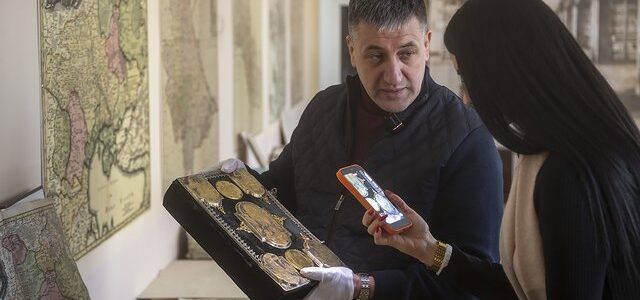
Director of the Central State Historical Archive of Ukraine in Kyiv, Yaroslav Fayzulin, spoke exclusively to the Culture Department of the Interfax-Ukraine agency about the institution’s most valuable collections and showed a selection of unique documents, old prints, maps, and manuscripts that form the “treasure trove of Ukraine’s archival heritage” and present it to the world.
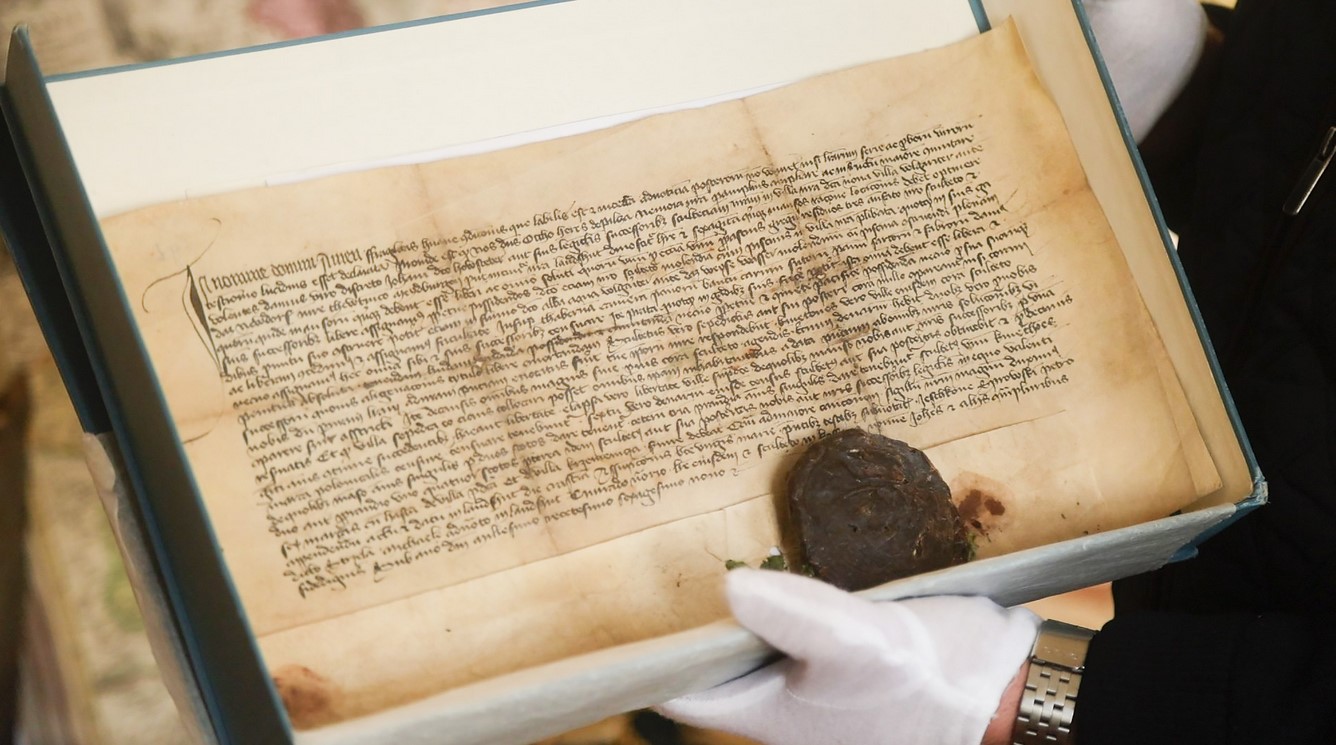
The oldest exhibit shown to journalists was a document from 1369. It concerns the granting of land to Johann Austerter, a resident of Novosidlov. The document is sealed with a wax seal, which confirms its authenticity.
“In the 14th century, as now, documents were sealed with seals, and it is this seal that certifies the authenticity of this document,” said Yaroslav Fayzulin during the demonstration.
A separate section of the exhibition was devoted to how the archive actually began as an institution. The archive began in 1852 with registry books. An imperial decree of 1852 established central archives in Kyiv, Vilnius, and Vitebsk, where ancient registry books and documents of the Polish-Lithuanian Commonwealth and the Grand Duchy of Lithuania were to be stored. The record books contained materials from courts — zemstvo, grodskoe, and podkomorskie — as well as documents from magistrates and town halls: decisions, purchase agreements, notarized deeds, and other original materials.
According to the director of the archive, by the end of the 19th century, about 6,000 record books had been stored, but during World War II, 4,000 were lost. Currently, the archive stores about 2,000 record books. They have already been digitized.
Among the most interesting examples is a record book with an entry of Petro Mohyla’s will regarding the distribution of his estate. During the inspection, attention was drawn to the security measures: the record books were bound with laces to prevent the replacement of sheets or “insertions.” In the 19th century, these documents were often used to confirm property rights or even nobility, and at the end, the book was certified with the seal and signature of the archive director.
In the 19th century and partly in the 20th century, the archive was located in the Red Building of St. Vladimir’s University (now Taras Shevchenko National University of Kyiv), as evidenced by the seal impressions on the documents.
Another rarity on display is the Gospel of the early 17th century, printed in the Lviv printing house and presented by Petro Mohyla to the Church of the Savior in Berestove. The book is decorated with precious metals and bears a dedication by Petro Mohyla and the family coat of arms of the Mohylas. The archive noted that Mohyla came from an ancient boyar family from Moldova.
An equally eloquent symbol of Ukraine’s presence in the European intellectual space is the 18th-century map by German cartographer Johann Baptist Homann, Ukraina, terra Cosacorum (Ukraine, Land of the Cossacks). It shows the Cossack lands and neighboring states. The first edition of the map dates back to 1716, and the atlas we were shown is from 1748. Thus, by the middle of the 18th century, Ukraine was already represented in European atlases under its own name.
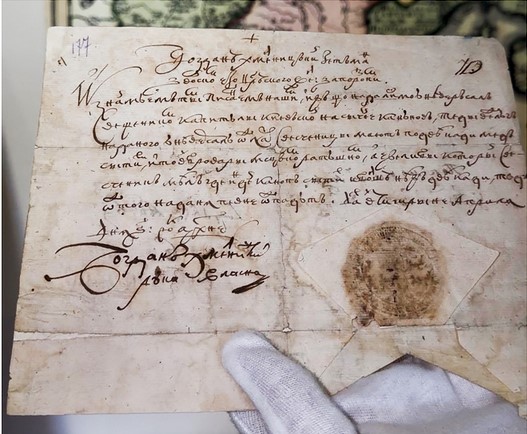
A separate section of the exhibition was devoted to documents of the Hetmanate’s state administration. The archive contains over 200 hetman decrees, from Bohdan Khmelnytsky to Kyrylo Rozumovsky, i.e., decrees from practically all Ukrainian hetmans. We were shown Khmelnytsky’s decree signed “by his own hand,” as well as decrees from Ivan Mazepa and Ivan Skoropadsky.
The documents are certified with seals, and their preservation was ensured by a custodian – a paper overlay over the seal. Using the example of decrees, it can be noted that reading signatures and cursive often requires special training – in particular, knowledge of paleography.
The archive emphasized that the universal letters of the 17th–18th centuries mostly regulated practical issues, such as appointments to positions, granting of land holdings, and transfer of property, while the universal letters of the Central Rada at the beginning of the 20th century were of a different nature, as state acts reflecting Ukraine’s path to independence.
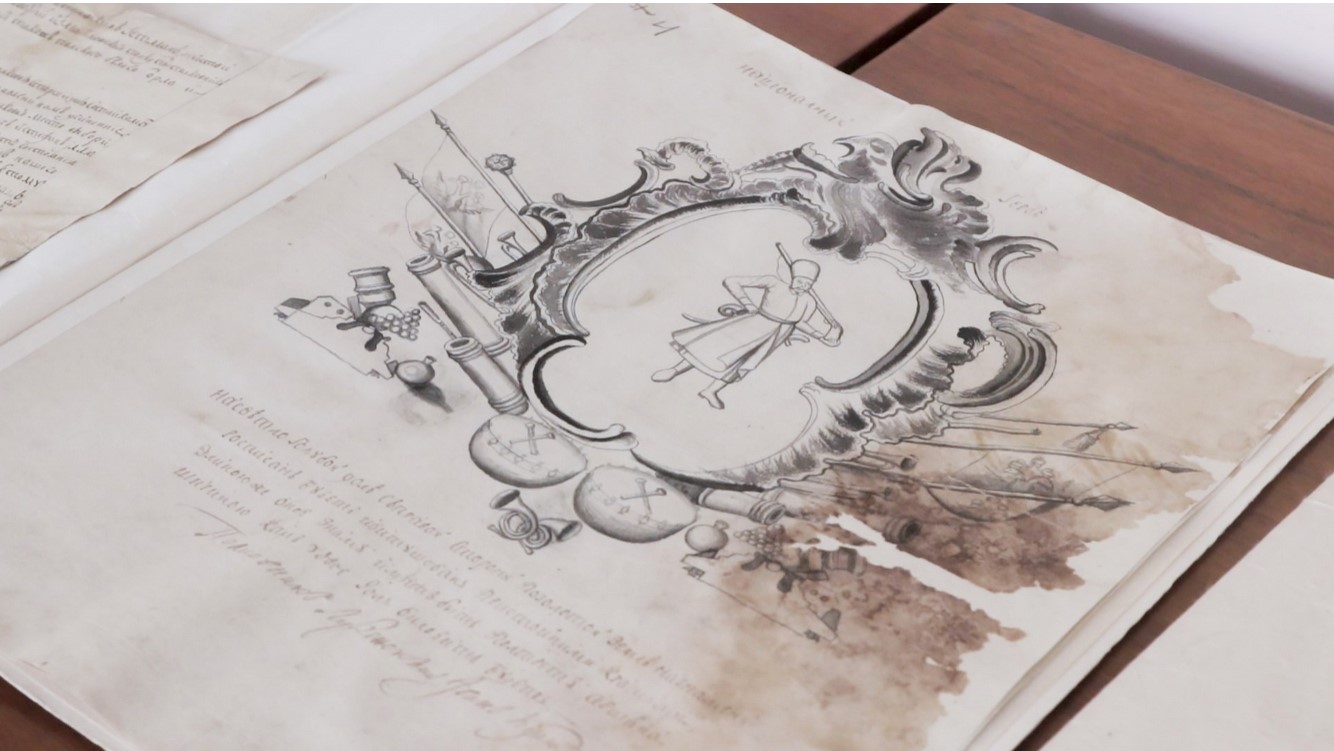
Among the visually striking artifacts is an image of the national coat of arms, which was planned to be developed during the time of the last hetman, Kyrylo Rozumovsky.
At the center of the composition is a Cossack with a musket, an image that was present on the coats of arms of many hetmans and later influenced the symbolism of Hetman Pavlo Skoropadskyi (the graphics were developed by Heorhii Narbut).
They also showed the firman of Turkish Sultan Mehmed IV with a tugra — a sultan’s sign containing key information about the ruler and his titles. The document, dated 1651, concerns the period of preparation of the Ukrainian army for the battle with the Polish-Lithuanian Commonwealth near Berestechko: in it, the sultan promises assistance to Bohdan Khmelnytsky — against the backdrop of the search for allies in the war with Poland.
A separate section focuses on the sources that Ukrainians most often use today to “restore” their own history: metric books, confessional records, and church records.
The archive also contains a metric book with an entry recording the birth of Taras Shevchenko. Archivists emphasize that such metric records are primary sources for researching biographies and family histories.
Confession records were kept to keep track of parishioners, but they were also important for the imperial authorities, particularly for population registration and taxation. Among the most telling examples is the record of the family of Hryhorii Shevchenko coming to confession, which mentions his wife Kateryna and their children Mykita, Taras, and Yosyp.
We were also shown a metric book with an entry about the birth of Goldi Meir, which, according to archivists, is of particular importance to researchers and international institutions.
A separate section of the exhibition was devoted to the collection of Mykhailo Hrushevsky. We were shown manuscripts, in particular those related to “The History of Ukraine-Rus,” as well as printed editions of the work, which show the evolution of the author’s formulations. Among the materials are postcards of European cities and capitals from the early 20th century, as well as a gendarmerie photograph from 1914 with Hrushevsky’s anthropometric data. Separately, they showed police and secret service albums, pocket “reference books” for surveillance, and explained that files were kept on figures in the Ukrainian, Polish, and Jewish movements, recording every episode that came to the attention of the authorities.
The final highlight of the collection was the documents of Hetman Pavlo Skoropadskyi. Among them is his correspondence with Carl Gustaf Mannerheim: some of the letters are handwritten, some are printed, and there are texts in Russian and German.
A separate rarity is the genealogical research of the hetman’s wife, Oleksandra Skoropadska, who traced the Durnov and Skoropadskyi lines back nine generations, compiling materials with coats of arms, portraits, and photographs.
The Skoropadskys’ family album and documents from organizations, in particular the All-Russian Zemstvo Union, with which the biography of Simon Petliura is connected, were also shown.
The archive emphasized that the selection on display is only a small part of the collection: it is an “improvised exhibition” prepared especially for our visit and represents only “one percent” of what is stored in the vaults.
Not only professional researchers can take a look “behind the scenes” of the archive. As explained by the institution, anyone interested can book a paid tour as part of the archive’s paid services, with the format and time of the visit agreed in advance. At the same time, the archive regularly conducts free introductory tours for students, in particular history students, as part of their professional training. Such visits are organized at the request of educational institutions with which the archive has concluded agreements or memoranda of cooperation.
Photo: Olga Levkun, Oleksandr Zubko
Treasury of the nation, documents, hetman, archive