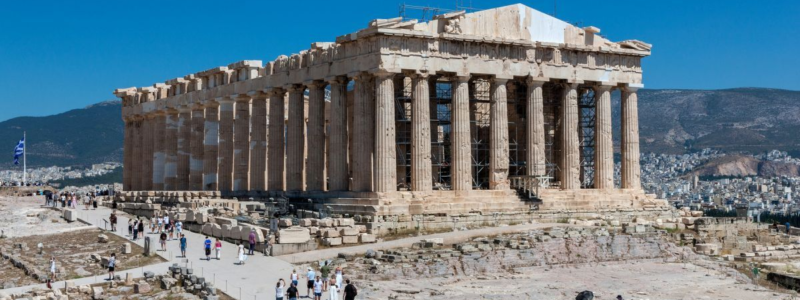
Visitors to the Acropolis of Athens can now see the west side of the Parthenon in its most complete form in around 220 years, following the completion of one of the key stages in the restoration of the ancient temple.
Restorers have installed two new marble blocks in the gaps in the western pediment. It is this side of the Parthenon that visitors see first upon entering the site.
The Greek Ministry of Culture stated that the completion of the work restores the architectural unity of the west pediment and allows the temple’s proportions and geometric precision to be seen once again. Culture Minister Lina Mendoni described the Parthenon’s renewed appearance as “truly impressive”.
The work was carried out by the Acropolis Restoration Service. According to Greek media reports, this was one of the most complex restoration operations in recent years: specialists had to join the surviving ancient fragments with new marble, precisely cut the blocks, hoist them into place and install them within the monument’s structure without disrupting the building’s historical fabric.
The project is funded through European programmes and forms part of the long-term restoration of the Acropolis, which began in 1975. Restorers are using marble from the Pentelicus area – the same source from which material was taken for the construction of the Parthenon in antiquity.
The Parthenon remains the main symbol of Athens and one of Europe’s most visited monuments. According to the AP, the Acropolis attracted around 4.6 million visitors last year. For Greece, it is not only a cultural asset but also a tourist attraction: restoring the temple’s appearance enhances Athens’ appeal as a destination for cultural tourism.
The Parthenon was built between 447 and 432 BC on the Acropolis of Athens and is dedicated to the goddess Athena. The temple is considered one of the principal monuments of classical ancient Greek architecture. In antiquity, it was adorned with sculptural compositions, friezes, metopes and pediments, many of which depicted mythological scenes and formed part of a unified artistic ensemble.
Throughout its history, the Parthenon has changed its function on numerous occasions: it was an ancient temple, a Christian church, a mosque, and during the period of Ottoman rule it was also used as a gunpowder store. In 1687, during the war between Venice and the Ottoman Empire, a shell struck the temple, causing an explosion that severely damaged the building.
Another severe blow to the monument’s integrity came in the early 19th century, when the British diplomat Lord Elgin removed a significant portion of the Parthenon’s sculptural decoration to the United Kingdom. These fragments, known as the Parthenon Marbles or the Elgin Marbles, have been housed in the British Museum since 1816.
For decades, Greece has been seeking the return of the sculptures, arguing that their removal compromised the integrity of the monument and deprived the Parthenon of part of its historical and artistic significance. The British Museum insists that the collection was acquired lawfully under the Ottoman administration of the time; however, Athens maintains that no genuine authorisation existed for the removal of key elements of the temple.
This is precisely why the current restoration of the west pediment has not only architectural but also symbolic significance. Greece is demonstrating that it continues to restore the Parthenon as a single monument of world culture, despite the fact that a significant part of its sculptural heritage still remains outside the country.
In 2024, a representative of the Turkish Ministry of Culture stated that there was no document bearing the sultan’s seal in the Ottoman archives that would confirm the lawful sale or authorisation for the removal of the Parthenon sculptures by Lord Elgin. This strengthened Greece’s position in the dispute with the British Museum.