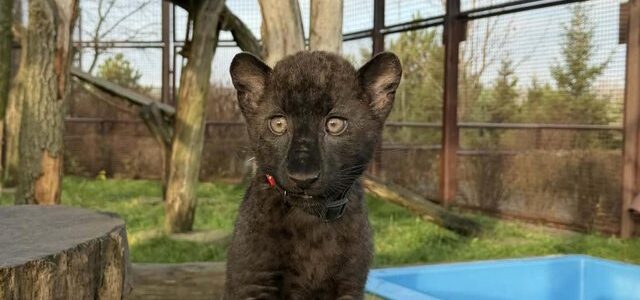
A Far Eastern leopard cub with melanism—a rare black coat color atypical for this subspecies—was born at the “XII Months” Zoo near Kyiv. The female, named Hera, was born on August 20, 2025, but the public was only informed about her now—after the animal had passed the most dangerous period of its first months of life. Mikhail Pinchuk, the zoo’s director and founder, shared this in an exclusive comment to the “Interfax-Ukraine” agency.
“This is a very rare occurrence. Hera’s parents are ordinary Far Eastern leopards, yellow with black spots. The black coloration is a recessive gene that may not manifest for generations. Only if both the mother and father carry it can such a black cub be born,” said Pinchuk.
According to him, the very appearance of a black leopard cub in the Far Eastern subspecies came as a real surprise to the park. The director explained that black Far Eastern leopards have rarely been recorded in the wild, which is particularly due to the characteristics of their habitat. While dark coloring may be an advantage in the jungle, in open snowy areas it, on the contrary, makes the predator too conspicuous.
Park officials say they didn’t immediately grasp the significance of the event at first, as no one expected such a birth from this particular pair of animals. At the same time, they decided not to publicly announce Gera’s arrival right away. The reason was the difficult start to her life.
As Pinchuk explained, a bacterial infection was detected in the cub during the first weeks after birth. Because of this, the leopard cub had to be taken away from its mother and treated. Additionally, it later turned out that the animal had swallowed straw in its mother’s den, and small straw fibers had entered its nasopharynx, complicating its condition.
According to the director, the name Gera was given by the park’s veterinarians. Today, she is already active, developing well, climbing trees, playing, and demonstrating quite distinct hunting instincts. Her diet already includes meat, specifically beef and quail, and the animal herself, despite her playfulness, is already showing the character of a true predator.
Pinchuk says with a smile that as she has grown older, Gera has become so energetic that all her play increasingly resembles training for future hunts.
“The difference between walking a dog and walking Gera (the leopard) is that you don’t lead her—she leads you. Wherever she wants to go, that’s where you have to follow her. If she decides we’re going to the woods today—then we’re going to the woods. If she wants to walk on rocks—we walk on rocks,” said zoo founder Mykhailo Pinchuk.
In the first few months, Gera was walked only in enclosed and safe areas. In the winter, she was let out into the large orangutan enclosure, and later they began taking her on a leash through the zoo grounds early in the morning or late at night, when there were no visitors yet. According to the director, the leopard cub grew up very quickly: while just recently she was a tiny kitten, now she is a serious young predator with sharp teeth, claws, and the habits of a hunter. That is why, after her play sessions, park staff have to replace damaged clothing and sometimes even repair the surrounding area.
At the same time, Hera’s story has become not only good news for the zoo but also a symbol of how the park is trying to hold on during a full-scale war. Pinchuk emphasized that today the main task of “XII Months” is not development or expansion, but simply survival until the end of the war.
“We are currently operating under the premise that we need to survive until the war ends. Nothing else matters. The number of people is about five times smaller compared to pre-war years,” he said.
According to the director, following the occupation of the Kyiv region, the park has completely rethought its security and support systems. Whereas a gas boiler room was previously the main source of power, the zoo has now established a multi-tiered backup system: alternative heat sources, a large backup generator for the entire park, and individual generators for each building where the animals live. All of this is necessary for one purpose—to prevent the temperature in the enclosures from dropping at a critical moment.
Pinchuk explained that some animals, especially primates and heat-loving species, cannot be kept in the cold even for a short time. For example, primates need to be kept at around 20 degrees Celsius; otherwise, they start to get sick. That is why the park begins preparing for the next winter as early as spring—purchasing pellets, branches, and feed, and checking heated floors, generators, and the entire infrastructure.
In fact, according to the director, the zoo’s current operating model is one of constant preparation for a new crisis. And while such measures might have seemed like overkill in peacetime, after 2022 they became a basic condition for survival.
Pinchuk also touched on the financial situation. He emphasized that the park’s only stable source of income remains ticket sales—that is, visitor admission fees. According to him, the zoo receives no systematic state support or significant international aid.
“Our visitors help us. Anyone who comes to us and buys a ticket has already helped automatically. We don’t so much ask for donations as we ask people to come visit us,” he said.
According to the park’s founder, help from caring people does exist, but in much smaller amounts than at the start of the full-scale invasion, when the zoo’s story under occupation particularly struck a chord with many Ukrainians. Today, he says, this is understandable, as the country has far more critical needs, and the army and the front lines remain the priority for people.
At the same time, the park is forced to reconsider ticket prices. Currently, an adult ticket costs 500 UAH, and a child’s ticket costs 350 UAH; however, prices will likely have to be raised, as the costs of maintaining a large number of animals, heating, feed, and backup systems are only increasing.
Pinchuk also noted that the park is currently trying to avoid focusing on active animal breeding. Whereas previously there were open borders and the possibility of full-scale exchanges with other zoos around the world, bringing in new animals under wartime conditions now seems too risky. That is why new additions to the park are currently the exception rather than the rule.
At the same time, “XII Months” remains a place where you can see not only Gera but also many other iconic and rare animals. During the conversation, the director specifically mentions primates, orangutans, large predators, as well as the entire infrastructure created specifically to house complex and valuable species. That is why every birth here is not just news for visitors, but the result of the complex daily work of a large team of veterinarians, paramedics, and keepers.
The behavior of animals during the war was also a separate topic of conversation. According to Pinchuk, while the reaction was dramatic in the early days of the full-scale invasion, most of the park’s residents have now largely adapted to the constant threats. They often react to the sounds of explosions more like they would to thunder, although nearby explosions, of course, frighten both animals and people.
Visitors will be able to see Hera starting in early April. The zoo hopes that the story of the black leopard cub will not only be good news for the Kyiv region but also an additional reason for people to visit the park and support it during these difficult times.
The “XII Months” Park in the Kyiv region was under occupation in 2022 and has since been operating amid constant security and financial challenges. The birth of a female Far Eastern leopard with melanism in August 2025 was a unique event for the park, which was only publicly announced after the animal had passed the critical survival period. Starting in early April 2026, Geru is scheduled to be shown to visitors for the first time.
Author: Olga Levkun