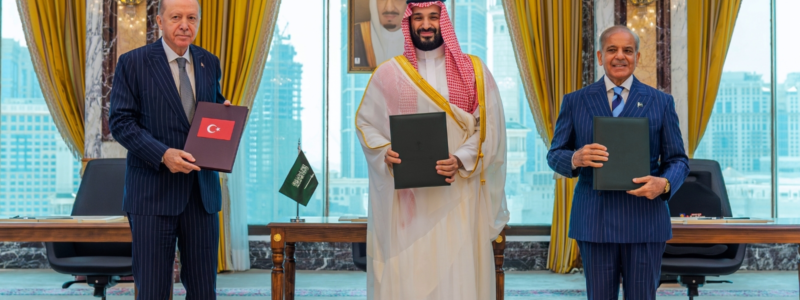
The signing of the “Mecca Joint Defence Agreement” by Saudi Arabia, Türkiye and Pakistan could become one of the most significant changes to the security architecture of the Middle East and South Asia in recent years, Experts Club analysts believe.
The agreement was signed on August 7, 2026, by Saudi Crown Prince Mohammed bin Salman, Turkish President Recep Tayyip Erdoğan and Pakistani Prime Minister Shehbaz Sharif after almost a year of negotiations.
The document’s main principle effectively replicates the basic logic of NATO’s collective defence: an armed attack against one participant must be regarded as an attack against all three.
On August 8, Turkish Foreign Minister Hakan Fidan directly compared this mechanism with Article 5 of the North Atlantic Treaty. At the same time, he stressed that the agreement was not directed against Iran or any other specific country.
However, the political geography of the three participants makes it possible to identify several areas that may have influenced the creation of the new security mechanism.
Iran is the most immediate factor behind the formation of the alliance.
Saudi Arabia and Iran have competed for influence in the Middle East for decades, despite the restoration of diplomatic relations mediated by China. Following a new escalation of the regional conflict in 2026, the security of Saudi Arabia, the oil infrastructure of the Persian Gulf and maritime routes once again became a central concern for Riyadh.
Reuters links the signing of the agreement specifically to growing regional instability and threats to the Persian Gulf states. At the same time, Iran has already reacted rather critically to the creation of the new mechanism.
According to Experts Club, deterring a possible expansion of the regional conflict surrounding Iran should be regarded as the first function of the new agreement.
However, this does not mean the creation of a classic “anti-Iranian NATO.” Pakistan maintains its own relations with Tehran and shares a border with Iran, while Türkiye is interested in preserving economic and political channels of interaction with it.
It is therefore more advantageous for all three states to formulate the agreement as a universal system of collective protection without naming an adversary.
The second area is connected with Israel.
Israel’s growing military autonomy and the expansion of its operations in the region are causing concern not only in Iran but also among a number of Arab and Muslim states.
Reuters notes that the participating countries are concerned both about Iran’s actions and Israel’s military policy.
At the same time, the participants’ relations with Israel differ substantially.
Pakistan officially has no diplomatic relations with Israel. Turkish-Israeli relations have repeatedly gone through periods of sharp deterioration in recent years. Saudi Arabia, by contrast, had long considered the possibility of normalising relations with Israel, although regional wars have significantly complicated this process.
The issue is therefore less about preparing an anti-Israeli military alliance than about attempting to create an independent centre of power capable of limiting the unilateral dominance of any regional player.
The third area is considerably more complicated — India.
For Pakistan, India remains its principal long-term strategic adversary. Both countries possess nuclear weapons, and another serious armed clash between them occurred in 2025. SIPRI specifically notes that the India-Pakistan confrontation remains one of the factors contributing to global nuclear risk.
Türkiye traditionally maintains close political and defence relations with Pakistan, while disagreements between Ankara and New Delhi have repeatedly intensified because of Türkiye’s position on Kashmir.
However, it would be an exaggeration to regard the new trilateral agreement as being directly aimed against India.
Saudi Arabia is simultaneously developing a strategic partnership with New Delhi. India is a major consumer of Saudi oil, while cooperation between the two countries encompasses investment, energy, security and defence contacts.
Riyadh is therefore unlikely to be interested in turning the agreement into an automatic Pakistani instrument against India. It is more likely that the treaty gives Islamabad additional political weight and potential support from its partners, but the application of the collective defence principle in the event of a new India-Pakistan crisis will become one of the main tests of the agreement’s actual substance.
The principal distinguishing feature of the new triangle is that one of its countries is a nuclear power.
Pakistan possesses nuclear weapons. According to estimates by Western research centres, its arsenal comprises approximately 170 nuclear warheads. SIPRI classifies Pakistan among the world’s nine nuclear-armed states and notes the continued modernisation of its nuclear capabilities.
However, the text of the agreement does not indicate that Pakistan is providing Saudi Arabia or Türkiye with a so-called nuclear umbrella. This is fundamentally important.
The very participation of a nuclear power increases the political value of the deterrence mechanism, but no automatic obligations to use nuclear capabilities in the interests of the partners have been publicly announced.
In this sense, the agreement creates strategic ambiguity rather than a formal system of extended nuclear deterrence.
The situation is additionally noteworthy because India also possesses nuclear weapons, while Israel, according to SIPRI, is classified as a nuclear-armed state, although it does not officially confirm the existence of a nuclear arsenal. Iran is not included in this SIPRI group.
Another indication of the new format’s long-term ambitions is the possibility of its expansion.
Fidan said that other states could join the agreement in the future. Egypt is mentioned first among the potential participants. To implement the treaty, it is planned to establish a permanent secretariat in Saudi Arabia and a mechanism for regular meetings of foreign and defence ministers.
Pakistani Defence Minister Khawaja Asif has already stated that such an association should not become a “closed club,” effectively allowing for the formation of a broader collective security system of Muslim states.
If Egypt and other major states actually begin joining the agreement, it may gradually become not merely a trilateral treaty but a new regional security architecture.
The creation of the new format does not mean that its participants are breaking with Washington. Saudi Arabia maintains extremely close military cooperation with the United States, Türkiye is a member of NATO, and Pakistan has a long history of cooperation with both the United States and China.
However, the new treaty demonstrates another trend: the region’s leading countries are seeking to create their own security guarantees that are not entirely dependent on decisions made in Washington. This is particularly evident against the background of simultaneously rising military expenditure, the crisis surrounding Iran, threats to the Persian Gulf’s energy infrastructure and instability along maritime routes.
The three countries bring together very different resources.
Saudi Arabia provides primarily the financial and economic component. According to SIPRI, its military expenditure reached approximately $83.2 billion in 2025, placing the kingdom eighth among the world’s largest military budgets. The strength of its armed forces and National Guard is estimated at approximately 250,000 personnel. The Saudi army is largely equipped with imported hardware and is closely integrated into the system of military cooperation with the United States and other Western countries.
Türkiye has the largest army by personnel among the three participants when regular armed forces are taken into account — approximately 495,000 military personnel, according to the World Factbook. Its military expenditure amounted to approximately $30 billion in 2025. Türkiye’s main distinguishing features are its large domestic defence industry and NATO membership, which give Ankara substantial institutional and technological resources.
Pakistan has the largest armed forces within the new association, with approximately 660,000 active military personnel. SIPRI estimated its military expenditure in 2025 at approximately $11.9 billion. Financially, Pakistan is significantly behind Saudi Arabia and Türkiye, but compensates for this with the scale of its armed forces and the possession of nuclear weapons.
Together, the three states have approximately 1.4 million active military personnel, while their combined military expenditure, according to 2025 data, exceeds $125 billion. However, the arithmetic addition of these figures does not yet turn the agreement into a unified military organisation. The parties have no joint command modelled on NATO, unified armed forces or publicly defined mechanism for automatically entering a war.
The main question is therefore not the quantity of resources possessed by the three states, but how far they are genuinely prepared to go to protect one another in a real crisis.
According to Maksym Urakin, founder of the Experts Club analytical centre: “The emergence of the Saudi Arabia–Türkiye–Pakistan triangle primarily indicates the formation of a more multipolar security system extending from the Eastern Mediterranean and the Persian Gulf to South Asia. Iran and Israel are the most obvious regional factors behind its emergence, while India is becoming an important indirect factor because of Pakistan’s participation.”
At the same time, the official absence of a designated adversary enables the three countries to strengthen deterrence while maintaining economic relations with states that may potentially perceive the agreement as being directed against them.