
Schneider Electric, a global leader in energy technologies, today released its results for the first quarter of 2026 as part of its new Impact 2030 sustainability roadmap.
Building on years of leadership and a unique approach to sustainability, Impact 2030 structures the company’s ambitions around four strategic pillars—electrifying the world, transforming industry, unlocking human potential, and supporting local communities—which are implemented through targeted programs and measured using clear performance metrics.
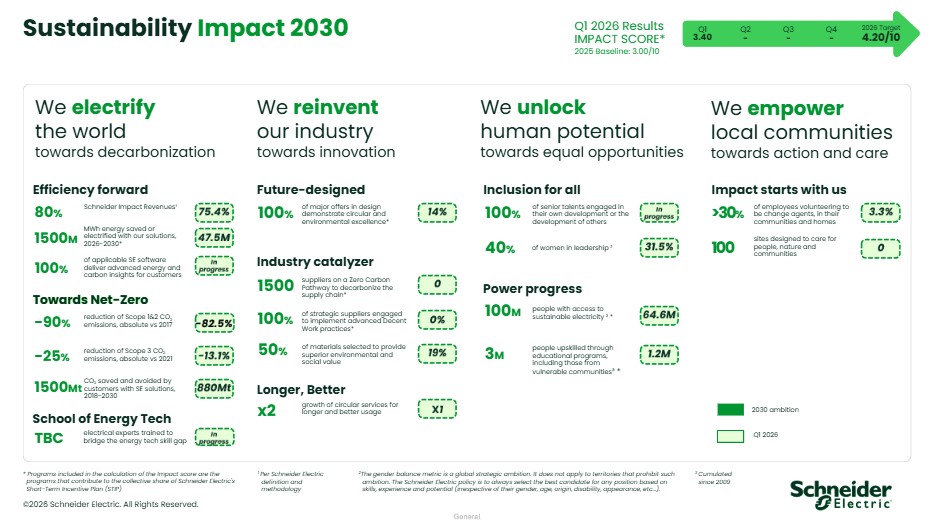
In the first quarter of the new cycle, the Impact Score reached 3.40/10, marking a strong start toward the 2026 annual target of 4.20/10 (where 10/10 corresponds to the 2030 ambition). This metric reflects early progress in key programs, combining results in the company’s operations with scalable impact for customers, suppliers, and communities.
Schneider Electric further reduced carbon emissions in its own operations: Scope 1 and 2 emissions decreased by 82.5% compared to 2017. In the first quarter, the company also helped customers save or electrify 47.5 million MWh of energy through energy management, automation, and digital solutions. These efforts resulted in a reduction and avoidance of 20 million metric tons of CO₂ equivalent for the quarter.
Achieving large-scale results also requires rethinking approaches to product design and manufacturing. In the first quarter, the company continued to implement the Future Designed framework: 14% of key products in the development phase already demonstrate high levels of circularity and environmental efficiency.
In the supply chain, the company accelerated the rollout of the Zero Carbon Pathway initiative, developing a long-term model for engagement with suppliers. In the first quarter, more than 1,100 suppliers joined the program, many of whom have already completed training and received practical tools to decarbonize their operations.
Supporting equal opportunities remains a key priority for the company. In the first quarter, more than 2.8 million people gained access to sustainable electricity through Schneider Electric’s community solutions, and 113,000 people received training and upskilling in programs related to energy, electrification, and automation. In total, more than 1.2 million people have been trained since 2009.
“Impact 2030 creates a framework for systemic transformation by engaging all stakeholders,” said Esther Finidori, Director of Sustainability at Schneider Electric. “We expect positive results to grow with each quarter as our ambition translates into tangible, consistent, and measurable progress.”
Detailed results and key sustainability indicators for Q1 2026 are available in the report.in Schneider Electric’s quarterly report, published alongside the Group’s first-quarter financial results.
Recognition:
Related resources:
About Schneider Electric
Schneider Electric is a global leader in energy technologies, driving efficiency and sustainability through the electrification, automation, and digitalization of industry, business, and residential spaces. The company’s technologies enable buildings, data centers, factories, infrastructure, and power grids to function as open, interconnected ecosystems, enhancing productivity, resilience, and environmental sustainability.
The company’s portfolio includes smart devices, software-defined architectures, AI-based systems, digital services, and professional consulting services. With 160,000 employees and 1 million partners in over 100 countries, Schneider Electric consistently ranks among the world’s most sustainable companies. Learn more at https://www.se.com/ua/uk/