
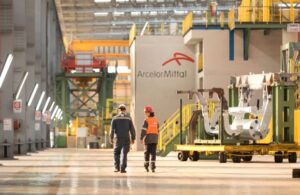
ArcelorMittal increased EBITDA by 35% in the first quarter of 2024 compared to the fourth quarter of 2023 to $1.96 billion, the company said in a statement.
The main increase in EBITDA was driven by improved performance of assets in North America, Brazil, Europe and India.
Operating profit in the last quarter amounted to $1 billion compared to a loss of $1.98 billion in the previous period.
Net profit in January-March amounted to $938 million, compared to a loss of almost $3 billion a quarter earlier.
Revenue increased by 12% last quarter compared to the fourth quarter, amounting to $16.28 billion.
ArcelorMittal’s capex in working capital amounted to $1.7 billion in January-March. The capex target for this year is $4.5-5 billion.
In the first quarter, the company increased steel production by 5% quarter-on-quarter to 14.4 million tons. Last quarter, metal shipments increased by 1.5% to 13.5 million tons. The company’s iron ore production increased by 4.8% to 6.5 million tons in the quarter.
According to ArcelorMittal’s forecasts, global steel consumption, excluding China, will increase by 3-4% in 2024. At the same time, demand in the US will increase by 1.5-3.5%, in Europe by 2-4%, in Brazil by 0.5-2.5%, and in India by 6.5-8.5%.
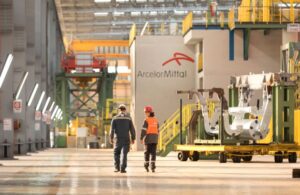
ArcelorMittal increased its EBITDA by 44% in Q2 2023 compared to Q1, to $2.6 bln, the company said in a statement.
The steelmaker points to improving market conditions as well as positive effects from M&A deals (the acquisition of Pecem in Brazil and the consolidation of ArcelorMittal Texas HBI). For the six months, EBITDA rose to $4.4 billion from $3.9 billion a year earlier.
Operating profit last quarter was up 62% on Q1, to $1.9 billion. January-June operating profit was $3.1 billion, compared with $8.9 in the first six months of 2022.
Net income in the April-June period was $1.86 billion (up 70%), down 63% to $2.96 billion for the first half of the year.
Revenue increased last quarter by 0.6% quarter-on-quarter to $18.6 bln. In January-June, ArcelorMittal’s revenue fell by 16% to $37.1 bln largely due to lower metal shipments and a 14.7% drop in average realized price.
ArcelorMittal’s April-June capex totaled $1.06 billion ($938 million quarter earlier), with a 2023 capex guidance of $4.5-5 billion.
In the second quarter, the company increased steel output by 1.4% quarter-on-quarter to 14.7 million tons; for the half-year, it decreased by 5.5% to 29.2 million tons.
Metal shipments fell 2% to 14.2 million tons last quarter, down 3.4% (to 28.7 million tons) in January-June.
The company’s production of yellow ore for the quarter fell 4.5% to 6.4 million tons, with 13.1 million tons produced in the six months compared to 14.2 million tons of yellow ore a year earlier.
ArcelorMittal Krivoy Rog (Dnipropetrovsk Region) has reduced its production to 15-20% of its pre-war level from 30-40% achieved recently due to problems with technical water supply after Russian occupants blew up the Kakhovska hydroelectric dam.
“From an industrial, industrial point of view, we are certainly feeling the effects. We can use what we have – the reserves. But still, you remember we were working, we had somewhere between 30-40% recently, now we’re back to 15-20% of our labor force. And we don’t see the opportunity to get more orders right now,” said ArcelorMittal Krivoy Rog (AMKR) CEO Mauro Longobardo at a discussion organized by the European Business Association (EBA) on Wednesday on “The Kakhovskaya HPP blast: implications for business.”
He said the company will focus on fulfilling earlier orders and implementing projects to provide the plant with water from alternative sources. Longobardo estimates it will take at least six months to implement projects that provide alternatives.
“We will do our best to fulfill previous orders. With the new orders, we’re waiting for the situation to normalize. We have yet to see the Dnieper water level stabilize – every day there is a decrease in the level, and we don’t expect things to return to previous levels anytime soon. But to start using water from other reservoirs, it takes time – we will need pumping stations. That is about half a year at least. Certain preparatory work is already underway,” said the AMKR CEO.
As one of the measures to minimize the negative effects, the company intends to make a change in production planning so that there are periods with high consumption and lower consumption. If during normal times the water consumption at the plant was 2.4 thousand cubic meters per hour, now it has dropped to 1 thousand cubic meters per hour or less, Longobardo specified.
In this case, the top manager noted that even though the customers are concerned, they are sympathetic to the situation, and assured that with the available reserves the company will meet all current orders.
In turn, Sergey Plichko, the financial director of ArcelorMittal Krivoy Rog, during the discussion explained that such a significant drop in water consumption was due to the lowering of its pressure, which was applied in connection with the need to save water in the southern reservoir, through which also meets the water needs of 70% of the population in Krivoy Rog.
“In order to adapt to these conditions, we had to stop some units. At first we stopped production of steel and rolled products. Now we understand that we will be able to restart some rolling mills. We will try to put one of them back in operation tomorrow. Then we’ll look at the level of consumption and whether we can launch some other units,” he said.
According to Plichko, the situation is better in the company’s mining department due to the fact that process water is used in a closed circuit. “The situation in the mining department is better – there is a closed circuit of water consumption. The water used in the production process is settled and fed back into production. There is only minor consumption to replenish this level. But there are also sufficient reserves after the spring floods. At least for the next 2-3 months the mining department is provided with water for work”, – specified the financial director of ArcelorMittal Krivoy Rog.
Earlier it was reported that ArcelorMittal Kryvyi Rih PJSC (Dnipropetrovsk region) is returning people to normal mode after sending some personnel to remote work due to the termination of water supply to some units because the occupants blew up the Kakhovskaya HPP dam. It was also reported that the company suspended steel smelting to reduce water consumption under critical conditions.
“ArcelorMittal Krivoy Rog is the largest producer of rolled steel in Ukraine. It specializes in the production of long products, particularly rebar and wire rod.
ArcelorMittal owns in Ukraine the largest mining and metallurgical plant “ArcelorMittal Krivoy Rog” and a number of small companies, in particular PJSC “ArcelorMittal Beryslav”.
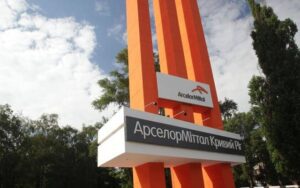
ArcelorMittal remains committed to Ukraine and believes in its future, despite the huge difficulties in the work of its own mining and smelting plant, ArcelorMittal Krivoy Rog (AMKR), caused by full-scale armed aggression of Russia, said Vijay Goyal, ArcelorMittal executive vice president and CEO of ArcelorMittal CIS.
“Every day we lose more than $1 million. 10% of our staff is at war, 67 people died defending the country… But I not only hope, but I believe that we will come out victorious. We are willing, able and ready to rebuild,” he said at a business forum on the rapid reconstruction of Ukraine in Luxembourg organized by the Ukrainian-Luxembourg Business Club.
ArcelorMittal board member Michel Wurth noted that since buying Krivorozhstal in a privatization tender in 2005, more than $10 billion has been invested in Ukraine in total, and in 2021 the plant, which employs 26,000 people, was a record producer.
“We remain committed to Ukraine, to its people, and we plan to participate in the rebuilding of Ukraine as quickly as possible,” he stressed
Goyal noted that the management and staff of AMKR set an incredible example of indestructibility, organizing the work of the enterprise during blackouts, without access to the Black Sea ports, during shelling.
According to him, ArcelorMittal counts on the high quality of state administration after the war, continued anti-corruption efforts, efficient infrastructure, as well as the provision of security conditions given the large number of weapons in the country.
For its part, he said, the company is exploring all opportunities to better integrate AMKR into the global market and bring new technologies to Ukraine.
For his part, Wurth added that the issue of public-private partnerships and attracting financing remains important.
“ArcelorMittal Kryvyi Rih is the largest producer of rolled steel in Ukraine. It specializes in the production of long products, in particular rebar and wire rod.
ArcelorMittal owns in Ukraine the largest mining and metallurgical plant “ArcelorMittal Krivoy Rog” and a number of small companies, in particular PJSC “ArcelorMittal Beryslav”.
European Bank for Reconstruction and Development (EBRD) will provide ArcelorMittal Kryvyi Rih PJSC (AMKR, Dnipropetrovsk oblast) with a $100mn loan to replenish its working capital.
“The loan will be used to finance the company’s working capital needs to ensure business continuity in Ukraine,” the bank said in a statement Thursday.
According to it, the bank’s board of directors approved the project at a meeting on Dec. 14.
The EBRD recalled that it provided financing to AMKR in 2017, developed a comprehensive Environmental and Social Action Plan (ESAP) and monitored its implementation by PESM, making monitoring visits to the company in recent years.
“Overall, the company was on track for implementation and reported as required. The provision of working capital under the concept of sustainability of Ukraine will allow, among other things, to continue investment plans and implement the existing ESAP, which, in turn, will significantly improve the environment, health and safety at the site,” – pointed out the bank.
The EBRD clarified that a key aspect of the current investment program is the modernization of the sinter plant, and this investment process is ongoing, with work on the sinter lines as well as the air treatment facilities, but some investments planned for 2022-2023 have been postponed due to the ongoing war and the proximity of the front.
“ArcelorMittal Krivoy Rog is the largest producer of rolled steel in Ukraine. It specializes in the production of long products, particularly rebar and wire rod, and is owned by ArcelorMittal.
On November 24 this year, after the blackout caused by Russian missile attacks on the energy infrastructure, AMKR reported about critical limitation of electricity consumption and suspension of most of the production processes. According to the company, the available amount of electricity is not enough to maintain production even at 20% of capacity.
In addition, on the night of December 5, AMKR was hit by a Russian missile strike.
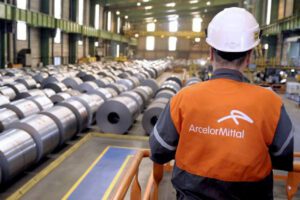
PJSC ArcelorMittal Kryvyi Rih (Dnipropetrovsk region) at its coke chemical division in January-July this year reduced production of metallurgical coke by 59.4% compared to the same period last year, to 696,700 tonnes.
A representative of the company told Interfax-Ukraine that in July the company produced 43,500 tonnes of metallurgical coke.
At the same time, in January-July 2022, production of 6% moisture gross coke at the plant amounted to 800,000 tonnes, including 51,000 tonnes in July.
Coke production at ArcelorMittal Kryvyi Rih over seven months of 2021 increased by 11.9%, to 1.716 million tonnes, including 257,000 tonnes in July last year.
In January-July 2022, the company received 216,000 tonnes of domestic coal, 390,000 tonnes from Russia (before the war), 65,000 tonnes from Kazakhstan, 27,000 tonnes from Poland, 15,000 tonnes from the Czech Republic, 190,000 tonnes from the USA and 126,000 tonnes from Australia. In July, the plant delivered 68,000 tonnes of domestic coal, 32,000 tonnes from the United States, and 4,300 tonnes from Australia.
ArcelorMittal Kryvyi Rih is the largest producer of rolled steel in Ukraine. It specializes in production of long products, in particular rebar and wire rod.



