

According to Serbian Economist, associations of truckers from Serbia, Montenegro, Bosnia and Herzegovina, and North Macedonia have announced their intention to start protest actions on January 26, 2026, by blocking freight terminals at border crossings in the direction of Schengen countries. The planned actions were reported by regional media outlets, citing statements from the relevant associations.
The carriers cite the practical application and future tightening of controls in connection with the introduction of the Entry/Exit System (EES) as the reason for their actions. According to them, professional drivers from non-EU countries will effectively be subject to the 90-day rule within a 180-day period for short stays in the Schengen area, just like ordinary tourists. Carriers warn that with the “strict” application of the rules from spring 2026, some drivers may quickly exhaust their stay limit, which will create risks for supply chains and freight traffic between the EU and the Western Balkans region.
The European Commission has stated that it is monitoring the situation and is in contact with its Western Balkan partners, while pointing out that the rules for short stays in Schengen are “clear” and that practical decisions at the external borders are the responsibility of the member states.
EES is an automated EU IT system for registering the entry and exit of non-EU citizens on short-term trips, including recording document and biometric data, with the aim of improving the efficiency of external border controls and detecting overstays. The European Commission has announced that the system is being implemented in stages, with full deployment at all border crossing points planned for April 10, 2026, when electronic records are to finally replace stamps in passports.
If blockades are implemented at freight terminals, queues and delays are possible in a number of EU-Western Balkans directions, which may affect the timing of commercial deliveries in the region and throughout Europe.
Blockade, Bosnia, CARGO, Macedonia, MONTENEGRO, Schengen, SERBIA, Trucking company
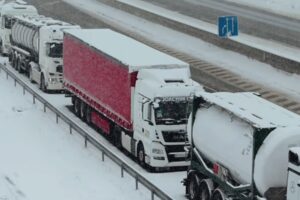
A blockade continues at six Ukrainian-Polish border crossing points (BCPs), with protesters, Polish farmers, allowing one or two trucks to pass in both directions per hour, resulting in increased traffic at BCPs with other countries, where traffic flows have been redirected, State Border Guard Service of Ukraine (SBGS) spokesman Andriy Demchenko said on a national TV marathon Wednesday.
According to him, the most difficult situation is at the Yahodyn-Dorogusk and Shehyni-Medyka checkpoints, where protesters are not letting trucks traveling from Ukraine to Poland through at all.
“Yesterday (February 20 – IF-U) the situation was different, because Polish farmers scaled up their actions to block traffic for vehicles. They made it virtually impossible for trucks to move in all directions, and at the three checkpoints Ustyluh-Zosin, Uhryniv-Dovhobochev, and Rava-Ruska-Krebenne they restricted traffic for other categories of vehicles, including cars and buses, which for some time could not cross the border either towards Ukraine or Poland. Gradually, after 4 p.m., until 6 p.m., traffic in these directions for cars and buses returned to normal,” Demchenko said.
He also said that on Wednesday, cars and buses were passing through the blocked checkpoints without any problems.
The total number of blocked trucks in the queues at the Polish-Ukrainian checkpoints due to the protest of Polish farmers has reached more than 2,500, the SBGS spokesman said.
Demchenko noted that the work of the checkpoints with other countries is going on as usual, but due to the fact that drivers choose them as an alternative to Polish crossings, the load is increasing. In particular, he said, this is evident in the situation on the borders of Slovakia and Hungary.
“While a few weeks ago there were no queues, as of Wednesday morning, there are about 600 trucks in the queues in Slovakia opposite the Uzhhorod-Vysne Nemecke checkpoint. In Hungary, about 750 vehicles are waiting to cross the border opposite the Tisa checkpoint (Chop-Záhony – IF-U),” Demchenko said.
He emphasized that the traffic intensity at these checkpoints corresponds to the capacity of each of them.
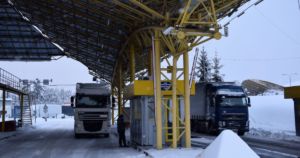
Polish carriers have ended the blockade of the Dorohusk-Yahodyn checkpoint, and truck traffic is moving as usual, the State Border Guard Service reports.
“Today at 2 p.m., the protest action of Polish carriers in front of the Dorohusk-Yagodyn checkpoint ended. Registration and passage of trucks across the border in both directions is carried out as usual,” the State Border Guard Service said in a statement posted on its telegram channel on Monday.
Drivers are asked to take this information into account when planning international transportation.
According to the State Customs Service, as of now, there are 1,000 trucks in line to enter Ukraine, 0 buses, 100 trucks to leave Ukraine, 473 trucks in the electronic queue, and 0 buses.



