

According to the Interfax-Ukraine Culture project, at least six bookstores closed in Ukraine in March alone, including in Vinnytsia, Kropyvnytskyi, and Kyiv, as reported by Viktor Kruglov, publisher and CEO of the “Ranok” publishing house, on his Facebook page.
After analyzing the published information and the situation in the book market, journalists from the “Culture” department of the Interfax-Ukraine agency sought comment from Artem Bidenko, chairman of the board of the Ukrainian Publishers Association.
“The market situation is difficult: people are buying less and less, while book production is becoming more expensive. Bookstores, both small and large, have already begun to close. Books are becoming unprofitable for retailers because they take up space and don’t sell well,” said Artem Bidenko, chairman of the board of the Ukrainian Publishers Association, in a comment to Interfax-Ukraine.
According to Viktor Kruglov, bookstores in Vinnytsia and Kropyvnytskyi—which opened in 2023–2024 amid a wave of enthusiasm and expectations of state support—have closed permanently.
In addition, next week “Yakaboo” is closing its only brick-and-mortar location at the Main Post Office on Khreshchatyk, and the publishing house “ArtBooks” is liquidating its flagship bookstore on Velyka Vasylkivska Street due to unprofitability.
Earlier, “Knyholand” closed its bookstore in the underground shopping center on Maidan Nezalezhnosti, and the future of the bookstore in Rusanivka, Kyiv, remains uncertain.
Additionally, according to Kruglov, the owner of the bookstore “My Bookshelf” announced the closure of the business, while the “Ridit” and “Sens” chains reported losses in the millions for the year.
According to Bidenko, in January–March, the average receipt at bookstores fell by nearly half: whereas shoppers previously chose 3–5 books, they now select 1–2.
Against the backdrop of falling demand, publishers are forced to offer significant discounts in an attempt to recoup at least part of their investment, but this does not solve the systemic problem.
“For retailers, books are becoming economically unprofitable: they take up space, require specific storage conditions, yet sell significantly worse,” he explained.
According to the expert, the next stage could be a payment crisis in the industry, which will first affect publishers and later printing houses.
“These are signs of a systemic crisis in the market that cannot be overcome without government intervention,” Bidenko emphasized.
He also noted that one of the key reasons for the rising cost of books is the increase in production costs.
“Raw materials are imported, logistics are complicated, and there is a shortage of personnel in both transportation and printing houses. All of this increases costs and, consequently, the final price of books,” he said.
Piracy in the e-book and audiobook sector remains a separate factor putting pressure on the market.
“About 80% of digitized content is illegal. Because of this, it is impossible to objectively assess real demand: we don’t know whether people are reading more in digital format or simply buying fewer books and reading less in general,” noted Bidenko.
He added that certain segments, particularly children’s literature, have been in crisis since the start of the full-scale war.
Assessing government policy, Bidenko stated that the market currently sees no practical implementation of the declared support.
“So far, these are just statements. There are no real actions, although we expect the situation to change. If these tools start working, the market will be able to return to pre-war levels and resume development. Without state participation, the publishing industry, which is subsidized in most countries, will not be able to function stably,” he concluded.
Text: Olga Levkun
https://interfax.com.ua/news/culture/1154870.html

The books were handed over to the warehouses of corporate enterprises JSC “Ukrvydavpoligrafia” JSC. From there, publications are sent to cities in Ukraine and Europe.
During this hour, almost 320,000 books were already handed over to volunteer centers in Ukrainian cities and European countries where refugees currently live. Delivery of literature is carried out by trucks of volunteers and volunteer organizations.
The largest number of books was transferred to the Lviv region — more than 25,000. Also, over 125,000 books were sent to Kropyvnytskyi, Ternopil, Drohobych, Chernivtsi, Kamianets-Podilskyi, Ivano-Frankivsk, Uzhgorod, Khmelnytskyi.
In addition, more than 190,000 copies of literature were sent abroad, namely: 45,000 books to Poland, almost 28,000 to Austria, more than 1,000 to Romania, 76,000 to Slovakia, 4,000 to the Czech Republic, more than 1,000 – to Hungary, 2 thousand – to Albania, about 2 thousand – to Croatia, more than 2 thousand – to Switzerland, 2 thousand – to the Netherlands, almost 5 thousand – to Germany, almost 8 thousand – to Great Britain.
Another 18,000 copies of the books are now on their way to Slovakia and Austria.
The campaign was launched on March 15 by the State Committee for Television and Radio Broadcasting of Ukraine together with the Office of the President of Ukraine and the Ministry of Culture and Information Policy.
The purpose of the campaign is to provide children who were forced to relocate to escape Russian armed aggression with textbooks, study aids, and fiction free of charge.
We will remind you that 100,000 copies of literature were sent to different European countries during this campaign.
As you know, the books were delivered to Poland, Lithuania, Great Britain and other countries as part of the “Books without Borders” project for children from Ukraine who were forced to leave for other countries.
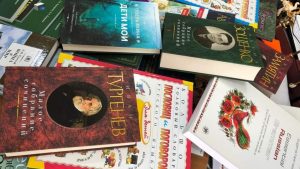
The State Committee for Television and Radio Broadcasting of Ukraine will allow the import of books from the Russian Federation to Ukrainian territory, referring to the law adopted by the Verkhovna Rada in 2016, the press service of the State Committee for Television and Radio Broadcasting reported.
“The issuance of permits for the import of books from the Russian Federation into the territory of Ukraine is carried out in accordance with the law that was adopted by the Verkhovna Rada at the end of 2016. This law provides that import permits are not granted exclusively to books of anti-Ukrainian content, as well as those containing propaganda in favor of the aggressor state,” the message said.
The department said that over the entire period of the law and, accordingly, the functioning of the licensing system, not a single book of anti-Ukrainian content has entered Ukraine legally, and the volume of books brought from the Russian Federation has decreased 12 times compared to 2011. It is reported that during 2017-2020 the law of the State Committee for Television and Radio Broadcasting made it possible to import into Ukraine 31,000 titles of books from Russia. Most of the books allowed for import are works of world classics, children’s and popular science literature. Part of the permits were issued for the import into Ukraine of Ukrainian-language books by Ukrainian publishing houses, printed in the Russian Federation.
In addition, during 2017-2020, the State Committee for Television and Radio Broadcasting provided 4,274 refusals to importers to import book products from the Russian Federation. Most of the refusals related to the submission of an incomplete package of documents by the applicants, and in 274 cases – anti-Ukrainian content found in publications.
Almost 1.5 million copies of anti-Ukrainian publications were not allowed to be imported into Ukraine. At the same time, the department reported that a complete cessation or restriction of the import of Russian books into the territory of Ukraine is possible only through the adoption of an appropriate law, which would provide for an embargo on their import.
BOOKS, IMPORT, RUSSIAN, UKRAINIAN STATE COMMITTEE ON TELEVISION



