
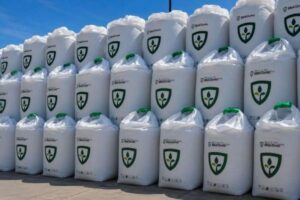
According to Serbian Economist, the Ukrainian company “Kaspit Trade” has tripled its shipments of mineral fertilizers from the Serbian chemical holding company Elixir Group to the Ukrainian market over the course of two years of cooperation. In 2026, the importer plans to ship approximately 90,000 metric tons of products to Ukrainian farmers, the company reported.
The information was released following the fourth partnership visit by Ukrainian agricultural producers to Elixir Group’s facilities in Serbia. Representatives of agricultural companies visited the Elixir Zorka plant in Šabac and the Elixir Prahovo production complex, where they familiarized themselves with fertilizer production, quality control, and logistics infrastructure.
According to the importer, compound NPK and NP fertilizers with added sulfur and micronutrients are in the highest demand in Ukraine. They are used for primary and starter fertilization of grain, oilseed, and industrial crops.
The Elixir Zorka product line includes over 30 compound fertilizer formulations.
The importer cites river logistics as one of the advantages of Serbian products. Fertilizers are loaded onto barges in Serbia and transported down the Danube to the port of Izmail. According to the company’s estimates, the shipment takes about six days. Elixir Group’s production sites have access to port, rail, and road infrastructure.
The growth in shipments of Serbian fertilizers is occurring against the backdrop of the Ukrainian market’s overall increasing dependence on imports. In the first half of 2025, Ukraine imported 1.563 million metric tons of mineral fertilizers, which was 25% higher than the figure for the same period in 2024. Imports of compound NPK fertilizers totaled approximately 379 thousand metric tons.
Elixir Group describes itself as the largest producer of compound mineral fertilizers in Southeast Europe. The company’s production facilities are located in Šabac and Prahovo. The total production capacity for mineral fertilizers is approximately 1 million metric tons per year, with over 70% of the output exported to more than 85 countries.
https://t.me/relocationrs/3238
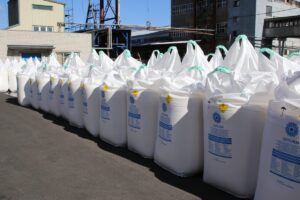
The plants of the Ostchem nitrogen holding, which unites the nitrogen businesses of Group DF, produced 849,900 tons of mineral fertilizers in January-June 2025, down 7.47% from the same period in 2024, when 918,500 tons of fertilizers were produced, according to a press release issued by the holding on Monday.
According to the report, Cherkasy Azot produced 567,100 tons of products in the first half of the year, which is 21% less than last year. Rivneazot increased production by 40.9% to 282,700 tons from 200,700 tons last year.
The overall decline in production at the holding company was explained by forced equipment shutdowns at Azot in Cherkasy in the first quarter of 2025, as well as unstable energy supplies. During this period, the holding company redistributed production loads between plants and increased fertilizer production at Rivneazot.
“Our priority remains the stable supply of fertilizers to Ukrainian farmers, even in the most difficult times. The success of spring and autumn field work depends on this. In wartime, technological flexibility, adaptability, and non-standard management decisions are paramount for us as a manufacturer. In addition, we continue to invest in production stability and energy efficiency,” said Ostchem Production Director Serhiy Pavliuchuk.
The holding company specified that the production structure has changed slightly compared to last year. In the first half of the year, ammonium nitrate was the most produced product, with 355,700 tons. Last year, this figure was 362,900 tons. UAN came in second place with a production volume of 308,900 tons. In this segment, the share of Ukrainian production remains high due to the logistical advantages of Ukrainian manufacturers. Urea came in third with 138,300 tons (183,600 tons last year). A small share of production falls on VAS – 16,200 tons and ammonia – 22,600 tons.
The release notes that against the backdrop of declining domestic production, the flow of uncontrolled cheap imports into Ukraine continues to grow: in the first half of the year, 1.5 million tons of traditional fertilizers (nitrogen and complex) were imported into Ukraine, including 828,000 tons of nitrogen fertilizers. At the same time, imports of ammonium nitrate amounted to 190,000 tons (176,600 tons last year), urea – 379,600 tons (311,300 tons), and UAN – 61,490 tons (50,800 tons).
“For the first time, the volume of urea imports has more than doubled the volume of Ukrainian production, which is an alarming signal for the entire industry and requires systemic solutions,” Ostchem concluded.
Ostchem is a nitrogen holding company owned by Dmitry Firtash’s Group DF, which brings together the largest mineral fertilizer producers in Ukraine.
Since 2011, it has included Rivneazot and Cherkasy Azot, as well as Severodonetsk Azot and Stirol, which are not operating and are located in the occupied territories.
Cherkasy Azot (Cherkasy, Ukraine) is one of Ukraine’s largest chemical companies. Its design production capacity is 962,700 tons of ammonia per year, 970,000 tons of ammonium nitrate per year, 891,600 tons of urea per year, and 1 million tons of UAN per year.
PJSC Rivneazot is one of the largest chemical companies in Western Ukraine. On April 12, 2024, Group DF and South Korea’s Hyundai Engineering signed an agreement to build a chemical hub in Rivne. The project involves the construction of plants for the production of green ammonia and hydrogen based on renewable energy sources, as well as new enterprises and production sites for the production of nitrogen fertilizers and chemical derivatives.
Agrochemical company Grossdorf LLC, specializing in the production of granular and liquid mineral fertilizers, has decided to expand its product range by developing a line of products for retail sales, industry analyst publication Infoindustria reported.
“Entering the retail market opens up new opportunities for growth and expansion of the consumer audience. The company believes in the quality of its products and is ready to meet the needs of retail customers with the same dedication it shows in the agrochemical sector market,” said Andrei Khalyavka, director of the agrochemical company.
According to him, Grossdorf produced about 20,000 tons of various NPK fertilizer formulas in 2023. In addition, the company became Ukraine’s second supplier of UAN in 2023 and produced more than 106 thousand tons of this fertilizer. In addition, Grossdorf produces granulated potassium chloride, NPK fertilizers and granulated (compacted) ammonium sulfate.
“In just one year, the manufacturer supplied more than 150 thousand tons of fertilizers to the market, becoming the second fertilizer producer in Ukraine,” Infoindustria summarized.
Grossdorf LLC was established in 2001. The company is a producer of mineral fertilizers, one of the leaders in UAN production in Ukraine, importer, supplier and end user of mineral fertilizers. It has its own plant in Odessa region for production of liquid fertilizers (RKD, UAN, UAN), storage for liquid fertilizers with the volume of more than 10 thousand tons, capacities for production of loose granular fertilizers, extensive network of agrochemical warehouses practically in all regions of Ukraine.
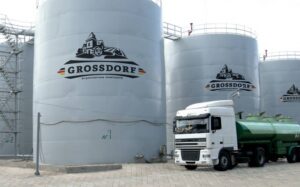
Grossdorf, an agrochemical company specializing in the production of granular and liquid mineral fertilizers, has decided to expand its product range by developing a line of products for retail, according to the industry analytical publication Infoindustriya.
“Entering the retail market opens up new opportunities for growth and expansion of the consumer audience. The company believes in the quality of its products and is ready to meet the needs of retail customers with the same dedication it shows in the agrochemical sector,” said Andriy Khalyavka, CEO of the agrochemical company.
According to him, in 2023, Grossdorf produced about 20 thousand tons of different formulas of NPK fertilizers. In addition, the company became the second largest supplier of UAN in Ukraine in 2023 and produced more than 106 thsd tonnes of this fertilizer. In addition, Grossdorf produces granular potassium chloride, NPK fertilizers and granular (compacted) ammonium sulfate.
“In total, the manufacturer supplied more than 150 thousand tons of fertilizers to the market last year, becoming the second largest fertilizer producer in Ukraine,” InfoIndustry summarized.
Grossdorf LLC was established in 2001. The company is a mineral fertilizer producer, one of the leaders in the production of UAN in Ukraine, an importer, supplier and end consumer of mineral fertilizers. The company has its own plant in Odesa region for the production of liquid fertilizers (UAN, UAN, UAN), a storage facility for liquid fertilizers with a capacity of over 10 thousand tons, facilities for the production of bulk granular fertilizers, and an extensive network of agrochemical warehouses in almost all regions of Ukraine.
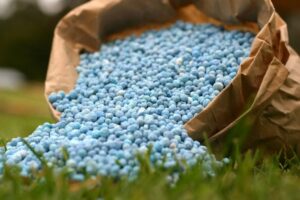
In 2023, the plants of Ostchem, a nitrogen holding company that unites Group DF’s nitrogen business, produced 2.1 million tons of mineral fertilizers, up 19.51% year-on-year.
According to a Group DF press release, Azot, the group’s Cherkasy-based plant, produced 1.56 million tons of mineral fertilizers in 2023, up 39.63% year-on-year, while Rivne Azot produced 528 thousand tons (-10.81%).
Urea, UAN and ammonium nitrate were the key fertilizers produced by Ostchem’s businesses, Group DF said.
According to the group, in 2023, it produced 835.9 thousand tons of ammonium nitrate, up 60.47% year-on-year, UAN – 572.7 thousand tons (+130%), and urea – 447.1 thousand tons (+145%). Production of UAN, a traditionally exported fertilizer produced by Rivne Azot, halved to 102 thousand tons.
“The fertilizer market is recovering, but imports of nitrogen fertilizers, which have increased significantly, do not allow us to fully utilize our plants. Despite the difficult situation in the agricultural sector, forced shutdowns of plants due to the hostilities, still high gas prices and abnormally high volumes of imports to Ukraine at dumping prices, Ostchem started to restore production in 2023. We fully met the demand from farmers even during peak periods,” said Sergiy Pavliuchuk, Production Director of Ostchem’s nitrogen business.
In 2023, Ostchem Holding doubled its production of UAN, the most promising fertilizer in Ukraine, to meet the demand. UAN was ranked second in terms of production, and its share in Ostchem’s product portfolio amounted to 27.3%, according to Group DF.
“It is no secret that we are negotiating with global players to develop several industrial sites. Our strategic plans include the construction of new workshops and enterprises. We are talking about investing in new, energy-efficient fertilizer production facilities and launching new products such as AdBlue, industrial gases, and petrochemicals,” added Pavliuchuk.
Commenting on the state of the domestic fertilizer market in Ukraine, Group DF said that the main feature of 2023 was the critical growth in imports imported at dumping prices. Compared to 2022, imports of mineral fertilizers to Ukraine increased 1.9 times, reaching 1.99 million tons. For example, urea imports increased 3.7 times over the year, reaching 501 thousand tons.
“A huge flow of cheap Belarusian and Russian fertilizers enters Ukraine through two channels: the first is from the former Soviet Union countries friendly to the aggressor. The second new channel is the re-export of Belarusian and Russian fertilizers from the EU. According to Eurostat, the total volume of nitrogen fertilizer imports to the EU increased by 34% in 2022-2023, while Russia accounted for about a third of these imports. Despite the sanctions and the existing embargo, a significant portion of these fertilizers is also entering Ukraine, slowly “killing” the Ukrainian producer and Ukrainian jobs,” emphasized Oleg Arestarkhov, Group DF’s Head of Corporate Communications.
In his opinion, the new trend is driven not only by Russia’s desire to expand its sales markets, but also by its strategic plan to make the EU and Ukraine dependent on its fertilizers.
Unable to compete with cheap imports, many EU companies are shutting down, and Ukrainian chemical companies such as Odesa Port and Sumykhimprom are also idle.
“The US and EU countries have already developed measures to ‘reduce dependence’ on fertilizers, grain and other food products from Russia. Formally, Ukraine has an embargo on imports of Russian and Belarusian fertilizers. However, fertilizers from these countries, as well as countries that buy cheap gas from Russia, continue to be supplied. As a result, our market is flooded with cheap imports, and Ukraine is facing critical dumping. Unfortunately, in 2023, we did not see any clear, tough economic actions by the authorities to protect the Ukrainian market and national producers. Fertilizer imports to the country are growing much faster than domestic production. Domestic production grew by about 20%, while imports grew by almost 100%,” stated Arestarkhov, adding that Ukraine needs to learn to better protect its interests.
Group DF consolidates Dmitry Firtash’s assets in the gas distribution, chemical, titanium and port industries, as well as in agriculture and media.
Ostchem is Group DF’s nitrogen holding company that unites the largest mineral fertilizer producers in Ukraine. It includes Rivne Azot, Cherkasy Azot, as well as Sievierodonetsk Azot and Stirol, which are not operating and are located in the occupied territories.
Cherkasy Azot PrJSC (Cherkasy, Ukraine) is one of the largest Ukrainian chemical companies and has been part of Group DF’s nitrogen business since 2011. The design production capacity of Cherkassy Azot is 962.7 thousand tons of ammonia, 970 thousand tons of ammonium nitrate, 891.6 thousand tons of urea, and 1 million tons of UAN per year.
Rivne Azot is one of the largest Ukrainian chemical companies in Western Ukraine and has been a part of Group DF’s Ostchem nitrogen holding since 2011. Since its acquisition, Firtash has invested over UAH 1.3 billion in Rivne Azot.
The Kernel agro-industrial group plans to supply Ukraine with oil products, fertilizers and other inventory items in order to overcome the shortage of resources for agricultural production in Ukraine, Ihor Stelmaschuk, head of the Kernel commercial department, said at the Fuel for Ukraine international conference.
“Together with partners, we will be able to establish long-term systematic work in the processes of production and supply of fertilizers. And in the future we will build a powerful diversified mechanism for providing Ukraine with oil products, we will meet the fuel needs of agricultural enterprises in a planned and cyclical way,” Stelmaschuk said on the Facebook page of the agrarian group.
According to him, now Kernel is exchanging experience and ideas with key players in the global oil products market.
“We decided on the urgent problems of a resource, logistics and infrastructure nature. We assessed the risks and trends in the fuel market. The country’s future annual demand for diesel fuel is estimated at 4 million tonnes, so Ukrainian consumers need to establish cooperation with Europe right now,” Stelmaschuk stressed.
According to him, due to the full-scale Russian invasion, Ukraine is forced to replace 100% of the pre-war sources of supplies of oil products, which is what Kernel plans to do.
In addition, the agricultural holding is working on projects to provide the agricultural sector with mineral fertilizers, their logistics and transshipment in ports. Kernel stated that it has already signed the first contracts for the supply of fertilizers for the sowing of winter wheat and rapeseed in the autumn, which is especially important given the likely global shortage of fertilizers in autumn 2022 and spring 2023.
Before the war, Kernel ranked first in the world in production of sunflower oil (about 7% of world production) and its export (about 12%), and was also the largest producer and seller of bottled sunflower oil in Ukraine. In addition, the holding was engaged in the cultivation and trade of other agricultural products.



