
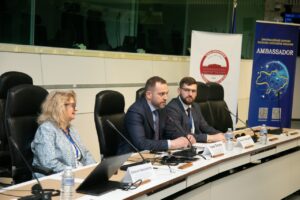
In the temporarily occupied territories of Ukraine, perceptions of the EU and the US are formed not through their own experience, but through the prism of Russian propaganda and information isolation. This was stated by sociologist, director of the Active Group research company Oleksandr Poznyi during his speech at the Forum on Countering Russian Propaganda and Disinformation, held on December 17-18, 2025 in Brussels.
In his speech, the expert relied on the results of sociological studies conducted in 2023-2025 and emphasized that residents of the temporarily occupied territories are virtually deprived of direct communication with Europe and the United States. In such circumstances, the perception of the West is formed mainly through narratives imposed by the occupation authorities. “For many people in the TOT, Europe and the United States are not partners or allies of Ukraine, but abstract, distant actors whose image is almost entirely shaped by the Russian media,” said Poznyi.
According to the sociologist, Russian propaganda systematically forms two dominant images of the West. The first one is aggressive and hostile, which allegedly “controls Ukraine”, “provokes war” and “uses Ukrainians in its own interests”. The second is cynical and indifferent, “tired of Ukraine” and ready to sacrifice its territories for the sake of stability. “These narratives contradict each other but coexist perfectly. They are not about logic, they are about emotion and fear,” explained Poznyi.
As a result, a part of the population has a distorted view of the role of the EU and the US, which has nothing to do with the real policy of supporting Ukraine, but directly affects public sentiment and expectations for the future. One of the key reasons for this perception is complete information isolation. Ukrainian and Western sources of information are blocked or criminalized, and any alternative viewpoints are viewed as “extremism” or “espionage.”
“People cannot verify information. They are forced to live inside an information bubble where the West is an image, not a reality,” the sociologist emphasized. According to him, even those TOT residents who support Ukraine internally often avoid talking about Europe or the United States, as these topics are considered “dangerous” and may arouse suspicion on the part of the occupation structures.
During the forum in Brussels, these observations were presented as a serious challenge for European policy. According to Poznyi, the perception of the EU and the US in the occupied territories will directly affect the processes of de-occupation and reintegration in the future. “If people have been hearing for years that Europe is an enemy or a traitor, these perceptions do not automatically disappear after de-occupation,” he emphasized.
The Forum on Countering Russian Propaganda and Disinformation, held on December 17-18, 2025 in Brussels at the European Parliament and the European Economic and Social Committee, was dedicated to strengthening Europe’s cognitive and information resilience in the face of hybrid threats.
The event brought together representatives of European institutions, think tanks, media and civil society from Ukraine and the EU. The event was aimed at outlining the scope and mechanisms of Russian propaganda, showing its destructive impact on public consciousness, and discussing ways to counter it.



