
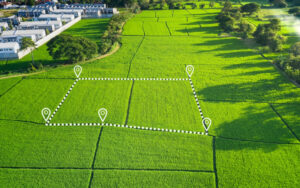
The Deposit Guarantee Fund (DGF, the Fund) has listed the first three land plots belonging to the bankrupt RVS Bank in the village of Pohreby (Brovary District, Kyiv Region)—with a total area of 2.23 hectares—for sale on the “Prozorro. Sales” system the first three land plots belonging to the bankrupt RVS Bank in the village of
Pohreby (Brovary District, Kyiv Region), with a total area of 2.23 hectares, at a combined starting price of 11.3 million UAH.
According to the announcement, the land plots are intended for the construction of a residential building and outbuildings.
The starting price for the 0.93-hectare plot is 4.7 million UAH, for the 0.55-hectare plot—2.8 million UAH, and for the 0.75-hectare plot—3.8 million UAH.
The auction for the first plot is scheduled for October 2, and the auctions for the other two are set for October 5, 2026. Bidding will follow the English auction model, consisting of three rounds of price increases.
The minimum bid increment for all three lots is 1% of the starting price, and the deposit is 10%.
In total, this fall, the Deposit Guarantee Fund plans to put up for sale 35 land lots belonging to RVS Bank in the Kyiv region, with a total area of 34 hectares.
All interested parties are eligible to participate in the auction, except for individuals associated with the aggressor state. Proceeds from the sale of the assets will be used to satisfy the claims of RVS Bank’s creditors.
As previously reported, the first property from RVS Bank’s assets put up for sale by the Deposit Guarantee Fund was an oil depot in the Poltava region with a starting price of 16.3 million UAH; however, the auction on June 1 did not take place due to a lack of participants.
AUCTION, Deposit Guarantee Fund, KYIV REGION, LAND, РВС Банк

Local budgets received 28.8 billion UAH in land tax revenues for January–July 2026, which is 13% higher than the figure for the same period in 2025 (25.5 billion UAH).
According to a report published by the State Tax Service (STS) on its website on Thursday, Dnipropetrovsk Oblast led in the volume of revenues to local budgets, with taxpayers contributing 5.3 billion UAH. Significant revenues were also received by the budgets of Kyiv (4 billion UAH), Odesa Oblast (2.5 billion UAH), and Lviv Oblast (2.1 billion UAH).
Land tax is a mandatory local tax paid by owners of land plots, land shares, and permanent land users. For individuals, tax assessments are issued by tax authorities, and payment must be made within 60 days of receiving the tax assessment notice. Legal entities calculate the tax themselves and file returns annually by February 20.
Land tax exemptions are available to retirees, individuals with Group I and II disabilities, war veterans, large families, and individuals affected by the Chernobyl disaster. The exemption applies within the established limits on land plot area. The State Tax Service emphasizes that the obligation to pay the tax remains with the owner even if no notice is received, and the status of payments can be checked through the taxpayer’s online account.
According to The Serbian Economist, based on the latest available official data, the ranking of the average cost of arable land is as follows:
1. Slovenia — 28,348 thousand euros per hectare, data for 2024.
2. Greece — approximately 14,312 thousand euros, 2024.
3. Serbia — 9,583 thousand euros, 2025.
4. Romania — 8.7 thousand euros, 2024.
5. Bulgaria — 8,679 thousand euros, 2024.
6. Croatia — 6,723 thousand euros, 2025.
The data reflects the cost of vacant arable land without buildings or perennial plantings. The periods of statistical observation vary, so the ranking shows the general price level rather than a fully synchronized comparison.
The most expensive land in the region is in Slovenia, where supply is limited and plots are often small and fragmented. In Greece, prices depend heavily on access to water, proximity to the coast, and the possibility of construction. Serbia has already surpassed Romania, Bulgaria, and Croatia in terms of average price, although its figures remain approximately 37% below the EU average.
For foreigners, price is not the only criterion. In Serbia, the direct purchase of agricultural land is almost entirely prohibited. In EU countries, citizens of other EU member states typically have more opportunities, while buyers from third countries may face restrictions, reciprocity rules, or the requirement to purchase through a local company.
Albania, Montenegro, North Macedonia, and Bosnia and Herzegovina are not included in the ranking due to the lack of recent comparable national statistics. Listing prices there may differ significantly from the actual transaction values.
https://t.me/relocationrs/3397

Thailand is tightening controls on foreigners who attempt to circumvent the ban on direct land ownership by using Thai nominee owners or specially created companies. Authorities are moving toward systematic inspections of land transactions, corporate structures, sources of financing, and actual control over real estate.
According to market operators, special inspection committees are being established in every province of the country, comprising representatives from land authorities, the police, the tax service, and other agencies. Their task is to identify schemes in which a foreign buyer effectively controls a land plot but formally registers it in the name of a Thai individual or a company with Thai shareholders.
Legal consultants in Thailand also note that starting in 2026, controls will be tightened regarding company registration and land transactions. The Department of Business Development requires confirmation of the actual source of funds and investment declarations when establishing or amending companies, while the Department of Land Resources cross-checks corporate data against land titles.
The focus is on so-called nominee structures, where Thai citizens or companies act as nominal owners of land on behalf of a foreigner. Thai law generally prohibits foreigners from directly owning land, although foreigners may own condominium units within established quotas, enter into long-term land leases, or own a building separately from the land.
The new checks will apply not only to future transactions but also to existing arrangements. Authorities intend to analyze the source of funds, the composition of shareholders, the family and business ties of the parties, the actual use of the land, as well as signs that the Thai nominee owner has no independent economic interest in the property.
For foreign buyers, this means a sharp increase in legal risks. The use of Thai nominee shareholders or fictitious structures may lead to criminal prosecution, liquidation of the company, forced sale of the land, and loss of control over the asset. Lawyers advise investors to review old ownership structures and bring them into compliance with the law in advance.
This is particularly important for Thailand’s real estate market amid growing foreign demand. In recent years, foreign buyers—including investors from Russia, China, Europe, and the Middle East—have shown strong interest in properties in Phuket, Bangkok, Pattaya, Samui, and other tourist destinations. Part of the demand has been for villas and land plots, where legal restrictions are significantly stricter than in the apartment segment.
Tighter controls could cool some villa and land transactions, especially if they were based on informal agreements with nominal owners. At the same time, this could increase demand for more transparent formats—such as purchasing condominium units within the foreign quota, long-term land leases, officially structured investments, and projects with legally verified ownership models.

Ukraine’s local budgets received 4.9 billion UAH in taxes on real estate other than land plots from January through April 2026, a 14.5% increase compared to the same period last year, according to the State Tax Service (STS).
The largest amounts of revenue were recorded in Kyiv (UAH 1.05 billion), Kyiv (UAH 547.3 million), Dnipropetrovsk (UAH 490 million), and Lviv regions (UAH 487 million). The agency noted that this tax is levied only on the area exceeding the tax-exempt thresholds: over 60 square meters for apartments, over 120 square meters for houses, and over 180 square meters for various types of housing. The tax rate is set by local authorities but cannot exceed 1.5% of the minimum wage per square meter above the threshold.
At the same time, land tax revenues for the first four months of this year increased by 14.3% compared to the same period in 2025—reaching 15.8 billion UAH. The additional revenue for local communities from this payment amounted to nearly UAH 2 billion. The leaders in land tax payments were Dnipropetrovsk Oblast (UAH 3 billion), Kyiv (UAH 2.3 billion), Odesa (UAH 1.4 billion), and Lviv (UAH 1.2 billion) Oblasts.
Land tax is a mandatory local payment made by owners of land plots, land shares, and permanent land users. For individuals, assessments are made by tax authorities, and payment must be made within 60 days of receiving the tax notice-decision. Legal entities calculate the tax themselves and file returns annually by February 20.
Land tax exemptions are available for senior citizens, individuals with disabilities of Groups I and II, war veterans, large families, and individuals affected by the Chernobyl disaster. The exemption applies within the established limits on plot size. The State Tax Service notes that the obligation to pay the tax remains with the owner even if no notice is received, and the status of payments can be checked through the taxpayer’s electronic account.

Land tax revenues to local budgets in January-November 2025 amounted to UAH 41.4 billion, which is 15% more than in the same period last year, according to the State Tax Service (STS).
According to the report, the leaders in land payments in regional terms were Dnipropetrovsk region (UAH 7.3 billion in taxes paid), Kyiv (UAH 5.9 billion), Odesa region (UAH 3.7 billion), and Lviv region (UAH 2.9 billion).
The STS reminded that every taxpayer has the right to check the correctness of land tax calculations and, if necessary, clarify their data. To do this, they must apply to the tax authority in writing or electronically, in particular to clarify the size of the area and the number of land plots or shares owned or used, as well as the availability of land tax exemptions.
The relevant application can be submitted either at the place of registration of the taxpayer or at the location of one of the land plots.
If, during the verification, there are discrepancies between the tax authority’s data and the taxpayer’s documents (ownership, use, exemptions, etc.) or if the land tax rate has changed, the State Tax Service will recalculate the tax within 10 working days, generate a new tax notice-decision with a detailed calculation, and send it to the taxpayer. In this case, the previous notice-decision is considered canceled (revoked).
The State Tax Service suggests checking the information about the accrued land tax in the electronic office.



