

Politechnoservice LLC (Brovary, Kyiv region) will supply 16 new low-floor 12-meter PTS trolleybuses to Kyivpastrans Municipal Enterprise by December 1, 2026, for a total amount of UAH 306.24 million.
According to information in the Prozorro system, the parties signed the relevant agreement on January 26 after Politechnoservice won the tender with an expected purchase amount of UAH 306.344 million.
The tender was announced by Kyiv on January 7, 2026. In addition to Politechnoservice, a tender offer was submitted by BAS Motor, the manufacturer of Bogdan trolleybuses. It offered trolleybuses for UAH 306.336 million.
PTS trolleybuses manufactured no earlier than 2025 have a passenger capacity of more than 100 people, including 34 seats (four of which are for priority passengers) and space for a passenger in a wheelchair.
The PTS T12309 trolleybus (with a body manufactured by the Turkish company IF-U) only has emergency autonomous drive.
As reported, similar trolleybuses are being purchased, in particular, by Chernivtsi.
According to openddatabot, in 2024, Politechnoservice LLC increased its net profit tenfold compared to 2023, to UAH 75 million, with a 2.2-fold increase in revenue, to UAH 377.2 million.
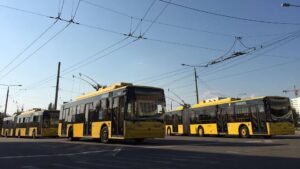
The municipal enterprise (ME) Kyivpastrans plans to purchase 16 new low-floor city trolleybuses with a length of over 11.9 m by December 1, 2026, for an estimated amount of UAH 306.344 million, according to the website of the Kyiv City State Administration.
“The renewal of the rolling stock is necessary to improve transport safety, ensure the stable operation of public transport, and reduce travel intervals on routes,” the statement said.
The required total passenger capacity is about 100 people, including 34 seats. The interior must provide space for passengers with reduced mobility, wheelchairs, strollers, and ramps.
Trolleybuses must be equipped with heating and air conditioning systems, tinted windows, LED lighting, external and internal information displays, and a system that blocks movement when the doors are open.
In addition, the vehicles must be equipped with a loudspeaker system for announcing the route and stops, as well as space for installing GPS trackers for traffic control and equipment for automated fare payment.
As reported, in October 2025, Kyivpastrans canceled the purchase of 40 low-floor trolleybuses for an expected amount of more than UAH 1.008 billion due to the inability to make changes to the technical requirements of the tender documentation, which would lead to a change in the estimated purchase price.
Earlier, Kyiv canceled the purchase of 20 buses for almost UAH 83 million by the end of 2025, announced at the end of August 2025, for the same reason.
In addition, as part of a EUR 50 million loan agreement with the European Investment Bank, Kyiv announced in the summer of 2024 the purchase of 12-meter and 18-meter trolleybuses without specifying the number of each length, but the final outcome of this tender is still unknown.
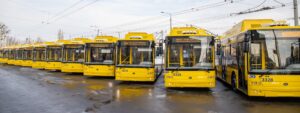
Ukrainian cities received 107 trolleybuses in 2025, 75 of which were new, compared to 34 trolleybuses (28 new) in 2024, according to AllTransUA.
“2025 was the year of recovery for the trolleybus market in Ukraine, and although the figures are still lower than deliveries from 2014 to 2021, Ukrainian cities received 107 trolleybuses, which is a record during the full-scale war with Russia. The lion’s share is made up of new trolleybuses (75 units), most of which (66 units) were purchased in cooperation with international financial organizations (IFOs). In 2024, many agreements were signed, which began to be implemented in 2025,” the website said.
In general, according to AllTransUA’s data, last year, Khmelnytskyi (30 units) and Mykolaiv (24 units) received the most new trolleybuses funded by IFOs. Eight trolleybuses were also delivered to Kremenchuk and four to Ivano-Frankivsk.
According to experts, in 2025, the market for new trolleybuses was dominated almost equally by Etalon (manufacturer – Chernihiv Automobile Plant) and PTS (Politechnoservice), covering 91% of the market, while the rest of the supply was covered by Lviv-based Electron (5%) and the Litan trading house (Dnipro brand, 4%), which manufactured trolleybuses for the first time in several years.
In particular, Electron began deliveries to Ivano-Frankivsk, and Litan manufactured trolleybuses for Mykolaiv in Belarusian MAZ bodies, completing the delivery of a batch that was interrupted by the start of a full-scale invasion.
“The question of the origin of the bodies remains open: it is unknown whether they arrived in Ukraine before 2022 or were obtained later through indirect channels,” the report states.
Only Chernihiv (three Etalon T121 Barvinok trolleybuses) and Chernivtsi (six PTS T123 trolleybuses) received new trolleybuses at public expense.
The main recipient of used trolleybuses was Kharkiv, which received 26 Škoda trolleybuses of various models. Rivne purchased four Solaris Trollio trolleybuses from Lublin, and Ivano-Frankivsk received the last Gräf & Stift from Austria.
The city of Dnipro also replaced one YMZ T1 trolleybus body with an unused body from the 1990s (there are three such vehicles in the city in total).
“In 2026, we expect continued revenue under existing agreements within the framework of cooperation with IFIs, both as the completion of deliveries already underway (in particular, Ivano-Frankivsk, Kremenchuk) and deliveries to other cities, in particular Lutsk, Ternopil, and Chernivtsi,” the report says.
According to AllTransUA, in 2024, the market received the smallest number of trolleybuses since 2009, and compared to 2023, deliveries fell by a third.
In pre-war 2021, Ukrainian cities purchased 170 trolleybuses, and in 2020, 337.
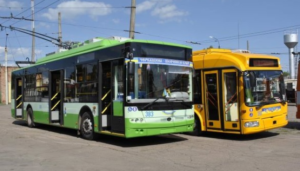
The European Bank for Reconstruction and Development (EBRD) is providing a €16 million loan to Cherkasy to finance the purchase of modern trolleybuses and the modernization of the relevant infrastructure, according to a statement on the EBRD website.
The loan, fully guaranteed by the city, will be co-financed by an investment grant of up to EUR4 million from the EBRD’s Shareholders’ Special Fund and will have partial first-loss risk coverage under the EU Investment Program for Municipal Infrastructure and Industrial Resilience (UIF MIIR).
The EBRD notes that the financing will enable Cherkasyelektrotrans to expand its fleet with new low-floor trolleybuses, modernize its depot and other infrastructure, and expand and redistribute three trolleybus routes.
According to information on the Cherkasy City Council website, the project involves attracting EBRD loan funds for the purchase of trolleybuses with a range of up to 20 km.
“Cherkasy has been preparing to implement this project for almost 10 years. Due to previous debt obligations, the city was unable to obtain a loan for a long time, but after a positive conclusion from the Ministry of Finance, active work on the final decisions was carried out over two years. Currently, all key approvals have been obtained,” said Cherkasy Mayor Anatoliy Bondarenko.
Thanks to the project, Cherkasy will be able to renew up to 90% of the rolling stock of the Cherkasyelektrotrans municipal enterprise.
As reported, the rolling stock of Cherkasyelektrotrans currently includes 12-meter Bogdan trolleybuses manufactured in 2015, Belarusian BKM trolleybuses manufactured in 2012, LAZ trolleybuses manufactured in 2006 and 2008, one articulated Aviant-Kyiv trolleybus manufactured in 1997, as well as ZiU trolleybuses manufactured in the 1980s and 1990s.
Last year, local authorities announced that they wanted to purchase approximately 45 trolleybuses with EBRD loan funds. Currently, the plan is to purchase up to 44 vehicles.



