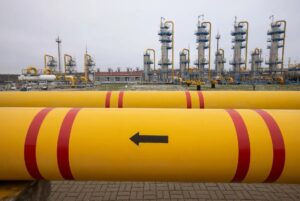
The average level of reserves in underground storage facilities in Europe fell to 29.99% at the end of the gas day on February 27, according to data from Gas Infrastructure Europe. This is 16 percentage points lower than the average for the last five years.
The fill rate of underground storage facilities in Germany and France, Europe’s leading economies, is significantly lower than the European average — 20.6% and 21.4%, respectively, and 10.7% in the Netherlands.
The spot price of gas with “day ahead” delivery on the benchmark European TTF hub closed at $387 per 1,000 cubic meters on Friday.
Since the beginning of 2025, the transit of Russian gas through Ukraine has ceased. Europe is trying to compensate for the shortage of Gazprom’s pipeline gas supplies by importing liquefied natural gas. At the end of 2025, countries in the region purchased 109 million tons of LNG (142 billion cubic meters after regasification), which is 28% more than in 2024. In February 2026, liquefied gas imports reached 9 million tons, which is 9% higher than a year earlier.
Despite high demand, there remains a large unused capacity reserve—on February 27, terminals were operating at 64% of their throughput capacity.
Europe entered the current heating season with incomplete underground gas storage facilities. The need to replenish the reserves used up during this period will be an additional factor driving demand on the global market throughout the coming year.
Given not only technical but also realistic and economic constraints that will limit the European injection campaign in the summer of 2026, the question of how much Europe will be able to fill its UGS facilities by next winter and how risky the 2026/27 heating season will be will be relevant.