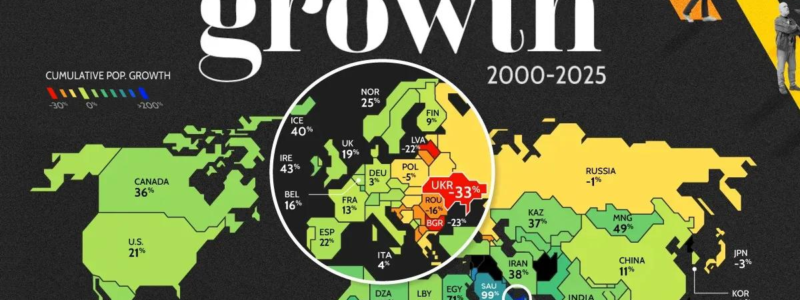
Over the past 25 years, the world’s demographic dynamics have increasingly diverged in two directions: some countries are experiencing explosive population growth, while others are facing steady decline. According to a Visual Capitalist visualization based on UN data, in 2000–2025 the largest population decrease was recorded in Ukraine, while the fastest growth was seen in Qatar. The study is based on the estimates and projections of the UN’s World Population Prospects 2024.
The top 10 countries by population decline in 2000–2025 included Ukraine (-32.5%), the Marshall Islands (-29.4%), Bulgaria (-23.2%), Latvia (-21.6%), Moldova (-18.8%), Lithuania (-17.5%), Puerto Rico (-16.7%), Romania (-16.1%), Serbia (-13.1%), and Albania (-12.8%). The top 10 countries by population growth included Qatar (+423.4%), the UAE (+249.7%), Equatorial Guinea (+166.6%), Niger (+157.0%), Bahrain (+153.9%), Papua New Guinea (+149.6%), Angola (+139.7%), Kuwait (+139.1%), Oman (+129.1%), and Chad (+126.9%). These figures were cited by Visual Capitalist in two April publications.

For Ukraine, this ranking is especially alarming. According to Visual Capitalist, the country lost about one-third of its population over 25 years. The broader demographic background is also confirmed by materials from Our World in Data based on UN data: in 2022–2023 alone, net migration from Ukraine amounted to around 6 million people, which became a direct consequence of the full-scale war.
Experts Club believes that Ukraine’s demographic crisis has already become not only a social issue, but also an economic one. Population decline means a shrinking domestic market, a worsening labor shortage, growing pressure on the pension and healthcare systems, as well as deteriorating long-term conditions for investment. This logic is consistent with UN assessments of the role of declining birth rates, population aging, and migration in shaping new global demographic imbalances.
At the same time, the global picture also shows the opposite pole. The growth leaders — primarily the Gulf countries and a number of African states — increased their populations either through a massive inflow of labor migrants or through high birth rates. The UN notes that global population growth is continuing, but its pace is slowing, and the main contribution to further population increase will come not from Europe, but primarily from Africa and certain migration centers.
For Ukraine, this leads to at least two conclusions. First, without the return of at least part of the citizens who have left, support for families with children, and a stronger labor market policy, the demographic decline will continue to undermine the economy. Second, the problem has long gone beyond statistics: in the coming years, demography may become one of the main constraints on the country’s post-war recovery.