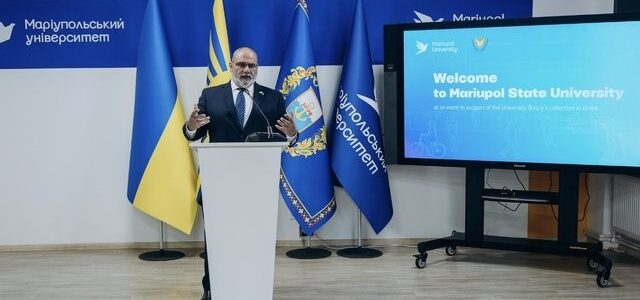
According to the Interfax-Ukraine Culture project, the Embassy of the Republic of Cyprus in Ukraine has donated a selection of books in Greek and English to Mariupol State University to replenish its library collection, reports a journalist from the “Culture” department of the Interfax-Ukraine agency from the scene.
“After relocating from Mariupol to Kyiv, the support of the Republic of Cyprus and the Cypriot Embassy has become even more important to us. Today, this is no longer just assistance, but a real contribution to preserving Mariupol State University as an important institution not only for the Donetsk region, but for all of Ukraine and Europe,” said Tetyana Marena, acting rector of Mariupol State University.
According to her, prior to the full-scale war, Mariupol State University housed the Konstantinos Levendis Library of Hellenistic Studies, which contained approximately 17,000 volumes and was one of the largest collections of Hellenistic literature in the former CIS.
Part of the library’s collection was destroyed as a result of Russian shelling of Mariupol, while a significant portion of the unique collection remained in the occupied territory and is currently under the control of the occupiers.
“We are proud to be a center for the preservation of the Greek language, culture, and history in Ukraine,” Marena emphasized.
Michalis Firillas, Ambassador Extraordinary and Plenipotentiary of the Republic of Cyprus to Ukraine, noted that supporting Mariupol University became one of the first areas of cooperation after he became acquainted with the institution.
“We immediately felt that Mariupol University’s struggle was very close to our hearts. One of the first ideas was to donate Greek-language books to the library to restore what had been lost,” he said.
According to the ambassador, most of the donated publications are devoted to the history, culture, architecture, and literature of Cyprus and Greece and cover the period from antiquity to the present day.
The event was also attended by the Deputy Minister of Education and Science of Ukraine and former rector of Mariupol State University, Mykola Trofimenko.
“It was one of the largest Hellenistic libraries in the world. And it is very important that today we are continuing this story—a story of success,” noted Trofimenko.
“Mariupol University, located in the city of Mariupol, housed one of the largest collections of Hellenistic publications in the former CIS—about 20,000 books. It was the center of Hellenistic studies, the most prominent in Ukraine, and it remains so to this day. Unfortunately, due to the occupation, a significant portion of this collection is now in the hands of the occupiers. We hope that the collection has been preserved,” said the ambassador’s assistant, Iryna Chalova.
According to her, after Mariupol State University relocated to Kyiv, the university began building a new library of Hellenistic publications.
“A new collection is currently being formed at the university’s Kyiv library, and thanks to a donation from the Embassy of Cyprus, it has already been supplemented with new books. We hope that we will be able to restore the library to the scale that Mariupol University had before the war,” Chalova noted.
She also emphasized that Cyprus’s support has taken on special significance following the university’s relocation.
“After Mariupol University moved to Kyiv, the support from Cyprus and the Cypriot Embassy has become even more important. This is a tangible contribution to preserving the university as a vital institution not only for the Donetsk region but for all of Ukraine and Europe,” she added.
After the official part, participants were invited to mingle during a reception and were also offered a short tour of the campus and a visit to the newly established Museum of Greek Cultural Heritage, located on the first floor of the academic building.
Separately, Firillas, responding to students’ questions, noted that for future specialists in international relations, it is no longer enough today to be an expert in just one field.
“In international relations, language skills are obviously necessary. But, in addition to this, you need to develop expertise in other areas. A foundation in economics or finance, even if it is not a full-fledged program of study, is an important complement,” the ambassador said.
He also emphasized the importance of cultural understanding in diplomacy.
“I have always considered it very important to have a certain cultural connection—to understand history, the origins of language, and its roots. It is these things that shape the identity of modern people and modern humanity,” noted Firillas.
According to him, young Ukrainian graduates should be given more opportunities for internships and training within the European Union, particularly in Brussels, in legal or business institutions.
“There is a certain way of doing things, a certain language, and a certain ethos of approach to the common compromise known as the European Union. We all have national interests, but we all share a common goal, so we must make some concessions. For Ukrainians who want to work in international relations, such an experience would be a wonderful addition,” the ambassador said.
After the occupation of Mariupol, Mariupol State University was relocated to Kyiv and continues to operate as a Ukrainian institution of higher education.
https://interfax.com.ua/news/culture/1167746.html
MARIUPOL, UNIVERSITY, Міхаліс, Фіріллас

Related: