

The Veterans Cluster of Ukraine, in collaboration with the “Architecture of Resilience” Veterans Institute at Kyiv National University of Construction and Architecture, continues to support veterans, active-duty military personnel, and their family members as part of the 2026 admissions campaign.
The application period for master’s programs begins on August 7. By that time, applicants must create an online account, register for any applicable benefits, complete a foreign language interview, and pass subject-specific entrance exams.
Program participants can receive tuition-free education in over 50 fields of study and more than 100 academic programs. Funding is available through state compensation programs, grants, scholarships, and employer support programs.
The program also provides opportunities for retraining, professional development, earning a second higher education degree, and admission to master’s or doctoral programs. Veterans are offered full-time, part-time, online, and distance learning options, allowing them to combine their education with work, medical treatment, rehabilitation, or military service.
Throughout their studies, participants can receive psychological support, get involved in projects to rebuild Ukraine, and interact with employers. Program partners include Axor, Barks, and other businesses.

The network of partner universities includes KNUBA, the National University of Physical Education and Sports of Ukraine, the Western Ukrainian National University, the Yuriy Kondratyuk Poltava Polytechnic National University, Vasyl Stefanyk Precarpathian National University, the National University of Life and Environmental Sciences of Ukraine, Drohobych State Pedagogical University, Igor Sikorsky Kyiv Polytechnic Institute, Ivan Pul’uj Ternopil National Technical University, and the University of Educational Management.
The National University of Physical Education and Sports of Ukraine operates a training and rehabilitation center for veterans.
One of the program’s students is veteran Vadym Honcharenko, who is studying at KNUBA to become a coach in adaptive sports. According to him, his choice of major was influenced by his own experience with rehabilitation through sports.
“I want to show people who, due to injuries or disabilities, think that an active life is over for them that this is not the case. A lot depends on us,” Goncharenko noted.
He also advises prospective students to focus on their own needs and choose a major that will be practically useful after graduation.
The Veterans’ Cluster emphasizes that there is not much time left to make a decision, but applicants can still prepare their documents and complete the necessary procedures before the application period begins.
Detailed information is available on the website Veterano.info.
Contact information for consultations:
+38 073 94 96 179
+38 050 22 35 182
+38 067 49 81 098
Artem Goncharenko, Director of the Veterans Institute: +38 073 177 72 73.
Antonina Savchenko, Coordinator of Higher Education and Admissions Programs: +380 63 245 34 05.
admissions, EDUCATION, GONCHARENKO, KNUBA, master’s program, UNIVERSITY, ветеран
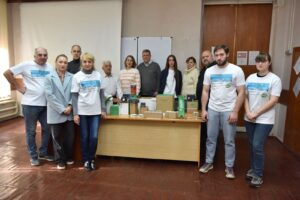
With the support of the international electrical engineering company Schneider Electric, Ukrainian universities have gained access to state-of-the-art ETAP software for designing and analyzing electrical networks. The company also conducted training for faculty members: more than 200 representatives from 30 universities learned how to use the professional tool SEE Electrical Expert. Thanks to this initiative, students will be able to learn how to design electrical schematics using modern digital solutions, preparing them for real-world professional challenges in the energy sector.
SEE Electrical Expert is software for creating electrical schematics, technical documentation, and 3D visualizations. The program allows users to develop schematic diagrams, work with component libraries, and automatically generate specifications and documentation, which significantly reduces project development time and helps minimize the risk of errors. It also enables the creation of a 3D model of an electrical panel, helping to avoid mistakes during assembly.

In addition to the software, in 2025 Schneider Electric donated equipment worth 2,000,000 UAH to universities for their educational laboratories, enabling students to apply modern concepts of automation and electrical engineering in practice and promoting the integration of innovative engineering solutions into the educational process.
Specifically, state-of-the-art electrical engineering equipment was donated to the National Technical University “Kharkiv Polytechnic Institute,” Lviv Polytechnic National University, Odesa National Technological University, National University of Food Technologies, National University of Life and Environmental Sciences of Ukraine, Kryvyi Rih National University, and other higher education institutions.
In 2025, more than 600 ETAP licenses were transferred to Ukrainian universities in several stages:
Training sessions on using SEE Electrical Expert took place from September 2025 through May 2026, with over 200 faculty members from 30 Ukrainian universities participating in total.
“Today’s students are the engineers who will be developing Ukraine’s energy sector tomorrow. That is why it is important for them to learn using the technologies employed in the real world. By investing in education, we not only help young professionals adapt more quickly to their careers, but we also contribute to the country’s reconstruction and create opportunities for young people to realize their potential in Ukraine,” said Mykhailo Bubnov, CEO of Schneider Electric.

“In the near future, we have an ambitious plan to create a modern project laboratory, the ‘Schneider Electric Academy-KAI,’ which will not only ensure the use of software in the educational process but also enable students to participate in creating digital twins of the power supply systems for critical infrastructure in the aviation industry. “Therefore, the effectiveness of our collaboration with Schneider Electric allows us to look to the future with confidence. The energy labor market will be supplied with specialists possessing the necessary professional skills and competencies,” commented Serhiy Ilienko, Associate Professor in the Department of Electrical Engineering and Power Machinery at the National University “Kyiv Aviation Institute.”
Schneider Electric also announced a teaching materials competition aimed at encouraging the academic community to actively use SEE Electrical Expert in the educational process. Competition participants have the opportunity to present their own approaches to solving applied electrical design problems.
EDUCATION, electrical design, ETAP, Schneider Electric, UNIVERSITY

At Kyiv University of Law of the National Academy of Sciences of Ukraine, a discussion has arisen ahead of the rector election regarding a possible change to the university’s management model and the creation of a new position of university president, according to the Anti-Corruption Business Front (ACBF).
According to the public organization “Anti-Corruption Business Front” and Ukrainian media, the election for rector of the Kyiv University of Law of the NAS of Ukraine is scheduled to take place on July 2, 2026. The current rector, Yuriy Boshitsky, has led the university for more than two decades, and after completing his second term, his powers were extended by a decision of the Presidium of the National Academy of Sciences of Ukraine for the duration of martial law.
The authors of the article note that, on the eve of the election, the position of university president appeared in the draft of the new charter of the State University of the National Academy of Sciences of Ukraine. It is precisely this, in their opinion, that raises the question: Is an additional center of influence being formed at the university alongside the future rector?
According to the publication, the draft charter stipulates that the university president may participate in shaping the institution’s development strategy, coordinate the activities of separate structural units, participate in property management matters, represent the university in the sphere of international cooperation, and serve ex officio on the academic council.
The media, citing the APF, note that the position of university president is not prohibited in and of itself and may serve a representative or advisory role at various institutions. However, risks arise if such a position is granted actual managerial authority and can influence the institution’s strategy, assets, international relations, and internal policies.
The reports also state that the revised charter was approved at general staff meetings concurrently with the nomination of Sergey Matveev, vice rector for academic affairs, for the position of rector. The authors of the publication emphasize that the candidate’s participation in the election is not in itself a violation; however, combined with the creation of the position of university president, this raises questions about the competitiveness of the election and the genuine renewal of the university’s leadership.
A separate section of the publication is devoted to the Rivne Institute of the State University under the National Academy of Sciences of Ukraine. The article discusses the need to investigate the use of the premises of this separate unit of the state university, including the grounds for the possible use of certain areas for purposes other than the educational process. The APF emphasizes that these facts require investigation and does not claim that they have been proven.
The civil society activists’ publications also mention criminal proceedings registered in 2024 on grounds of abuse of power or official position. According to APF, there is no information in open sources regarding anyone being notified of suspicion or the conclusion of the investigation.
The authors of the article believe that the situation at the Kyiv University of Law of the National Academy of Sciences of Ukraine is significant not only for this single educational institution, as it touches on the broader issues of leadership turnover at state universities, transparency in asset management, the role of the founding body, and the limits of university autonomy.
For the higher education system, this story could serve as a test case: can a state university’s charter establish an administrative position that effectively influences key decisions but is not subject to the rector’s election procedure and does not fall under the same term limits for holding a leadership position?
The Kyiv University of Law of the National Academy of Sciences of Ukraine was established in 1995 on the basis of the V.M. Koretsky Institute of State and Law of the National Academy of Sciences of Ukraine. The university is a state institution of higher education subordinate to the National Academy of Sciences of Ukraine and specializes in training professionals in the fields of law and international law.
Source:
https://apf.org.ua/yak-u-kyivskomu-universyteti-prava-mozhe-narodytysia-novyi-tsentr-vlady/
https://lenta.ua/yak-u-kiyivskomu-universiteti-prava-mozhe-naroditisya-noviy-tsentr-vladi-194784/
ADMINISTRATION, Boshitsky, CHARTER, ELECTIONS, NAS, rector, State University of the National Academy of Sciences of Ukraine, UNIVERSITY
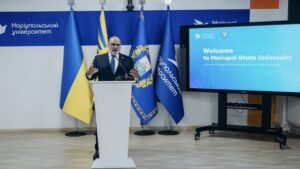
According to the Interfax-Ukraine Culture project, the Embassy of the Republic of Cyprus in Ukraine has donated a selection of books in Greek and English to Mariupol State University to replenish its library collection, reports a journalist from the “Culture” department of the Interfax-Ukraine agency from the scene.
“After relocating from Mariupol to Kyiv, the support of the Republic of Cyprus and the Cypriot Embassy has become even more important to us. Today, this is no longer just assistance, but a real contribution to preserving Mariupol State University as an important institution not only for the Donetsk region, but for all of Ukraine and Europe,” said Tetyana Marena, acting rector of Mariupol State University.
According to her, prior to the full-scale war, Mariupol State University housed the Konstantinos Levendis Library of Hellenistic Studies, which contained approximately 17,000 volumes and was one of the largest collections of Hellenistic literature in the former CIS.
Part of the library’s collection was destroyed as a result of Russian shelling of Mariupol, while a significant portion of the unique collection remained in the occupied territory and is currently under the control of the occupiers.
“We are proud to be a center for the preservation of the Greek language, culture, and history in Ukraine,” Marena emphasized.
Michalis Firillas, Ambassador Extraordinary and Plenipotentiary of the Republic of Cyprus to Ukraine, noted that supporting Mariupol University became one of the first areas of cooperation after he became acquainted with the institution.
“We immediately felt that Mariupol University’s struggle was very close to our hearts. One of the first ideas was to donate Greek-language books to the library to restore what had been lost,” he said.
According to the ambassador, most of the donated publications are devoted to the history, culture, architecture, and literature of Cyprus and Greece and cover the period from antiquity to the present day.
The event was also attended by the Deputy Minister of Education and Science of Ukraine and former rector of Mariupol State University, Mykola Trofimenko.
“It was one of the largest Hellenistic libraries in the world. And it is very important that today we are continuing this story—a story of success,” noted Trofimenko.
“Mariupol University, located in the city of Mariupol, housed one of the largest collections of Hellenistic publications in the former CIS—about 20,000 books. It was the center of Hellenistic studies, the most prominent in Ukraine, and it remains so to this day. Unfortunately, due to the occupation, a significant portion of this collection is now in the hands of the occupiers. We hope that the collection has been preserved,” said the ambassador’s assistant, Iryna Chalova.
According to her, after Mariupol State University relocated to Kyiv, the university began building a new library of Hellenistic publications.
“A new collection is currently being formed at the university’s Kyiv library, and thanks to a donation from the Embassy of Cyprus, it has already been supplemented with new books. We hope that we will be able to restore the library to the scale that Mariupol University had before the war,” Chalova noted.
She also emphasized that Cyprus’s support has taken on special significance following the university’s relocation.
“After Mariupol University moved to Kyiv, the support from Cyprus and the Cypriot Embassy has become even more important. This is a tangible contribution to preserving the university as a vital institution not only for the Donetsk region but for all of Ukraine and Europe,” she added.
After the official part, participants were invited to mingle during a reception and were also offered a short tour of the campus and a visit to the newly established Museum of Greek Cultural Heritage, located on the first floor of the academic building.
Separately, Firillas, responding to students’ questions, noted that for future specialists in international relations, it is no longer enough today to be an expert in just one field.
“In international relations, language skills are obviously necessary. But, in addition to this, you need to develop expertise in other areas. A foundation in economics or finance, even if it is not a full-fledged program of study, is an important complement,” the ambassador said.
He also emphasized the importance of cultural understanding in diplomacy.
“I have always considered it very important to have a certain cultural connection—to understand history, the origins of language, and its roots. It is these things that shape the identity of modern people and modern humanity,” noted Firillas.
According to him, young Ukrainian graduates should be given more opportunities for internships and training within the European Union, particularly in Brussels, in legal or business institutions.
“There is a certain way of doing things, a certain language, and a certain ethos of approach to the common compromise known as the European Union. We all have national interests, but we all share a common goal, so we must make some concessions. For Ukrainians who want to work in international relations, such an experience would be a wonderful addition,” the ambassador said.
After the occupation of Mariupol, Mariupol State University was relocated to Kyiv and continues to operate as a Ukrainian institution of higher education.
https://interfax.com.ua/news/culture/1167746.html

Ukrainian higher education institutions and scientific establishments will continue to enjoy free access to key international scientometric and full-text resources Scopus and WoS in 2026, according to the Ministry of Education and Science of Ukraine.
“Clarivate has confirmed uninterrupted access for Ukrainian institutions to Web of Science, InCites, and Derwent Innovation resources until December 31, 2026. The decision is aimed at supporting the Ukrainian scientific community and ensuring stable access to reliable scientific information in the context of the war,” the statement said.
It is noted that Elsevier has also confirmed the continuation of access for Ukrainian educational and scientific institutions to its scientific electronic resources, in particular Scopus and SciVal, in 2026, which will allow researchers and teachers to work with relevant international publications and use modern analytical tools.
In addition, Ukrainian universities and scientific institutions will have free access to full-text electronic resources on the Research4Life platform until the end of 2027.
“The Research4Life portal provides access to over 200,000 titles of books and journals from international publishers, including Elsevier, Springer Nature, John Wiley & Sons, Taylor & Francis, Emerald, Sage Publications, Oxford University Press, Cambridge University Press, IOP Publishing, and others,” the ministry said.
The Ministry of Education noted that continued access to international scientific resources is an important element of integrating Ukrainian science into the global research space and supporting the ability of educational and scientific institutions to operate even in conditions of full-scale war.

The Ukrainian Ministry of Education and Science has announced competitions to fill rector positions at three more universities in Sumy and Zhytomyr.
According to the ministry, competitions have been announced for the positions of rector of the A. S. Makarenko Sumy State Pedagogical University, Sumy State University, and Polissya National University.
It is noted that Ukrainian citizens who are proficient in the state language in accordance with the level determined by the National Commission for State Language Standards (fluent command of the state language of the first or second degree), have an academic title and degree, and at least ten years of experience in scientific and pedagogical positions are eligible to participate in the competitions.
The deadline for submitting applications is two months from the date of publication of the announcement on the official website of the Ministry of Education.
As reported, on 3 September, the Ministry of Education cancelled the competition for the position of rector of the Kyiv National University of Technology and Design (KNUTD) due to a lack of candidates.
In October-November, the Ministry of Education announced competitions to fill the positions of rectors at 11 universities in Odesa, Vinnytsia, Kropyvnytskyi, Kharkiv, Chernihiv and Kyiv, in particular: Odessa State Academy of Civil Engineering and Architecture, Kharkiv National Economic University named after Semen Kuznets, National Technical University ‘Kharkiv Polytechnic Institute’, Kharkiv National Pedagogical University named after G. S. Skovoroda, National University of Food Technologies, Yaroslav Mudryi National Law University, Vinnytsia National Technical University, Vinnitsa State Pedagogical University named after Mikhail Kotsyubinsky, Kharkiv National Automobile and Road University, Central Ukrainian National Technical University, and Chernihiv Polytechnic National University.



