
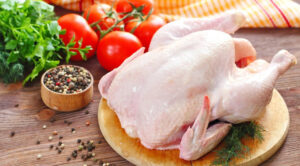
In January–August 2026, Ukraine increased poultry meat exports by 12.5% compared to the same period last year—to 330,200 metric tons—while foreign exchange revenue from these exports decreased by 2.6%—to $697.9 million, according to the Ukrainian Poultry Farmers’ Union.
In August 2026, poultry meat exports totaled 40,600 metric tons, which is 1.5% less than in July (41,200 metric tons).
In monetary terms, August exports fell by 7.9% compared to July, to $82.2 million. The average export price for poultry meat in August was $2.02/kg, which is 20.9% lower than in August of last year. According to the Association, this is due to changes in the range of exported products and a decline in export prices on foreign markets.
The main buyers of Ukrainian poultry meat during the first eight months of 2026 were the Netherlands (20% of exports), the United Kingdom (11.7%), Slovakia (10.6%), and the UAE (6.4%).
EU countries accounted for 36% of total poultry meat exports during this period, or 118,900 metric tons. In monetary terms, the EU’s share amounted to nearly half of foreign exchange earnings—47%.
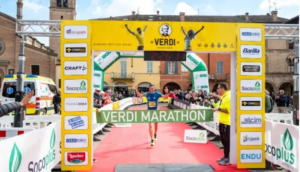
Swiss ultramarathon runner Frédéric Splendore plans to complete the Beyond Borders charity run—a journey of approximately 4,200 kilometers that he began in Monaco on July 24—in Ukraine on September 21, International Day of Peace.
As the athlete told the Open4Business editorial team, he expects to arrive in Lviv early in the morning on September 21, completing the walking portion of his journey across Europe. After that, Splendore and his support team plan to travel by camper van to Kyiv and visit Maidan Nezalezhnosti in the afternoon. Their departure from Ukraine is scheduled for September 22.
The main goal of the Beyond Borders project—known as “Courir pour Unir” (“Run to Unite”) in its French-language version—goes beyond mere athletic achievement. Splendor is using the run to draw attention to the consequences of the war in Ukraine and to raise funds to help Ukrainians affected by the conflict.
“This project isn’t just about sports or a record. It’s about using endurance to raise awareness, collect funds, and convey a universal message of peace and solidarity all the way to Ukraine,” said Splendor.
In total, the route spans approximately 4,200 km and passes through 13 European countries. On some days, the athlete covers 70–100 km. The project’s official website confirms that the goal of the journey is to arrive in Ukraine on September 21—International Day of Peace.
The first and most challenging stage of the route followed the Via Alpina through the Alps. Splendor covered about 2,000 km of the Alpine route and set a new men’s record for completing the route with team support—23 days, 11 hours, and 42 minutes. The result was recorded on August 16.
After completing the Alpine section, the athlete continued on for another approximately 2,200 km through Central and Eastern Europe toward Ukraine.
“When things got tough, I reminded myself that everything I’m going through is temporary and voluntary, whereas millions of Ukrainians have had no choice for many years and live with the consequences of war every day,” the athlete noted.
The charitable component of the project is being carried out through the Swiss association Au-delà de l’Effort. The funds raised are being directed to the Chaîne du Bonheur (Swiss Solidarity) fund to support Ukrainians affected by the war. The money is planned to be used, in particular, to rebuild destroyed buildings, assist internally displaced persons, and ensure access to education and medical care. According to the project, at least 95% of the funds raised will go directly to the fund for aid to Ukraine.
The campaign’s goal is to raise approximately EUR 140,000.
Frederick Splendor, 33, previously worked as a professional firefighter and a chemistry lab technician. He is the 2023 Swiss champion in the 100-km race and the 2024 national runner-up. His personal best in the marathon is approximately 2 hours and 22 minutes. In 2018, the athlete ran approximately 4,300 km on his own along the Pacific Crest Trail in the United States.
According to Splendor, arriving in Ukraine on International Day of Peace is meant to be a symbolic conclusion to his nearly two-month-long journey.
“I want to use running as a way to mobilize people, to remind Europeans that we must not turn a blind eye, and to show solidarity with a population that has been living with war for many years,” he noted.
Photo: ibelieveinyou.ch, Embassy of Ukraine in Hungary
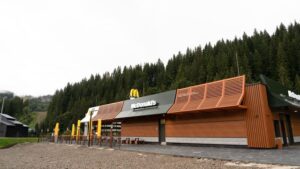
McDonald’s Ukraine Ltd., which operates the McDonald’s fast-food restaurant chain in Ukraine, has opened its first restaurant in Bukovel, in the village of Polianytsia, according to the company’s press office.
This is the 10th restaurant in the chain to open this year.
The restaurant, with an area of nearly 477 square meters, has about 280 seats. All of McDonald’s modern service channels will be available at the restaurant. Customers will be able to place orders at self-service kiosks in the dining area, use “McDrive,” or place orders in advance via the “Mobile Ordering” service in the McDonald’s app. The dining area is open daily from 7:00 a.m. to 11:00 p.m., and “McDrive” is open from 5:00 a.m. to 11:30 p.m.
As previously reported, all McDonald’s restaurants in Ukraine operate in compliance with enhanced safety protocols: during an air raid alert, the restaurant temporarily suspends operations so that employees and guests can proceed to the nearest shelter, and resumes service once the all-clear is given. Employees receive their full wages regardless of the time spent in the shelter during their shift.
The first McDonald’s restaurant in Ukraine opened on May 24, 1997, in Kyiv. Today, McDonald’s employs nearly 11,000 Ukrainians and operates 131 restaurants in 44 locations. Since the start of the full-scale invasion, the company has opened 43 new locations.
According to data from the OpenDataBot analytics system, McDonald’s in Ukraine generated 21.3 billion UAH in revenue in 2025, which was 26.6% higher than the figure for the same period last year. Net profit increased by 21.3% to 1.567 billion UAH. Last year, the company paid 3.5 billion UAH in taxes to the state budget.
McDonald’s in Ukraine is a founding partner and the largest corporate partner of the charity organization “Ronald McDonald House Ukraine.”
MCD Europe Limited (London, United Kingdom) is listed as the owner of the foreign direct investment entity “McDonald’s Ukraine Ltd.” with a 100% stake.
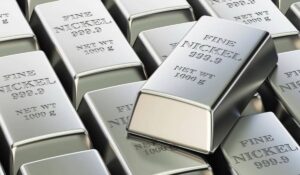
In January–August 2026, Ukraine increased imports of nickel and nickel products by 8.9% compared to the same period last year, reaching $15.811 million.
According to statistics released by the State Customs Service of Ukraine, nickel and nickel product imports totaled $1.967 million in August.
Exports of nickel and nickel products in January–August 2026 totaled $404,000, and in August, $34,000, compared to $746,000 for the first eight months of 2025.
As previously reported, Ukraine reduced imports of nickel and nickel products by 2.7% in 2025 compared to 2024, down to $26.011 million. Exports of nickel and nickel products totaled $1.420 million, compared to $602 thousand in 2024.
Nickel is used in the production of stainless steel and for nickel plating. It is also used in battery manufacturing, powder metallurgy, and chemical reagents.
The organizers of the first International “Charitable Italy – Ukraine” Competition (Sostenitori dell’Ucraina in Italia) have extended the deadline for submitting applications through October 5, 2026, the Association of Ukrainian Philanthropists announced.
The announcement of the results and the awards ceremony are scheduled for late October 2026. The competition is being held as the international stage of the National Competition “Charitable Ukraine-2025: Charity in Defense of Ukraine.”
The goal of the initiative is to recognize charitable and volunteer organizations, informal communities, socially responsible businesses, and individuals in Italy who provide humanitarian, financial, social, educational, and cultural assistance to Ukraine and Ukrainians.
The organizers also hope that the competition will help strengthen the Ukrainian community in Italy and foster cooperation among volunteers, charitable organizations, businesses, and local communities that support Ukraine.
Eligible participants include charitable, volunteer, and civic organizations; formal and informal associations; socially responsible companies; and individuals who are located or registered in Italy and provide support to Ukraine.
Applications may be submitted not only by the philanthropist or organization itself. Ukrainian aid recipients, as well as any legal entities or individuals who consider a specific candidate worthy of the award, may also nominate Italian volunteers and organizations.
The competition features four categories: “Philanthropist of the Year—Non-Governmental Organization,” “Philanthropist of the Year—Individual,” “Ukrainians for Their Homeland,” and “Goodness Starts with You.” The latter category is intended for children’s and youth initiatives aimed at assisting Ukraine and fostering a culture of philanthropy.
Applications are accepted in Ukrainian or Italian. The completed application form can be sent in Word format to the organizing committee’s email address, konkurs@blagoukraine.org, or submitted via the online form.
The Italian-Ukrainian cultural association Futura Nostra in Rome serves as the organizing partner for the competition in Italy.
The Ukrainian Philanthropists Association announced the first “Charitable Italy – Ukraine” competition, to be held in late May–early June 2026. The deadline for submissions was originally set for September 1, but the organizers decided to extend the campaign by more than a month.
In January–August 2026, Ukraine increased imports of aluminum and aluminum products by 31.7% compared with the same period last year, reaching $453.439 million.
According to statistics released by the State Customs Service of Ukraine, aluminum and aluminum product imports totaled $64.792 million in August.
Exports of aluminum and aluminum products in January–August of this year rose by 25.3% compared to the same period last year, reaching $123.934 million; in August, they totaled $14.369 million.
As previously reported, in 2025 Ukraine increased imports of aluminum and aluminum products by 15.3% compared to 2024, reaching $514.098 million. Exports of aluminum and aluminum products in 2025 rose by 22.9% to $152.919 million.
Aluminum is widely used as a structural material. The main advantages of aluminum are its light weight, formability, corrosion resistance, high thermal conductivity, and the non-toxic nature of its compounds. In particular, these properties have made aluminum extremely popular in the production of cookware, aluminum foil in the food industry, and for packaging. The first three properties have made aluminum the primary raw material in the aviation and aerospace industries (though it has recently been displaced by composite materials, primarily carbon fiber). After construction and packaging production—aluminum cans and foil—the energy sector is the largest consumer of this metal.
For a more detailed overview of global aluminum production from 1970 to 2024, watch the video on the Experts Club YouTube channel.
ALUMINUM, EXPERTS CLUB, EXPORTS, IMPORTS, METALLURGY, UKRAINE



