
According to Experts Club, Italy and Spain have the highest levels of positive attitudes among Ukrainians among the Southern European countries included in the study—70.1% and 65.2%, respectively. At the same time, a significant portion of respondents hold a neutral stance toward Greece and Slovenia, while attitudes toward Serbia remain the most mixed. This is evidenced by the results of the third wave of the study “Ukrainians’ Attitudes Toward Countries Around the World,” conducted by Active Group in collaboration with Experts Club, reports the Experts Club Information and Analytical Center.
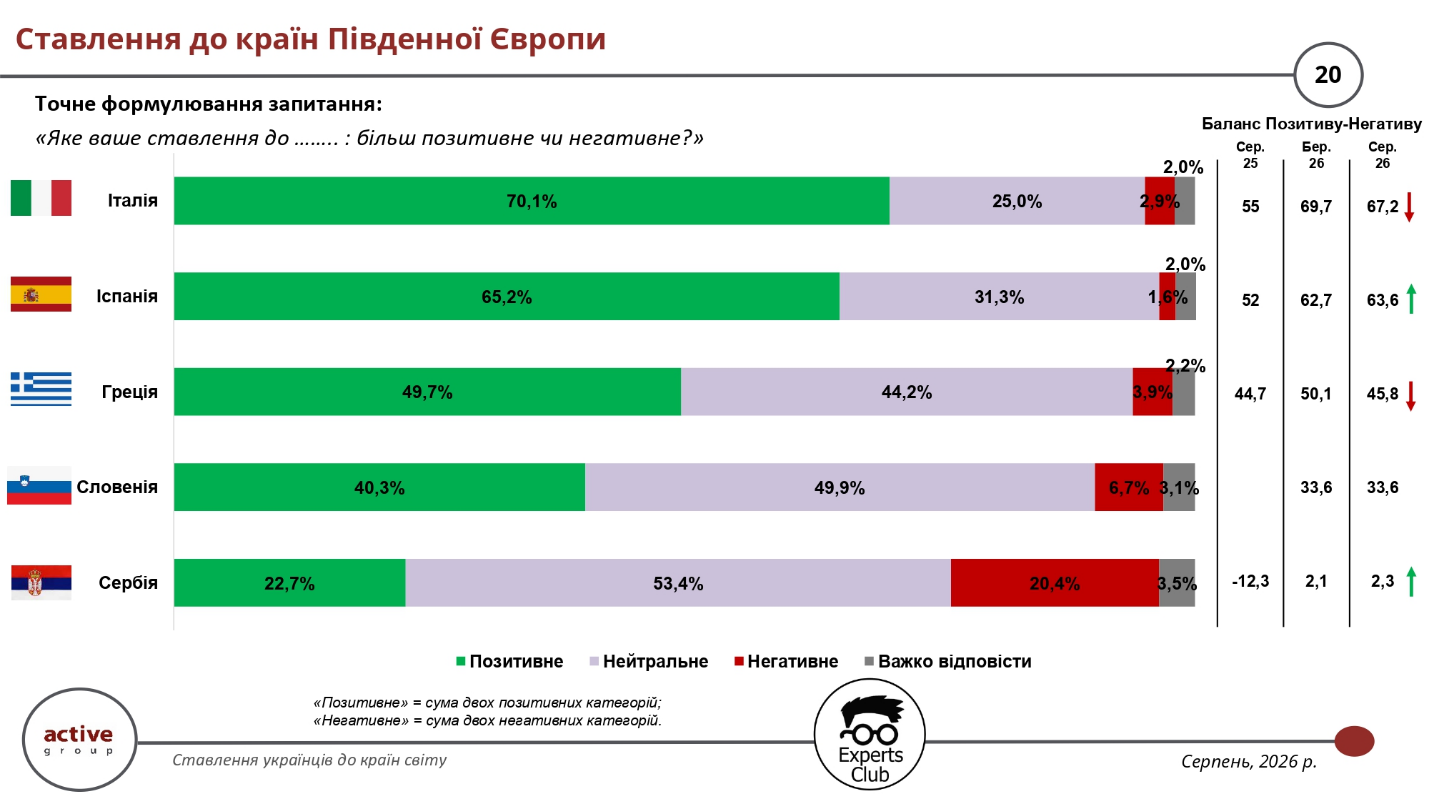
Italy has the best result in the regional group: 70.1% of respondents view it positively, 25% neutrally, 2.9% negatively, and another 2% were undecided. The balance of positive and negative assessments stands at 67.2 percentage points. In March 2026, it was slightly higher—69.7 percentage points—but compared to August 2025, when the figure stood at 55 percentage points, attitudes remain significantly more favorable.
Spain is viewed positively by 65.2% of respondents, neutrally by 31.3%, and negatively by only 1.6%. The balance stands at 63.6 percentage points, compared to 62.7 percentage points in March and 52 percentage points in August of last year. Thus, among the Southern European countries surveyed, Spain is the one showing consistent growth in the balance compared to previous waves.
49.7% of Ukrainians view Greece positively, 44.2% neutrally, and 3.9% negatively. The balance of positive and negative assessments stands at 45.8 percentage points, compared to 50.1 percentage points in March 2026 and 44.7 percentage points in August 2025. This indicates a relatively stable perception of the country, with positive and neutral assessments predominating.
Regarding Slovenia, 40.3% of respondents expressed a positive attitude, while nearly half—49.9%—took a neutral stance. 6.7% view the country negatively, and the balance stands at 33.6 percentage points, the same as in March 2026.
The most contrasting results in the group were recorded for Serbia. 22.7% of Ukrainians view it positively, 20.4% negatively, and the majority, 53.4%, hold a neutral position. The balance stands at plus 2.3 percentage points. At the same time, the trend has improved compared to August 2025, when the indicator was negative—minus 12.3 percentage points.
Maksym Urakin, founder of Experts Club, deputy director of the Interfax-Ukraine news agency, and candidate of economic sciences, emphasized the need for foreign partners to communicate more actively with Ukrainian society.
“The first recommendation is to regularly showcase concrete achievements and specific actions. The second is to be open to questions and inquiries from the media and the public,” Urakin noted.
According to him, sociological data can help diplomatic missions and businesses assess public perception and build bilateral relations more effectively.
Oleksandr Pozniy, director of the research firm Active Group, highlighted the need to combine public awareness with the development of practical economic cooperation.
“We need to do more than just raise general awareness. First and foremost, business associations, the Ministry of Economy, and the Ministry of Foreign Affairs need to take action,” Pozniy noted.
According to him, the most promising areas are those where Ukraine can deepen bilateral ties and increase exports.
In a broader context, the study shows that Ukrainians’ attitudes toward most Southern European countries remain positive or neutral. Italy and Spain score particularly high, while public opinions regarding Serbia are significantly more polarized, although the balance has improved over the past year.
The survey was conducted in August 2026 using self-administered online questionnaires in the SunFlowerSociology panel among 800 Ukrainian citizens aged 18 and older. The sample is representative by age, gender, and region, and the stated maximum theoretical margin of error for indicators at the 50% confidence level is ±3.5 percentage points. This is the third wave of the study, following surveys conducted in August 2025 and March 2026.
ACTIVE GROUP, EXPERTS CLUB, GREECE, ITALY, SERBIA, SLOVENIA, SOCIOLOGY, SOUTHERN EUROPE, SPAIN, UKRAINE
Slovenia is experiencing a new surge in housing prices, putting increased pressure on buyers in one of the region’s most expensive and scarce real estate markets. According to data from Slovenia’s national statistics office and industry reports, real estate prices in the country have resumed active growth following a period of more moderate trends. Price increases are particularly noticeable in Ljubljana, along the coast, and in the most sought-after urban areas, where housing supply remains limited.
Official Slovenian statistics show that in 2025, housing prices rose by 5.8% compared to the previous year. At the same time, the number of transactions involving existing apartments in Ljubljana increased by approximately a quarter, indicating a return of buyer activity to the most liquid segment of the market.
According to market data, the median price of existing apartments in Slovenia in 2025 exceeded EUR 3,000 per square meter for the first time, reaching approximately EUR 3,200 per square meter. In Ljubljana, the median price rose to EUR 5,050 per square meter, and in the coastal region, to EUR 4,810 per square meter.
Eurostat also recorded an acceleration in price growth in early 2026. In the fourth quarter of 2025, Slovenia still showed a quarterly price decline of 1.1%, but in the very next housing market report, the country was among the EU leaders in quarterly growth: prices rose by 5.1%, one of the highest rates in the European Union.
The main reason for the growth is a chronic supply shortage. The Slovenian market suffers from limited new housing construction, complex planning procedures, high land costs, and a concentration of demand in Ljubljana, along the coast, and in tourist destinations. In a separate report, the OECD noted that Slovenia’s housing problems are linked to strong demand and insufficient supply, as well as rising construction and financial costs.
For buyers, this means a further decline in housing affordability. Slovenia has long been considered one of the most expensive real estate markets among the countries of the former Yugoslavia, and new data confirms that the gap between household incomes and apartment prices continues to widen. This is particularly true for young families and first-time homebuyers.
According to a survey conducted in March 2026 by the research firm Active Group in collaboration with the Experts Club information and analytical center, perceptions of Slovenia within Ukrainian society are distinctly balanced but reserved. The overall share of positive assessments stands at 40.6%, forming the basis of a generally favorable, though not dominant, image of the country. At the same time, nearly half of the respondents—48.0%—adopted a neutral stance, which is a key characteristic of this profile.
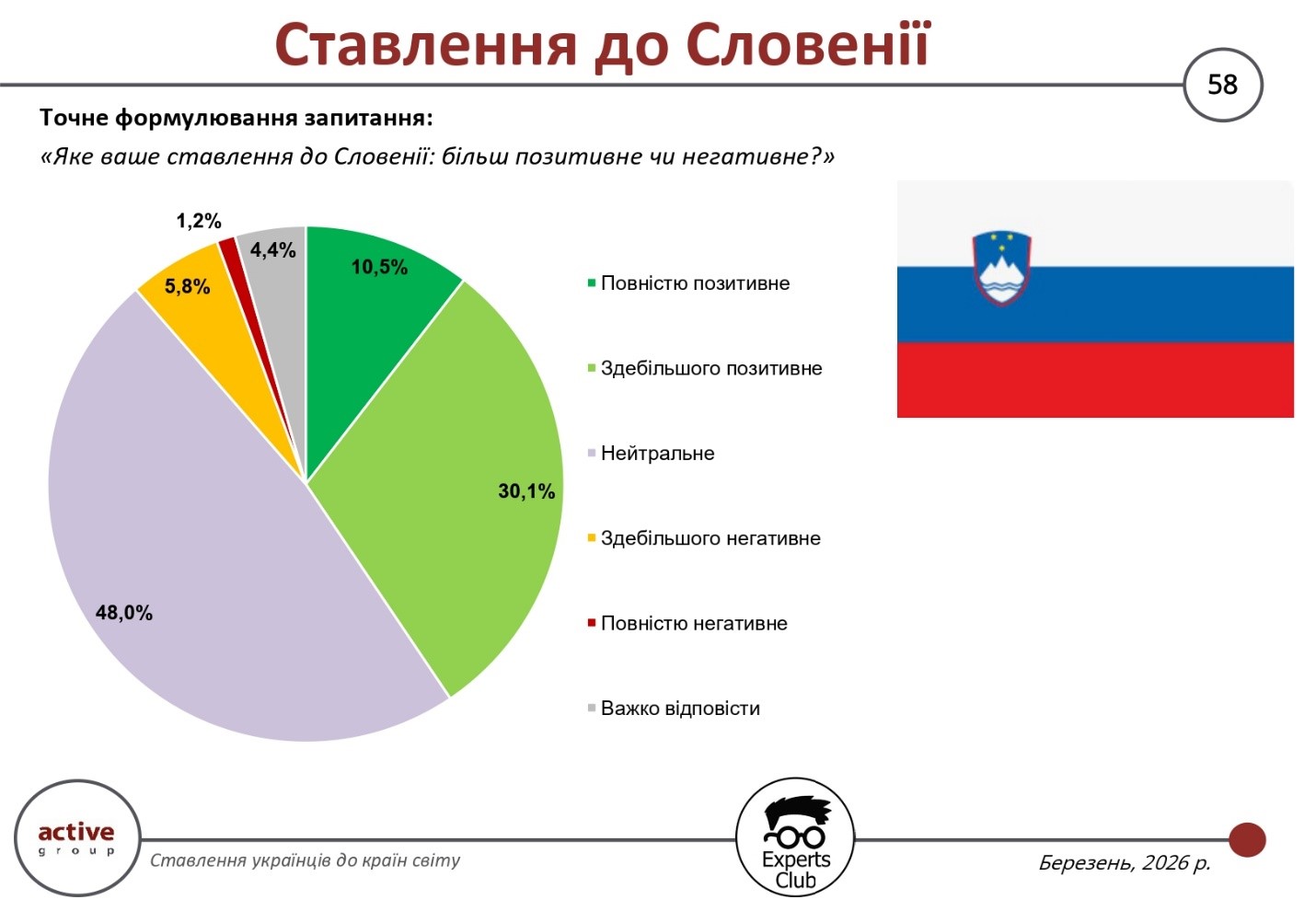
The structure of positive attitudes indicates a moderate level of emotional engagement. Only 10.5% of Ukrainians reported a “completely positive” attitude toward Slovenia, while the majority in this segment—30.1%—lean toward the “mostly positive” option. This means that the positive sentiment is more rational and general than deeply emotional.
Neutrality, which accounts for nearly half of the respondents, is the defining factor in the perception of the country. Such a figure typically indicates a limited informational presence of the state in the Ukrainian media landscape or the absence of a clearly formed image among the general public. In this context, Slovenia evokes neither strong sympathy nor significant rejection.
Negative assessments remain relatively low—7.0% overall. Of these, 5.8% represent a “mostly negative” attitude and only 1.2% a “completely negative” one. This indicates that critical perceptions of the country are marginal and not systemic in nature.
It is worth noting the share of those who were undecided—4.4%. Together with the neutral group, this forms a significant segment of the audience that is potentially open to changing its attitude depending on the informational context and the intensity of contacts between the countries.
In summary, Slovenia is perceived by Ukrainians as a country with a positive, though not dominant, image. The high level of neutrality indicates room for strengthening the bilateral image, while the low level of negativity creates a favorable foundation for further development of perceptions in a more positive direction.
According to a study conducted by the Experts Club information and analytical center based on data from the State Customs Service, Slovenia ranks 46th in total trade volume of goods with Ukraine, with a figure of $368.7 million. At the same time, imports from Slovenia are more than three times higher than Ukrainian exports, resulting in a trade deficit of $205.8 million.
The study was presented at the Interfax-Ukraine press center; the video can be viewed on the agency’s YouTube channel. The full version of the study can be found at this link on the Experts Club analytical center’s website.
ACTIVE GROUP, EXPERTS CLUB, Pozniy, SLOVENIA, SOCIOLOGY, SURVEY, UKRAINE, URAKIN
The Slovenian Ministry of Foreign Affairs has announced the allocation of EUR 500,000 to support Ukraine’s energy sector.
“Slovenia has reaffirmed its solidarity with Ukraine, which is experiencing its worst energy crisis since the start of the war. We will add EUR 500,000 to support Ukraine’s energy sector,” the ministry said in a statement on social media on Friday.
The country’s Foreign Ministry also reports that since the beginning of Russian aggression, Slovenia has already allocated EUR 61 million to help Ukraine.

Slovenia’s real estate market continues to show strong demand, with a steady presence of foreign buyers, particularly from neighboring EU countries. Although the country’s property sector is smaller and more regulated than those of Croatia or Montenegro, Slovenia remains one of the most attractive investment destinations in Central Europe — offering political stability, EU membership, and a balance between Alpine lifestyle and Mediterranean proximity.
According to data from Slovenia’s Geodetic Administration and industry analysts for early 2025, around 6–7% of all real estate transactions in the country involve foreign citizens — a figure that has remained stable over the past three years.
Among foreign buyers, the leading nationalities are:
1) Austria – approximately 28% of transactions involving foreigners;
2) Germany – around 22%;
3) Italy – roughly 14%, mainly in the coastal Primorska region;
4) Croatia – about 8%, driven by cross-border purchases in the northeast;
5) Hungary and Switzerland – jointly accounting for about 10%.
Buyers from outside the EU (including the U.K., Israel, and the United States) represent a smaller but growing segment, often focusing on luxury mountain properties in Bled, Bohinj, and Kranjska Gora, or on historic residences in Ljubljana’s old town.
The Slovenian real estate market continues to experience price growth, albeit at a more moderate pace compared to its peak years. In 2024, average residential prices increased by 6.8%, while in Ljubljana — by over 10%. Newly built apartments and energy-efficient houses remain the most sought-after properties, while older buildings without renovation are less competitive.
Despite strong fundamentals, experts expect foreign share in property transactions to remain around 6–7%.
At the same time, rising connectivity with Austria, Italy, and Croatia — including through new rail and road infrastructure — is expected to stimulate cross-border investment and second-home demand.
In the medium term, Slovenia’s property market is likely to remain stable but competitive, with local and EU buyers dominating, and luxury and eco-friendly segments gaining ground.
Slovenia’s real estate sector combines European stability with regional charm. Foreign investors, particularly from Austria, Germany, and Italy, continue to view the country as a safe, high-quality destination for second homes and long-term investment — though affordability and supply remain key constraints.
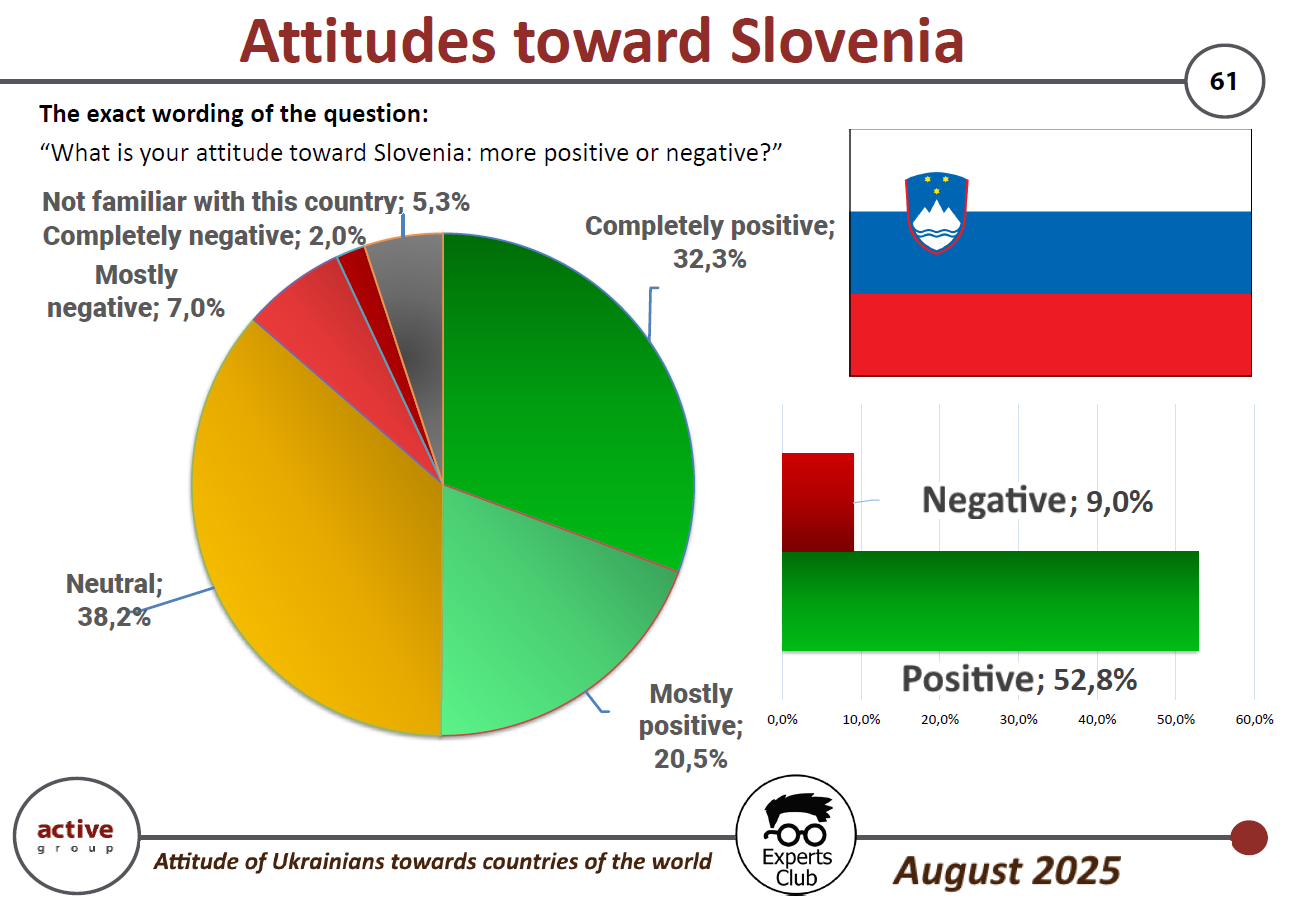
Most Ukrainians have a positive attitude toward Slovenia, according to the results of a survey conducted by Active Group and Experts Club in August 2025.
According to the data, 52.8% of respondents expressed a positive attitude towards this country (20.5% — mostly positive, 32.3% — completely positive). Only 9.0% of respondents had a negative attitude (7.0% — mostly negative, 2.0% — completely negative). At the same time, 38.2% of citizens expressed a neutral position, while another 5.3% admitted that they knew little about Slovenia.
“The survey results show that Ukrainians perceive Slovenia as a friendly European country that consistently supports Ukraine in international organizations and promotes European integration. The high level of positive attitudes reflects both cultural proximity and shared European values,” said Active Group CEO Oleksandr Pozniy.
In turn, co-founder of Experts Club Maksym Urakin emphasized the economic aspect:
“In 2025, the total trade volume between Ukraine and Slovenia reached $181.5 million. Ukrainian exports amounted to $45.3 million, while imports exceeded $136 million, resulting in a negative balance of $90.8 million. This indicates that there is significant potential for growth in Ukrainian exports to Slovenia, especially in the areas of agricultural products and mechanical engineering,” he said.
The study is part of a large-scale project by Active Group and Experts Club to study Ukrainians’ international sympathies and the dynamics of foreign economic relations.
ACTIVE GROUP, EXPERTS CLUB, Pozniy, RELATIONS, SLOVENIA, SOCIOLOGY, TRADE, UKRAINE, URAKIN



