
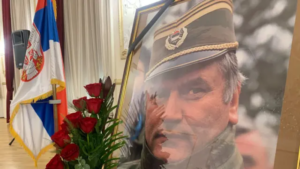
Bosnia and Herzegovina Foreign Minister Elmedin Konaković announced the withdrawal of most of the BiH embassy staff from Belgrade following the funeral of former Army of Republika Srpska commander Ratko Mladić, reports the Serbian Economist Telegram channel. He said he intends to reduce relations with Serbia to the “lowest possible level.”
The BiH ambassador and consul, however, remain in Belgrade: their appointment and recall fall under the authority of the collective Presidency of Bosnia and Herzegovina, not the Foreign Ministry. Under the Constitution, it is the Presidency that conducts the country’s foreign policy, so the minister cannot legally sever relations with Serbia on his own.
The reason was not only the funeral ceremony itself on September 7, but also the scale of participation by Serbian state institutions. As the coffin was returned, it was accompanied by representatives of the state and the military, while Defense Minister Bratislav Gašić and Justice Minister Nenad Vujić attended the funeral. President Aleksandar Vučić did not attend the ceremony, but his son Danilo was present. The funeral drew thousands of people.
Serbian Foreign Minister Marko Đurić responded extremely harshly, calling Konaković’s statements “hypocrisy.” He recalled that former BiH army commander Rasim Delić had also been convicted by the Hague Tribunal for crimes committed by the “El Mujahid” unit, and accused the Bosnian side of taking a selective approach to war crimes. Đurić also recalled the attack on Vučić in Potočari in 2015, when the then Serbian prime minister was pelted with stones after laying flowers at the Srebrenica memorial.
Why does the figure of Mladić still provoke such a harsh reaction in the Balkans?
Ratko Mladić commanded the Army of Republika Srpska from May 1992. The International Criminal Tribunal for the former Yugoslavia, and later the UN appeals chamber, ultimately found him guilty and sentenced him to life imprisonment for the Srebrenica genocide, crimes against humanity and war crimes during the war in Bosnia. In Srebrenica, after the enclave was captured in July 1995, around 8,000 Bosnian Muslims — men and boys — were killed.
Therefore, for a significant part of the Bosniaks in Bosnia, Mladić is above all a symbol of Srebrenica, the siege of Sarajevo and ethnic cleansing. His public honoring in Belgrade is perceived there not as a private funeral, but as a denial or justification of the crimes.
Croatia also views Mladić extremely negatively. Before the formation of the Army of Republika Srpska, he served in the Yugoslav People’s Army in the Knin area during the war in Croatia. After the final verdict in 2021, the Croatian government even officially expressed regret that the Hague proceedings had not covered crimes committed by him on Croatian territory.
In Serbia and Republika Srpska, attitudes are different. For many, Mladić remains the man who defended Bosnian Serbs during the breakup of Yugoslavia. That is why thousands of people attended the funeral, chants of “hero” were heard, and his portraits remain widespread. At the same time, Serbia itself has politicians, public organizations and media outlets that accept the findings of international courts and oppose the glorification of Mladić.
Belgrade also constantly emphasizes the issue of Serbian victims of the war and believes that crimes against Serbs receive less attention in regional and international discourse.
The scandal is already moving beyond Bosnian-Serbian relations. EU Commissioner for Enlargement Marta Kos canceled a planned visit to Serbia, explaining the decision by the unacceptability of glorifying convicted war criminals.
The story surrounding Mladić’s funeral is no longer merely a dispute over a single historical figure. It has once again exposed the central political contradiction of the Western Balkans: more than 30 years after the Bosnian war, Belgrade, Banja Luka, Sarajevo and Zagreb still differ substantially in their assessments of the war, responsibility, and of who should be regarded as a criminal and who as a hero.
BALKANS, Bosnia and Herzegovina, DIPLOMACY, RATKO MLADIĆ, SERBIA
Indian Foreign Minister Subramaniam Jaishankar stated that India has provided Ukraine with 19 shipments of humanitarian aid, including 160 metric tons of cargo consisting of generators, medicines, and medical equipment.
According to a correspondent for “Interfax-Ukraine,” he made these remarks at a press conference with Ukrainian Foreign Minister Andriy Sibiga on Thursday in Kyiv. Jaishankar noted that he would meet with Ukrainian President Volodymyr Zelenskyy later that day and convey greetings from Prime Minister Narendra Modi.
“To date, we have provided 19 shipments of humanitarian aid, including 160 metric tons of generators, medicines, medical equipment, and other items. Minister Sibiga and I will discuss what further steps can be taken in this regard,” the minister said.
He expressed regret and condolences regarding the death of an Indian citizen two days ago as a result of an attack in Kyiv. Jaishankar noted that, in India’s view, “solutions will not emerge on the battlefield.”
“Every day of the conflict means only more deaths and more destruction. It is clear that the parties involved must find a way forward. But if India can help in any way, we are ready,” the foreign minister emphasized.
He added that this was the focus of today’s conversation with the Ukrainian foreign minister.
The sides also discussed attacks on commercial shipping.
According to the “Serbian Economist,” Serbia is ready to provide its territory as a venue for negotiations between Ukraine and Russia if both sides consider Belgrade’s involvement to be useful, said Andon Sapundži, Serbia’s ambassador to Ukraine.
“If there is a need for a venue for dialogue or negotiations, Serbia is ready to offer it,” the diplomat said in an interview with the Ukrainian publication “Apostrophe,” published on August 27.
At the same time, the ambassador emphasized that Belgrade has no intention of imposing its own terms for a settlement on the parties and believes that decisions regarding the start of negotiations, their format, and conditions should be made directly by Ukraine and Russia.
Sapundži also rejected the interpretation of Belgrade’s position as a call for Ukraine to cede part of its territory in order to end the war.
According to him, Serbia consistently supports Ukraine’s territorial integrity within its internationally recognized borders.
At the same time, Belgrade does not consider itself a party to the war and hopes to maintain the ability to engage in political dialogue with both sides.
In early August, Ukrainian President Volodymyr Zelenskyy visited Belgrade. This was the Ukrainian president’s first visit to Serbia in eight years. According to Sapundži, during the visit, Zelenskyy and Serbian President Aleksandar Vučić held three separate meetings in less than a day, including a nearly four-hour informal conversation over dinner, official talks, and a one-on-one meeting.
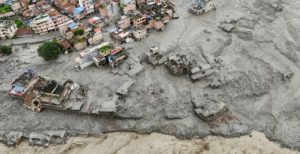
The Embassy of Ukraine in India, which also represents Ukraine in Nepal, has sent two staff members—including a consul—to that country to assist Ukrainian citizens following a massive flash flood and landslides in the Rasuwa district of Bagmati Province.
According to the embassy, Ukrainian diplomats will work directly on the ground in coordination with the relevant Nepalese authorities, local rescue services, and the Honorary Consul of Ukraine. The primary task is to locate Ukrainian citizens with whom contact has been lost and to provide them with consular assistance.
According to the latest data from the Ministry of Foreign Affairs of Ukraine, 55 Ukrainian citizens are considered missing as a result of the natural disaster in Nepal. These include two tourist groups consisting of 47 and seven people, respectively, as well as one Ukrainian woman who was part of a foreign tourist group. As of August 27, there is no information regarding Ukrainian citizens who have died or been injured.
According to information received by the Ukrainian Ministry of Foreign Affairs from local authorities, more than 1,100 people are considered missing following the massive flooding and landslides, including over 700 tourists from nearly 30 countries. At the time of the Ukrainian Foreign Ministry’s announcement, at least 165 fatalities had been confirmed.
The natural disaster occurred on August 26 in the Rasuwa mountain district near the Nepal-Tibet border. A powerful torrent of water, rocks, and soil swept through the valleys of the Bhote Koshi and Trishuli rivers, damaging settlements, roads, bridges, power facilities, and tourist infrastructure.
According to the latest expert assessments, one of the likely causes of the disaster may have been the collapse of a section of a glacier along with a mass of rocks and snow. Rescue operations are being hampered by damage to transportation and communications infrastructure.
The Embassy has urged Ukrainian citizens currently in Nepal to inform diplomats of their whereabouts and condition at the earliest opportunity, to follow the recommendations of local authorities and rescue services, and to avoid visiting the affected areas.
Relatives of Ukrainians with whom contact has been lost and who may have been in the disaster zone are asked to provide diplomats with information about their last known whereabouts.
Hotline of the Embassy of Ukraine in India: +91 92055 07157 (Viber, Telegram), email: consul_in@mfa.gov.ua.
Honorary Consul of Ukraine in Nepal: +977 1 441 6544, +977 1 441 6767.
24-hour hotline of the Ministry of Foreign Affairs of Ukraine: +38 044 238 1588, email: cons_or@mfa.gov.ua.
Original source — Embassy of Ukraine in the Republic of India, statement dated August 27, 2026. Additional up-to-date information on Ukrainian citizens was provided by the Ministry of Foreign Affairs of Ukraine to the Interfax-Ukraine news agency.

According to The Serbian Economist, Tamara Vučić, the wife of the President of Serbia, participated in the 6th Summit of First Ladies and Gentlemen, which took place on August 24 in Kyiv on Ukraine’s Independence Day. The theme of this year’s meeting was “Peace-2026: Finding Stability in Times of Uncertainty.”
The First Lady of Lithuania, Diana Nausėdenė; the wife of the President of Estonia, Sirje Karis; the wife of the President of Finland, Susanna Innes-Stubb; the First Lady of Romania, Mirabela Gredinaru; Tamara Vučić; and the First Gentleman of Slovenia, Ales Musar, all traveled to Kyiv in person. As is tradition, Olena Zelenska served as the host of the summit. Representatives from Germany, Turkey, Israel, the Czech Republic, Georgia, Belize, and Guatemala joined online. In total, the event brought together representatives from 14 countries.
An interesting part of the summit was the presentation of a unique “dictionary of resilience”—words and traditions from various nations that help society maintain unity in times of crisis.
Serbia presented “krsna slava”—a unique Serbian tradition of honoring the family’s patron saint.
Vucic called the slava “the living code of our identity” and explained that this tradition unites the family regardless of where its members are.
Speaking about the historical roots of Serbian resilience, she recalled the medieval rulers who, instead of palaces, left behind monasteries and charitable foundations. Vucic specifically mentioned the Serbian monasteries in Kosovo and Metohija, which are on UNESCO’s List of World Heritage Sites in Danger.
According to her, during difficult historical periods, Serbs effectively “brought the church under their own roof”: the home became a place for preserving faith, memory, and family unity, while glory became an intangible legacy passed down from generation to generation.
The First Ladies and Gentlemen Summit was launched at the initiative of Olena Zelenska in 2021 as an international platform for humanitarian and social projects. This year, the main focus was on what helps people, families, and nations maintain resilience during times of war and global uncertainty.
https://t.me/relocationrs/3532
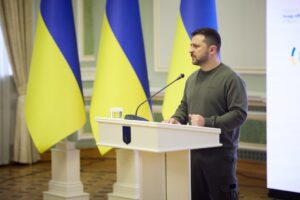
Ukrainian President Volodymyr Zelenskyy accepted letters of credence from the newly appointed ambassadors of Bulgaria, Estonia, India, and Germany and congratulated them on the start of their missions in Ukraine.
“He discussed diplomatic efforts to bring about peace and the importance of supporting Ukraine amid intensified Russian shelling and preparations for winter,” according to the president’s Telegram channel.
According to reports, they discussed shared priorities: the development of trade and economic relations and specific areas of cooperation—“everything that can make our nations stronger.”
“I am grateful to all partners who are truly helping Ukraine,” Zelenskyy emphasized.



