

Vietnam’s apartment market has cooled sharply following a period of rapid price growth: developers are facing a decline in transactions, buyer caution, and the need to stimulate sales.
According to local media reports, demand for apartments has dropped significantly amid high interest rates, inflationary pressures, and general geopolitical instability. Vietnam’s Ministry of Construction has also recorded a decline in transaction volumes nationwide, confirming the market’s shift from a phase of frenzied growth to more selective demand.
However, the market’s problem is not limited to a decline in buyer interest. An imbalance in supply persists in Vietnam: in the largest cities, primarily Hanoi and Ho Chi Minh City, there remains a shortage of affordable housing, while a significant portion of new projects falls into the higher-priced segment. Vietnam Investment Review notes that in the first quarter of 2026, Hanoi and Ho Chi Minh City continued to face a gap between supply and demand due to a shortage of affordable apartments.
The most pressing issue remains housing costs. In Hanoi, prices for new apartments continued to rise in the first quarter of 2026, reaching an average of approximately 128 million dong per square meter, while the secondary market has already begun to show signs of a price correction. Developers attribute the price increases to rising costs of construction materials, financing, and land.
In Ho Chi Minh City, the trend is different: after prices rose in 2025, the market began to cool, and in some areas, prices fell by 1–7%, which partially stimulated demand.
The Vietnamese government is trying to curb market overheating and expand the supply of affordable housing. Earlier, Prime Minister Pham Minh Chinh called for accelerating housing construction, simplifying administrative procedures, and developing social housing, as rising prices have made real estate purchases unaffordable for many families.
Additional pressure on the market is being created by the government’s plans to curb speculative demand. In January 2026, Reuters reported that Vietnam was preparing tax measures against speculation in the real estate market, where in 2025 apartment prices rose by 20–30% and land prices by 20–25%.
Thus, the Vietnamese apartment market is entering a more complex phase: prices remain high, there is a shortage of affordable supply, but demand is no longer ready to automatically absorb new properties at any price. For developers, this means the need to revise pricing policies, offer installment plans, discounts, and more realistic purchase terms. For buyers, it presents an opportunity for stronger bargaining positions, especially in the secondary market and in areas where supply is growing faster than demand.

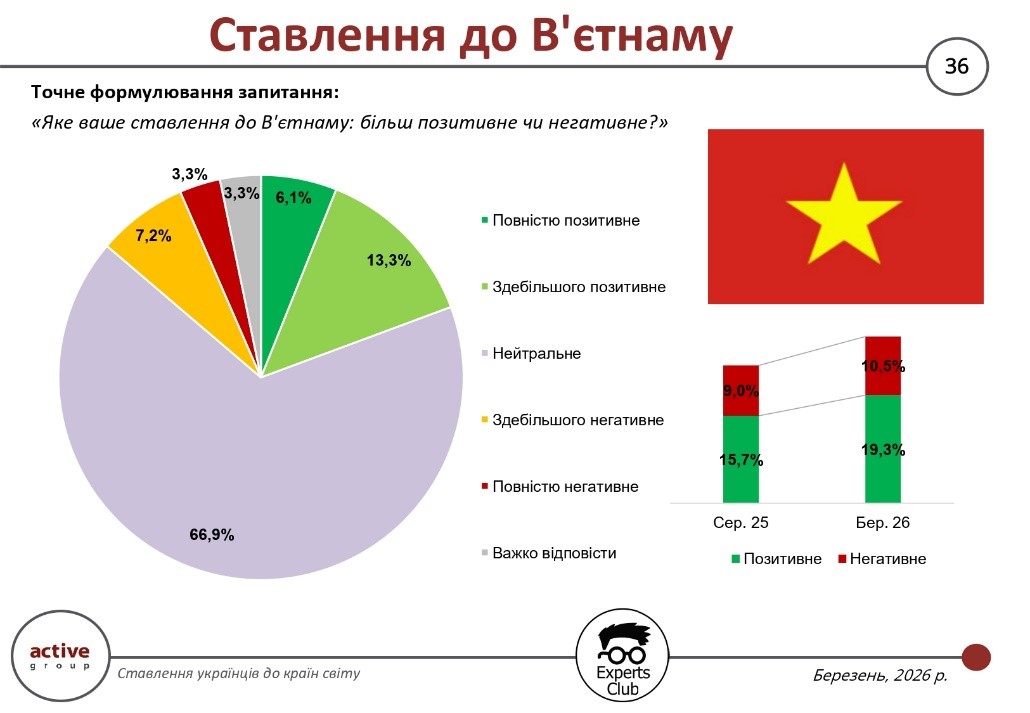
The results of a public opinion poll conducted in March 2026 by the research firm Active Group in collaboration with the Experts Club information and analytical center indicate that, for most Ukrainians, Vietnam remains a country with an undefined or neutral image. The largest share of respondents—66.9%—expressed a neutral attitude, which significantly distinguishes Vietnam from countries with a clearly formed positive or negative perception.
At the same time, the share of positive assessments has increased—to 19.3% compared to 15.7% in August 2025. Of these, 6.1% of respondents indicated a completely positive attitude, while another 13.3% described it as mostly positive. This indicates the gradual formation of a more defined positive image of the country, although this process is proceeding slowly.
Negative attitudes also increased slightly—from 9.0% to 10.5%. Specifically, 7.2% of respondents chose “mostly negative,” and 3.3% chose “completely negative.” The share of those who could not decide on an answer is 3.3%. Overall, these figures demonstrate a slight increase in the polarization of assessments while maintaining a high proportion of neutrality.
The dynamics of change indicate a gradual decrease in uncertainty: some respondents who previously had no formed opinion are beginning to lean toward either a positive or a negative assessment. At the same time, the absence of sharp changes in the structure of responses indicates that Vietnam does not yet occupy a prominent place in the focus of public opinion in Ukraine.
“When we see such a high level of neutral responses, it means that the country is effectively outside the active informational and social sphere. Ukrainians simply do not have enough contacts, experience, or cues to form a clear attitude. That is why any systematic presence—economic, cultural, or diplomatic—could quite quickly shift the balance of assessments in one direction or another,” noted Maksym Urakin, founder of the Experts Club information and analytical center.
Thus, Vietnam is currently characterized as a country with high potential for building a positive image in Ukraine; however, this potential largely depends on the intensity of interaction and the level of presence in the Ukrainian information space.
According to a study conducted by the Experts Club information and analytical center based on data from the State Customs Service, Vietnam ranks 23rd in total trade volume with Ukraine, with a figure of $1.16 billion. At the same time, imports of Vietnamese goods exceed exports from Ukraine by several times, resulting in a trade deficit of over $706 million.
The study was presented at the Interfax-Ukraine press center; the video can be viewed on the agency’s YouTube channel. The full version of the study can be found at this link on the Experts Club analytical center’s website.
ACTIVE GROUP, EXPERTS CLUB, Pozniy, SOCIOLOGY, SURVEY, UKRAINE, URAKIN, VIETNAM
The real estate markets of Vietnam, Thailand, Cambodia, and Bali will be in different phases of the cycle by 2026, but they share one common factor—the significant role of foreign demand. That said, the degree of dependence on foreign buyers, the supply structure, and price levels vary significantly across these markets.
Vietnam currently appears to be the most balanced of these markets. Here, the recovery is driven primarily by domestic demand, while foreigners play an important but not dominant role. In Hanoi, the average price of new apartments has already reached about $3,800 per square meter, while in the coastal city of Da Nang, the primary market stands at $2,200–2,300 per square meter. Foreigners can only purchase housing in approved commercial projects, cannot directly own land, and their share is limited by quotas, specifically to 30% of the apartments in a single condominium.
This is precisely why Vietnam remains largely a market for local buyers, while foreign demand is concentrated in the premium segment and in the largest cities. Among the key foreign groups in the market, citizens of South Korea, China, Singapore, Japan, and some overseas Vietnamese are typically cited. Russians are present mainly in resort locations, primarily in Nha Trang, while Ukrainians are also found among renters and individual buyers, but their share in publicly available statistics is not disclosed and remains niche.
Thailand, on the other hand, is much more dependent on external demand, especially in the condominium segment. According to REIC, in 2025, foreigners completed 14,899 condominium transactions, which is 2.2% more than the previous year. They accounted for 14.7% of all property transfers by volume and 25% by value. Chinese buyers retained the top spot among foreign buyers, Myanmar moved up to second place, and Russia remained among the largest groups.
In terms of prices, Thailand is significantly more expensive than Vietnam, especially in the capital and major resort areas. In Bangkok, the average price of condominiums in early 2026 was estimated at approximately $4,200–4,300 per square meter, and in central districts, the price was even higher. In Phuket, the median price of condominiums as of 2025 was about 144,000 baht per square meter, which corresponds to approximately $4,000 per square meter at the current exchange rate. The law allows foreigners to own units in condominiums but not the land, with the foreign quota in a project limited to 49% of the total area.
In Thailand, the role of foreigners is already directly influencing market dynamics in Bangkok, Pattaya, and especially Phuket. Russians remain one of the most prominent groups of buyers in resort regions, while Ukrainians, although not officially in the top 10, are considered by market estimates to be among the most active second-tier buyers and are primarily active in resort real estate.
Cambodia appears to be a riskier market, but also one more dependent on foreign capital. Following a boom and subsequent downturn, the market in Phnom Penh and Sihanoukville is recovering more slowly than in Thailand or Vietnam. In Phnom Penh, prices for condominiums in the business district are around $2,746 per square meter, and the market as a whole remains under pressure due to a high supply base and slower absorption.
The Cambodian market has historically been closely tied to Chinese capital, especially in Sihanoukville, and this dependence persists. Foreigners can purchase apartments but not land, making condominiums the primary vehicle for foreign investors. At the same time, there is virtually no comprehensive, up-to-date official breakdown of homebuyers by nationality available to the public. According to market reviews, the largest foreign groups remain the Chinese, as well as investors from South Korea, Singapore, and Malaysia. The presence of Russians and Ukrainians in this market remains limited and has no significant impact on the overall demand structure.
Bali occupies a special place among this quartet, as it is not a separate country but Indonesia’s most internationalized resort market. The driver here is not so much local demand as it is tourism, short-term rentals, digital nomads, and relocation. In 2025, Bali welcomed 6.33 million foreign tourists, a 9.7% increase from 2024, with Australia remaining the largest source market by visitor numbers.
Prices in Bali depend heavily on the property type and location. According to market surveys, the average selling price in 2025 was approximately $1,970 per square meter, and by early 2026, the average price in the villa market had risen to about $2,210 per square meter. At the same time, in the central areas of Badung, prices often exceeded $3,000 per square meter, and the average cost of villas, according to some surveys, rose from approximately $321,000 to $484,000 per property over 12 months. For foreigners, the primary option remains long-term leasehold, as direct land ownership is restricted.
Foreigners play a key role in Bali, but statistics on the nationalities of homebuyers here are less transparent than in Thailand. Based on tourism and market trends, Australians, British, Americans, and Russians are the most prominent. Since 2022, the market has also seen growing interest from Ukrainian citizens, primarily in the rental, relocation, and some investment purchase segments. However, as in Cambodia, there is no complete official breakdown by buyer nationality available to the public.
If we compare these four markets based on their market models, Vietnam currently appears to be the most internally stable and less dependent on foreigners. Thailand is the most transparent and institutionally developed market for foreign buyers, where the influence of foreign capital is already well-documented by statistics. Cambodia remains a more speculative market dependent on specific external groups. Bali, on the other hand, is a story of global mobility, tourism, and rental yields, where foreign demand effectively drives a significant portion of price dynamics.
In terms of price levels, capital cities and resorts also fall into different tiers. Bangkok and select projects in Phuket remain the most expensive in this group, followed by Hanoi. Da Nang and Phnom Penh fall within the mid-range price bracket, while in Bali the spread is particularly wide: from relatively affordable properties outside premium zones to expensive villas in Chang, Seminyak, and Bukit.
For an investor from Ukraine, this quartet looks like this: Thailand and Bali are the most straightforward markets for a resort strategy and rental income, but also the most dependent on external market conditions; Vietnam is more complex from a legal standpoint but has a strong domestic market; Cambodia is a potentially more profitable but also riskier market. At the same time, Ukrainians are already present in the Thai and Balinese markets, while in Vietnam they primarily operate as a niche group in resort locations.
Source: https://expertsclub.eu

In 2026, Vietnam’s real estate market is entering a phase of more sustained recovery following a period of correction, though growth no longer appears uniform across all segments. Key drivers remain the new legal framework for the market, the gradual removal of some administrative and financial restrictions, high domestic demand for housing, and sustained interest from foreign investors in specific projects. This is evidenced by data from Vietnam’s Ministry of Construction and assessments by market participants.
According to the Ministry of Construction, in 2025, apartment prices in Hanoi, Ho Chi Minh City, and a number of other major cities rose by 20–30% compared to 2024, and in some locations, growth exceeded 40%. The average primary price of apartments in Hanoi reached approximately $3,846 per square meter, making the capital one of the country’s most expensive markets. Selected market reviews at the end of 2025 also recorded a range of approximately $2,880–3,400 per square meter for new projects in Hanoi, and approximately $2,270–2,650 per square meter for the secondary market.
On the coast, the price picture is more varied. In Da Nang, considered one of the country’s key coastal markets, the average primary price of apartments in the first half of 2025 was around 58 million dong per square meter, equivalent to approximately $2,200–2,300 per square meter, while the secondary market was slightly lower—around $2,000–2,100 per square meter. At the same time, prices were significantly higher in certain premium seaside projects: for example, in Da Nang, at the Sun Symphony Residence project, they reached 115.6 million dong per square meter, or about $4,400–4,500 per square meter, and in Nha Trang, in the Grand Mark project, they were 38–47.2 million dong per square meter, or approximately $1,450–1,820 per square meter.
The overall market outlook remains mixed. On the one hand, the Ministry of Construction and industry experts expect the market to be more active in 2026, with end-consumer demand continuing to drive sales. On the other hand, the government and banks are tightening their approach to speculative lending, and rising mortgage rates and housing costs are limiting affordability, especially in the mass-market segment.
Legislative updates remain a key factor. New provisions of housing legislation took effect in Vietnam in August 2024, and by 2026, the market will already be operating under the new legal framework. For foreigners, this means more clearly defined—but still limited—rules for home ownership. Foreign nationals may purchase housing only in approved commercial projects, cannot own land directly, and the ownership limit for foreigners is up to 30% of apartments in a single building or block and up to 250 individual houses within an administrative unit of comparable level.
This is why the influence of foreigners on the Vietnamese market remains noticeable but not dominant. Local buyers drive the main demand, while foreigners are primarily focused on the premium segment, projects in major cities, and resort real estate. The most attractive locations for foreign buyers remain Ho Chi Minh City, Hanoi, Da Nang, and Nha Trang, where international demand is driven by business activity, tourism, and the expat community.
According to Vietnam News, foreign demand for housing in Hanoi in 2025 has grown significantly following the entry into force of the revised Housing Law 2023, with one contributing factor being the high concentration of foreign workers and businesses. Previously, government and industry sources also indicated that a significant portion of foreign demand in Vietnam is driven by citizens of South Korea, China, Singapore, Russia, and the United States.
However, no open and comprehensive official statistics on homebuyers in Vietnam broken down by nationality for the years 2025–2026 have been found in the public domain. As a result, it is currently impossible to compile a top 10 list of foreign nationalities of homebuyers based on government data. The most specific public data cited by the market pertains to individual projects and cities. In particular, CBRE previously reported that in Ho Chi Minh City, among foreign buyers who transacted through the company, Chinese buyers led with a 31% share, followed by South Koreans with 19%; while this is not nationwide statistics, it illustrates the demand structure in the most liquid segments.
Taking into account more recent market reports and the structure of foreign presence in Vietnam, it can be said that the main groups of foreign homebuyers include citizens of South Korea, China, Singapore, Taiwan, Japan, Hong Kong, the United States, as well as some overseas Vietnamese. Russians are present in the market primarily in resort locations, particularly in Nha Trang, where a significant Russian-speaking community has historically formed. Ukrainians are also among buyers and renters in resort areas; however, their share, like that of Russians, is not officially disclosed in national statistics and, according to available data, remains niche compared to the largest Asian groups.
Thus, Vietnam’s real estate market in 2026 is recovering primarily due to domestic demand, but foreigners continue to play an important role in the most expensive and liquid projects. An additional feature of the current cycle is the sharp gap between the capital and the coast: while in Hanoi the average price of new apartments has already approached $3,850 per square meter, in coastal markets such as Da Nang the average price remains at $2,200–2,300 per square meter, although the best coastal projects are already significantly more expensive.

The Vietnamese authorities have changed the procedure for applying for Temporary Residence Cards (TRCs): from February 2026, it will only be possible to submit documents directly within the country if you have an LD2 (work) or TT (family member) visa. Holders of other visas, including business visas, must now first go through the mandatory stage of converting their visa to the appropriate category before applying for a TRC.
According to estimates by the international consulting company Fragomen, the introduction of this additional step will increase the processing time for TRCs by approximately two weeks. Experts recommend first obtaining a work permit and then applying for the appropriate type of entry visa to avoid delays in legalizing your status.
The change effectively establishes a stricter “chain” of migration control: work permit – work visa – residence card, which increases the risks for those who enter on an e-visa or a “start-up” business visa and only then apply for work documents.
According to the World Bank (UN estimate on international migration), in mid-2024, there were about 326,400 international migrants (born outside the country) living in Vietnam, which corresponds to approximately 0.3% of the population.
At the same time, Vietnam received a record 21.2 million foreign visitors in 2025, with the largest markets being China (5.28 million), South Korea (4.33 million), Taiwan (1.23 million), the United States (849,000), Japan (814,000), India (746,500), Russia (689,700), Cambodia (687,100), Malaysia (573,700), and Australia (548,500). Ukraine is not included in the top 10 markets in the summary.

On January 20, 2026, the 14th National Congress of the Communist Party of Vietnam (CPV) was officially opened at the National Convention Center in Hanoi. Held every five years, this is an important political event for the country, ushering in a new era of national development.
This congress brought together more than 1,500 delegates to discuss strategic issues for the country in the fields of politics, diplomacy, and economics.
The congress was attended by 111 ambassadors, chargés d’affaires of various countries, as well as heads of diplomatic missions and international organizations in Vietnam.
The opening session of the Congress was chaired by Vietnamese Prime Minister Pham Minh Chinh on behalf of the Presidium. After that, Vietnamese President General Luong Quang delivered an opening speech to the Congress, in which he presented the main theses and tasks of the country’s development vision and emphasized the beginning of a new page in Vietnam’s domestic and foreign policy.
In his speech, the President stressed that Vietnam prioritizes economic development, building on the achievements of 40 years of reform and creating a solid foundation for the country’s further development in a new era, pursuing an independent, self-reliant, multilateral, and diversified foreign policy, harmoniously managing relations with partners, especially with major powers, neighboring countries, and important partners.
Therefore, one of the central topics discussed and decided at this congress was the focus on the goal of high economic growth over the next five years.
• The Vietnamese economy is currently in a boom phase with GDP growth rates of 7.09% in 2024 compared to the previous year and an estimated 8.02% in 2025.
• Vietnam aims to achieve annual economic growth of at least 10% over the next five years, while maintaining macroeconomic stability and controlling inflation.
• Unlike many countries, where strategic documents are often dependent on political cycles, Vietnam declares an approach focused on consistency, institutional continuity, and development in clearly defined stages.

Secretary General of the CPC Central Committee, Chairman of the Document Subcommittee Mr. To Lam presented the 13th Central Committee’s report on the documents of the 14th Party Congress.
In his speech, he reaffirmed the strategic vision, spirit of innovation, and need for decisive action for a new stage of national development. “The 14th National Party Congress marks an important event, opening a new chapter in the country’s development under new conditions, situations, and goals; it is a congress of strategic autonomy, independence, self-reliance, national pride, aspirations for progress, and unwavering faith in the path chosen by the Party, President Ho Chi Minh, and our people,” said the General Secretary.
To achieve the country’s development goals in the near term, emphasis is placed on key guiding principles that are considered a strategic “launch pad” for realizing the goal of transforming Vietnam into a developed country with a high income level by 2045, namely:
1. Strategic decisions on economic development and domestic policy, with an emphasis on technology, innovation, and digital transformation (Active introduction of digital technologies into all areas of life and governance, identifying them as a new driver of growth, linked to artificial intelligence (AI), digital government, and digital society).
The prioritization of science, technology, digital transformation, and artificial intelligence is in line with global trends.
At the same time, Vietnam declares its desire to combine technological modernization with the development of its own human resources and internal competencies. This approach is characteristic of countries seeking to transition from the role of production sites to participants in higher-level technological and innovation chains.
2. Institutional reforms and strengthening of public administration
Significant emphasis is placed on improving institutional architecture: optimising the administrative system, decentralisation and developing the legal environment.
In a comparative context, this brings Vietnam closer to development models where institutional capacity is seen as a key driver of sustainable growth, rather than just a supporting element of a market economy.
3. Energy transformation is seen not as an environmental policy, but as an economic prerequisite for maintaining export competitiveness.
The Joint Energy Transition Partnership (JETP) and aggressive development of renewable energy should ensure compliance with the decarbonization requirements of global supply chains.
4. Anti-corruption campaign (“Blazing Furnace”) and management balance
The anti-corruption campaign will be shifted from political mobilization to an institutional format.
The key challenge remains overcoming the so-called “fear of signing” — bureaucratic paralysis that slows down the implementation of infrastructure and investment projects. The focus is expected to be on the digitalization of control and a clearer division of responsibilities.
5. Comprehensively develop the cultural and social spheres, improve people’s living standards, and ensure social security.
6. Confirm the course of independence and multi-vector foreign policy.
The confirmation of a multi-vector foreign policy indicates Vietnam’s intention to maintain strategic autonomy in the face of growing global competition.
Vietnam’s declared strategic course combines:
• long-term state planning;
• ambitious economic growth targets;
• institutional and administrative reforms;
• selective technological modernization;
• the pursuit of foreign policy balance.
Taken together, this forms a pragmatic development model that differs from both liberalized market approaches and rigidly centralized economic systems, reflecting an attempt to adapt to conditions of global uncertainty.



