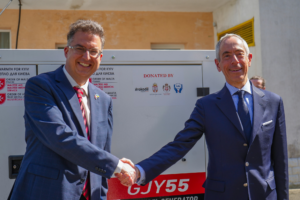
The ‘Kapitoshka’ nursery school in Bucha, Kyiv Oblast, has received a diesel generator and a modern backup power system as part of an international aid initiative, according to Andon Sapundži, Serbia’s ambassador to Ukraine, on his Facebook page.
The facility was provided with a 35 kW (or 44 kVA) diesel generator, as well as a hybrid backup power system comprising an inverter and batteries. The equipment is intended to ensure the nursery’s uninterrupted operation in the event of external power cuts.
According to the Education Department of Bucha City Council, ‘Kapitoshka’ previously had no alternative power sources. The installed system will enable the nursery to increase its energy independence and maintain stable conditions for the children even during potential power cuts.
According to the Telegram channel Serbian Economist, the aid was delivered by the Maltese Relief Service as part of the Sovereign Order of Malta’s Warmth for Ukraine programme. An international delegation, comprising diplomatic representatives and deputy heads of mission from the Sovereign Order of Malta, Serbia, Montenegro, Albania, Azerbaijan, Indonesia, Croatia, Poland and North Macedonia, visited the nursery where the equipment has already been installed.
“Unfortunately, modern wars share one common characteristic. They primarily target those most affected by the war. And we must protect these people,” said Antonio Gazzanti Puliese di Cotrone, Ambassador of the Sovereign Order of Malta to Ukraine.
“That is why I am particularly pleased that a project aimed at meeting the needs of children has been completed. This is for the future of Ukraine and for the whole world,” he added.
Andon Sapundži, Serbia’s Ambassador to Ukraine, emphasised the significance of the project for Bucha and its residents.
“This town and its residents are heroes who stood firm in the face of the horrific crimes of 2022. Your courage and unity are an example to us all. The launch of the hybrid energy system at the ‘Kapitoshka’ nursery is not only a technical foundation but also a symbol of care for the future. This project is the result of joint efforts and international solidarity,” he said.
Taras Shapravsky, Secretary of the Bucha City Council, noted that a difficult winter may lie ahead, which is why such support is particularly important for the community’s education sector.
Nikita Gerashchenko spoke on behalf of the Kyiv Regional State Administration. He stated that thanks to the implementation of such projects, more educational and social infrastructure facilities are becoming energy-independent and energy-efficient.
For Serbia, participation in such humanitarian projects has not only diplomatic but also practical significance. Belgrade has not officially joined the EU’s anti-Russian sanctions, but is providing humanitarian support to Ukraine, including through international frameworks and assistance to civil infrastructure.
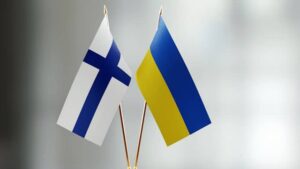
Finland has announced that it will allocate €72 million in humanitarian aid, of which €20 million will go to Ukraine, according to the Finnish government’s website.
“A total of €20 million in humanitarian aid will be allocated to Ukraine from the budget item ‘Support for Ukraine’. The aid will be provided through UN humanitarian organizations and the International Committee of the Red Cross (ICRC),” the statement said.
The organizations will, in particular, respond to people’s winter needs and heating requirements by distributing, among other things, heaters, fuel, clothing, and cash assistance, as well as helping to repair houses, water, electricity, and heating systems damaged during the attacks.
Finland will allocate EUR6 million to the UN Refugee Agency (UNHCR), EUR6 million to the World Food Programme (WFP), EUR 5 million to the ICRC, and EUR 3 million to the Ukraine Assistance Basket Fund of the UN Office for the Coordination of Humanitarian Affairs (OCHA), from which funds will be distributed at the local level according to needs.
“Russian attacks are making it much more difficult for people living in the midst of war to survive in winter conditions in Ukraine. Supporting access to energy and heat is particularly important now, as the need for humanitarian support is acute. Our increased assistance is helping people with basic needs. Finland supports Ukraine,” said Minister for Foreign Trade and Development Ville Tavio.
In its humanitarian aid decisions for the beginning of the year, Finland, in addition to Ukraine, emphasizes the main areas of conflict and refugee crises in Africa, as well as the humanitarian situation in the Middle East.
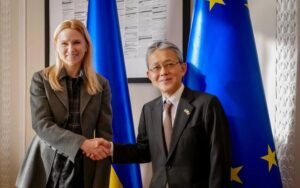
In 2026, Ukraine will receive $6 billion from the Japanese government for humanitarian and technical support, according to Deputy Speaker of the Verkhovna Rada Olena Kondratiuk.
“The Rada at our first official meeting with Japanese Ambassador to Ukraine Masashi Nakagome… Japan has already provided Ukraine with more than 2,500 electric generators of various capacities, more than 65 transformers and 10 electric generator sets, and other critical equipment to support and restore the power system,” she wrote on her Facebook page on Wednesday.
Kondratyuk also expressed gratitude for the allocation of approximately $149 million in the supplementary budget approved by the Japanese parliament at the end of 2025 for projects under the Emergency Recovery Program for Ukraine.
She noted that Japan’s total financial and humanitarian assistance has already exceeded $15 billion.
In addition, Japan is assisting with the rehabilitation of Ukrainian military personnel, has joined the International Coalition for the Return of Ukrainian Children, and has voted in favor of recent pro-Ukrainian resolutions at the UN. In particular, Japan co-authored and supported the resolution “Return of Ukrainian Children.”
“It is important that Japan, as a G7 country, is putting sanctions pressure on Russia and supporting the prosecution of the aggressor country. This includes through the mechanism of the Special International Tribunal. I am convinced that only joint sanctions by all G7 countries, including the US and Europe, can force Russia to engage in peace talks,” Kondratyuk added.
As for the meeting itself, the parties discussed interparliamentary cooperation and the situation with the announcement of early parliamentary elections in Japan, which are scheduled for February 8, 2026.
In turn, Ambassador Masashi Nakagome noted that the vast majority of Japan’s key political forces support Ukraine. According to him, Japan will continue to provide financial and humanitarian assistance to Ukraine.

The United Nations is short of more than a billion dollars to provide humanitarian aid to Ukraine in 2025, UN Emergency Relief Coordinator for Ukraine Matthias Schmale said at a briefing in Geneva, Deutsche Welle reports.
He noted that about four million Ukrainian residents received humanitarian aid this year, but funding remains insufficient.
“This year, donors have provided only $1.15 billion, which is 44% of the total amount estimated to be needed for humanitarian aid to Ukraine,” Schmale said.
According to the UN, due to massive Russian strikes, part of Ukraine’s energy, water, and heating systems remain paralyzed, so with winter approaching, the affected regions need urgent support.
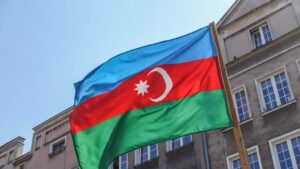
Ukraine received a new batch of humanitarian aid from Azerbaijan to restore energy infrastructure damaged during the armed conflict, according to Ukrainian and Azerbaijani press services.
The aid consists of the supply of electrical equipment worth $2 million, approved by a decree of the President of the Republic of Azerbaijan, Ilham Aliyev, dated August 11, 2025, with funds from the presidential reserve fund and the 2025 state budget. The equipment includes generators, transformers, and electrical cables manufactured in Azerbaijan.
The first batch of aid — about 10 trucks sent from the Sumgait Technology Park — contains about 90,000 meters of electrical cables, 25 generators, and seven sets of transformers. They are intended to restore stable power supply in regions of Ukraine destroyed by Russian strikes.
Ukrainian President Volodymyr Zelensky and Azerbaijani President Ilham Aliyev discussed energy cooperation and interaction with the US and European partners during a telephone conversation on August 10. The parties emphasized that the assistance is based on the principles of humanism and partnership enshrined in bilateral agreements, including the 2000 Treaty on Friendship, Cooperation, and Partnership and the 2008 Declaration on Strategic Partnership.
Diplomatic relations between Ukraine and the Republic of Azerbaijan were established on February 6, 1992, when Azerbaijan officially recognized Ukraine’s independence. The Ukrainian Embassy in Baku began operating in 1996, and the Azerbaijani Embassy in Kyiv in 1997.