

Sweden, Finland, and Estonia plan to lay a telecommunications cable between the three countries along the bottom of the Baltic Sea, the Estonian broadcaster ERR reported on Wednesday.
“The project developer and owner of the future infrastructure is GlobalConnect AB, a telecommunications company registered in Sweden. The same company is organizing the surveys necessary for project preparation,” the report states.
The cable will run along the seabed from the Swedish island of Gotland to the Estonian islands of Saaremaa and Hiiumaa, then connect to the Estonian mainland, and finally continue along the seabed to Helsinki.
“In Estonia, the project involves both submarine and terrestrial fiber-optic communication cables,” Tinu Nirk, head of the Communications Markets Department at the Ministry of Justice and Digital Technologies, told ERR. The total length of the terrestrial cable route in Estonia is expected to be 250 km; undersea connections to Finland,
Sweden, and the major islands will add another 300 km.
Construction of the cable will cost approximately EUR40 million, of which EUR15.7 million will be provided by the European Union’s Cohesion Fund.
Currently, there are two communication lines between Estonia and Sweden, and six between Estonia and Finland. However, various cables and pipes have been damaged at sea on multiple occasions in recent years, so a new alternative connection is needed, Nirk stated.
According to him, demand for data transmission is constantly growing, and the new connection will increase data transmission capacity across networks in the Baltic Sea region.
Preparations for the project began in 2025. Cable laying is scheduled for this year and next, and the connection is set to become operational in 2027.
ESTONIA, FINLAND, INFRASTRUCTURE, SWEDEN, telecommunications
Sweden remains among the countries with the highest level of positive perception among Ukrainians: in August 2026, 71.4% of respondents expressed a positive attitude toward it, while only 0.8% expressed a negative one. Compared to March, the share of positive assessments decreased slightly, but negative attitudes also declined, according to the Experts Club Information and Analytical Center.
According to the results of the August survey, 31.9% of Ukrainians have a completely positive attitude toward Sweden, and 39.5% have a mostly positive attitude. A neutral stance is held by 26.2% of respondents. Only 0.8% view the country mostly negatively; no entirely negative assessments were recorded in the survey, and another 1.6% were undecided.
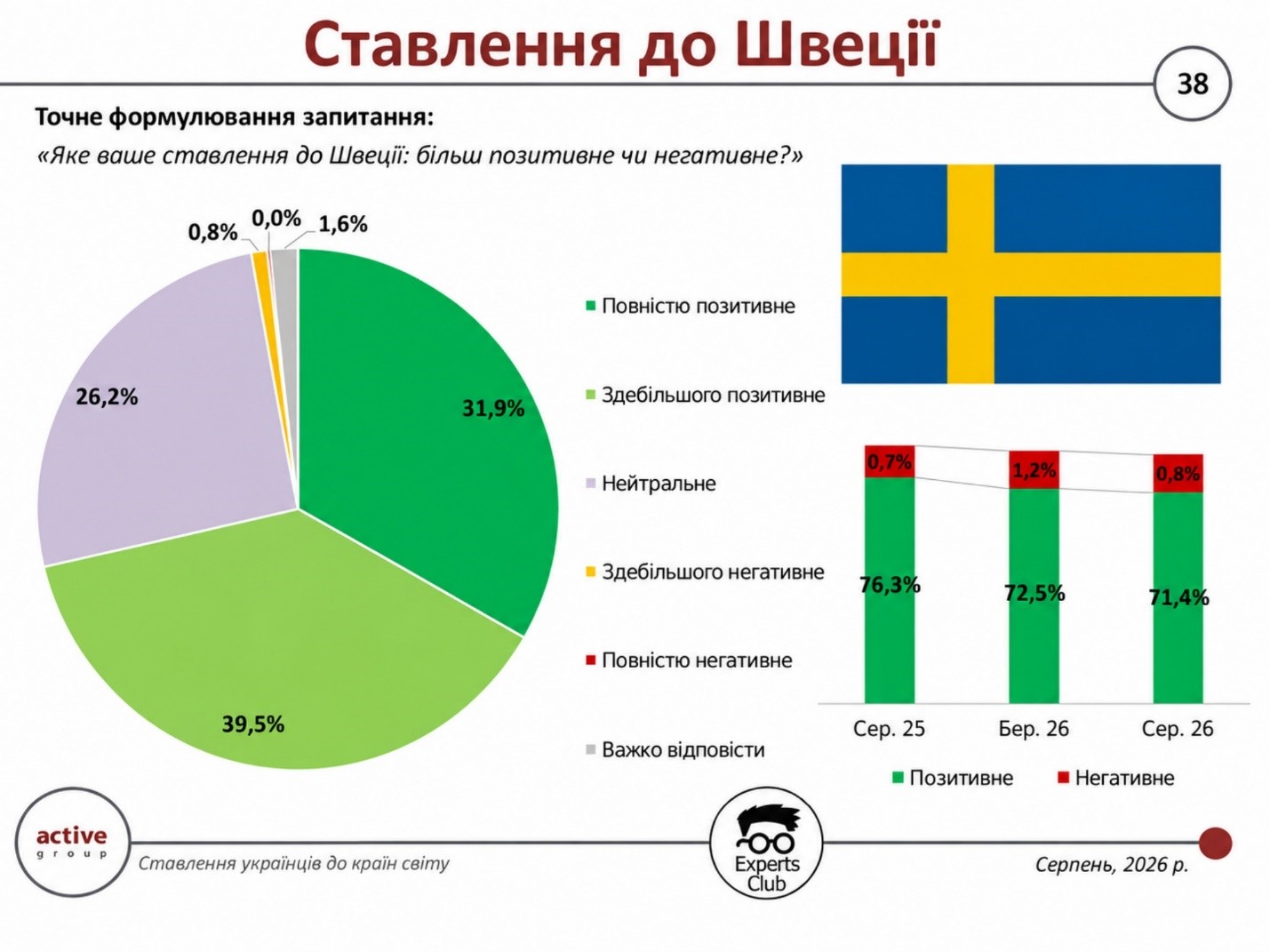
The balance between positive and negative assessments stands at plus 70.6 percentage points. By this measure, Sweden ranks among the highest of all countries included in the study. Positive attitudes outnumber negative ones by nearly 90 to 1.
In March 2026, 72.5% of respondents viewed Sweden positively: 35% viewed it entirely positively and 37.5% viewed it mostly positively. At that time, 24.7% of respondents held a neutral stance, while negative attitudes accounted for about 1.2%.
Thus, over the course of five months, the share of positive assessments decreased by only 1.1 percentage points—from 72.5% to 71.4%. Negative responses decreased by 0.4 percentage points, while the neutral segment increased by 1.5 percentage points—from 24.7% to 26.2%. The balance between positive and negative attitudes remained virtually unchanged—from approximately plus 71.3 to plus 70.6 percentage points.
At the same time, there was a certain redistribution within the positive segment. The share of fully positive assessments decreased from 35% to 31.9%, while the share of mostly positive assessments rose from 37.5% to 39.5%. This indicates a moderate decline in the intensity of positive attitudes rather than a deterioration in the country’s overall image.
Oleksandr Pozniy, director of the research firm Active Group, commented on the previous wave of the survey by highlighting the stability of Ukrainians’ attitudes toward Sweden.
“Sweden remains a country with a very high level of trust among Ukrainians, and this is evident from the structure of the responses. At the same time, we are observing a certain increase in the share of neutral assessments, which indicates not a change in attitude but a decrease in its intensity. This is a typical effect for countries that are not constantly in the spotlight,” Pozniy noted.
The new results effectively confirm this trend. The proportion of neutral responses continued to rise moderately, but this was not accompanied by an increase in negative attitudes. Sweden remains one of the countries with the most consistently positive image in Ukrainian society.
The previous wave of the survey was conducted in March 2026 among 800 Ukrainian citizens aged 18 and older using self-administered online questionnaires in the SunFlowerSociology panel. The sample was representative by age, gender, and region; the maximum theoretical margin of error for indicators at the 50% confidence level was ±3.5 percentage points.
ACTIVE GROUP, EXPERTS CLUB, international relations, NORTHERN EUROPE, Pozniy, PUBLIC OPINION, SOCIOLOGY, SWEDEN, UKRAINE
According to Experts Club, Ukrainians’ attitudes toward the United Kingdom, the Scandinavian countries, and the Baltic states remain predominantly positive: in August 2026, the share of positive assessments for the countries included in the study ranged from 66.9% to 72.6%. At the same time, the balance between positive and negative attitudes toward all countries in this group has declined slightly compared to the previous survey wave in March 2026. This is evidenced by the results of a study conducted by Active Group and the Experts Club Information and Analytical Center, reports the Experts Club Information and Analytical Center.
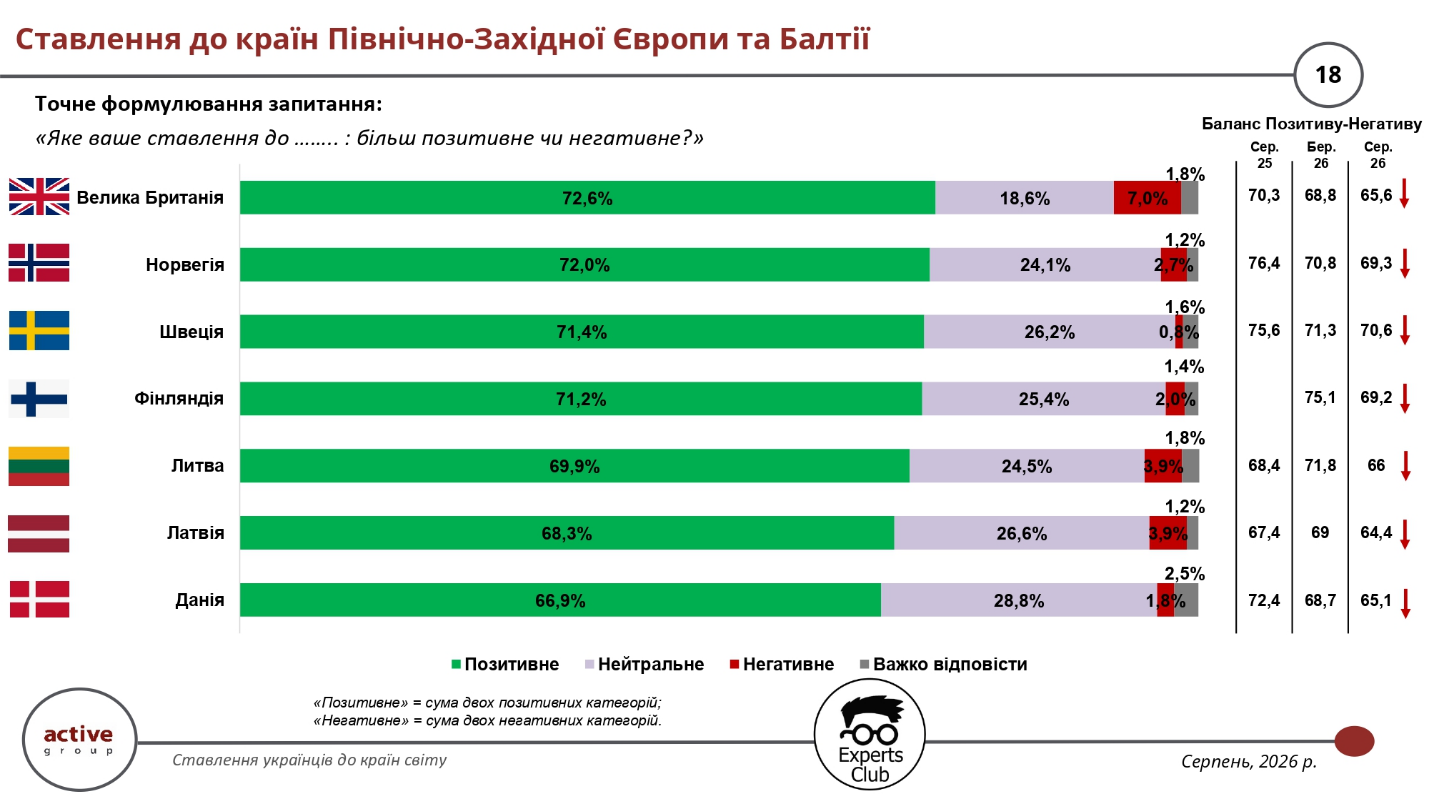
The United Kingdom received the highest share of positive assessments in the group—72.6%. 18.6% of respondents had a neutral attitude toward it, 7% had a negative attitude, and another 1.8% were undecided. The balance of positive and negative assessments stands at 65.6 percentage points, compared to 68.8 percentage points in March 2026 and 70.3 percentage points in August 2025.
Seventy-two percent of Ukrainians view Norway positively, while only 2.7% view it negatively, resulting in a balance of 69.3 percentage points. In March, this balance stood at 70.8 percentage points, and in August of last year, at 76.4 percentage points. Sweden has 71.4% positive and only 0.8% negative assessments—its balance stands at 70.6 percentage points and is the highest among the countries presented on the slide. Overall, the study records approximately 67–73% positive ratings for the countries of Northwestern Europe and the Baltic states.
71.2% of respondents view Finland positively, 25.4% neutrally, and 2% negatively. The balance stands at 69.2 percentage points, down from 75.1 percentage points in March. Lithuania is viewed positively by 69.9% of respondents and negatively by 3.9%; the balance fell from 71.8 percentage points in March to 66 percentage points in August.
A positive attitude toward Latvia was expressed by 68.3% of respondents, a neutral one by 26.6%, and a negative one by 3.9%. Its balance stands at 64.4 percentage points, compared to 69 percentage points in March. For Denmark, the corresponding figures are 66.9% positive, 28.8% neutral, and 1.8% negative assessments, with a balance of 65.1 percentage points, compared to 68.7 percentage points in the previous survey wave.
Maksym Urakin, founder of the Experts Club Information and Analytical Center, deputy director of the Interfax-Ukraine news agency, and candidate of economic sciences, emphasized the importance of constant communication between foreign partners and Ukrainian society.
“The first recommendation is to regularly showcase concrete achievements and concrete actions. Second, be open to questions and inquiries from the media and the public,” Urakin noted. According to him, the results of sociological surveys can be used to strengthen bilateral relations, particularly trade relations.
Alexander Pozniy, director of the research company Active Group, also drew attention to the need to combine public perceptions of countries with the development of practical economic cooperation.
“We should do more than just raise general awareness. We need to expand cooperation with countries where we can maintain a positive balance,” Pozniy noted. He also emphasized the role of business associations and government agencies in developing bilateral economic ties.
Overall, the results show that Northern and Northwestern Europe, along with the Baltic states, continue to enjoy a high level of positive perception among Ukrainians. At the same time, the decline in the balance compared to March 2026 indicates that even regarding countries with traditionally high ratings, public opinion is not static. In the overall ranking, Sweden, Finland, Norway, Lithuania, and the United Kingdom were among the top ten countries with the highest net sentiment.
The survey was conducted in August 2026 using self-administered online questionnaires via the SunFlowerSociology panel. It included 800 Ukrainian citizens aged 18 and older. The sample is representative by age, gender, and region; the stated maximum theoretical margin of error is ±3.5 percentage points. This is the third wave of the study, following surveys conducted in August 2025 and March 2026.
ACTIVE GROUP, DENMARK, EXPERTS CLUB, FINLAND, LATVIA, LITHUANIA, NORWAY, SOCIOLOGY, SWEDEN, UKRAINE, UNITED KINGDOM
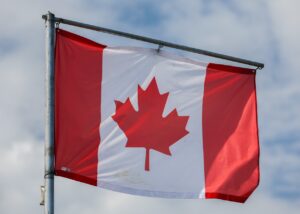
Canada ranked first among countries with the highest net positive sentiment among Ukrainians—in August 2026, this figure stood at 73.8 percentage points. The top ten also included mainly countries from Northern and Western Europe, according to the results of the third wave of the study “Ukrainians’ Attitudes Toward Countries Around the World,” conducted by Active Group in collaboration with Experts Club, reports the Experts Club Information and Analytical Center.
Sweden took second place in terms of the balance of trust and distrust with a score of 70.6 percentage points, while the Netherlands came in third with 69.7 percentage points. Finland and Norway each scored 69.3 points, France scored 69.1 points, Italy scored 67.1 points, and Lithuania scored 65.9 points. Rounding out the top ten are Switzerland and the United Kingdom, which both scored 65.6 percentage points.
The sentiment score is calculated as the difference between the proportion of positive and negative ratings. Specifically, 76.3% of respondents view Canada positively, 2.5% negatively, and 19.2% neutrally. Thus, Canada’s high score is due not only to a significant proportion of favorable ratings but also to a minimal level of negative sentiment.
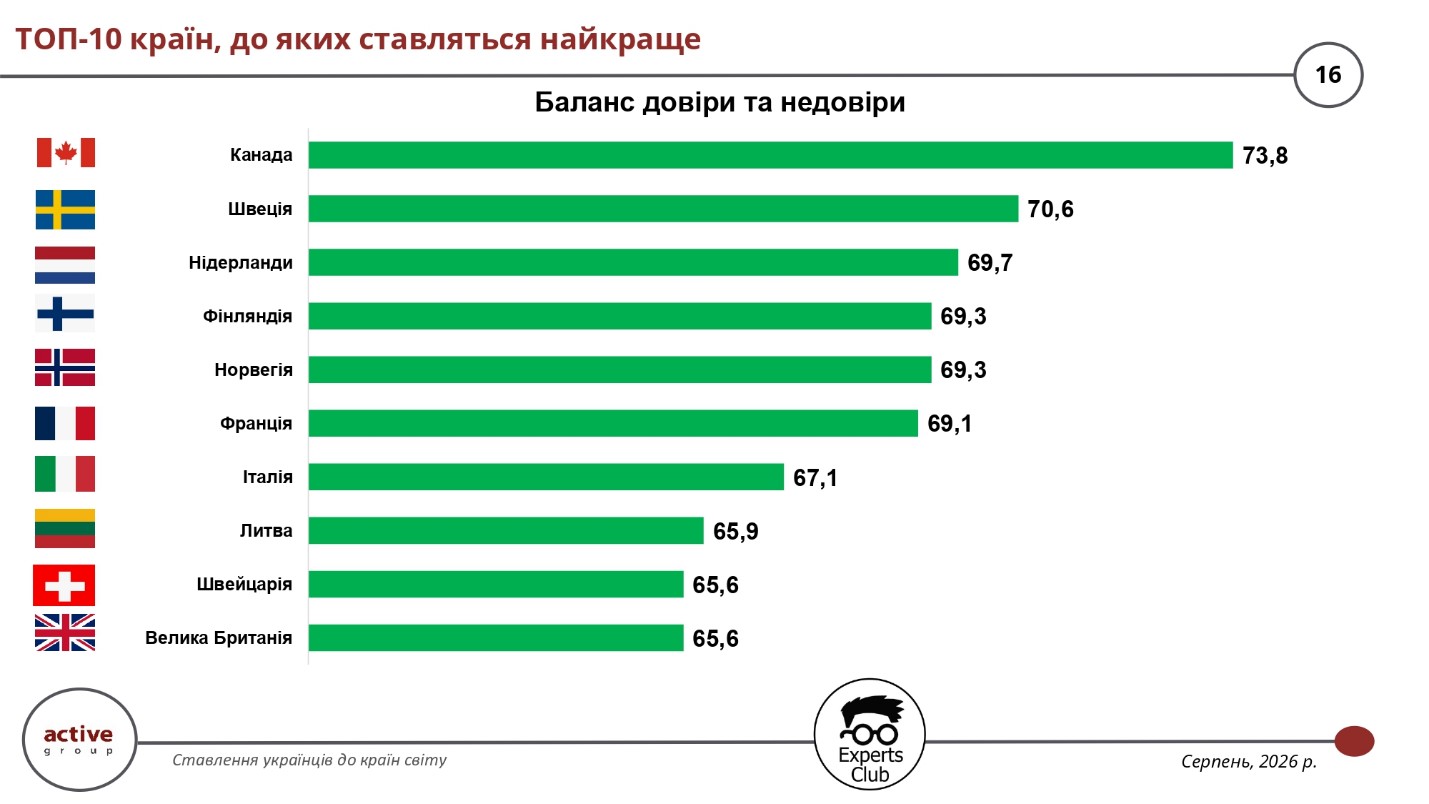
The survey results show that the top ten countries with the most favorable balance of attitudes consist almost entirely of countries in Northern and Western Europe, along with Canada. At the same time, the level of public favor does not always directly correspond to the scale of Ukraine’s trade and economic ties with a specific country. For example, China was Ukraine’s largest trading partner in the first half of 2026, yet it received the lowest balance of positive and negative assessments—minus 25.4 percentage points.
Maksym Urakin, founder of Experts Club, deputy director of the Interfax-Ukraine news agency, and candidate of economic sciences, emphasized that studies of public perception should be considered alongside actual foreign trade indicators.
“That is why it is very important for us to analyze our main partners. We must be open to questions and inquiries from the media and the public,” Urakin noted. According to him, the results of sociological surveys can be used to assess international relations and their further development.
Alexander Pozniy, Director of Active Group, drew attention to the need to combine the creation of a positive image of countries with the practical development of bilateral economic ties.
“We should focus on developing more than just general awareness. We need to expand cooperation with countries where we can achieve a positive balance,” Pozniy noted. According to him, both government agencies and business associations should be involved in this process.
The survey was conducted in August 2026 using self-administered online questionnaires via the SunFlowerSociology panel. A total of 800 Ukrainian citizens aged 18 and older were surveyed. According to the organizers, the sample is representative in terms of age, gender, and region; the maximum theoretical statistical margin of error at a 95% confidence level is 3.5%. This is the third wave of the survey, following surveys conducted in August 2025 and March 2026.
ACTIVE GROUP, CANADA, EXPERTS CLUB, FINLAND, international relations, NORWAY, SOCIOLOGY, SWEDEN, THE NETHERLANDS, UKRAINE, URAKIN
The Swedish Parliament has approved stricter rules for obtaining citizenship: starting June 6, 2026, the minimum total period of residence in the country required to apply for a passport will increase from five to eight years.
The new rules apply to adult applicants. The Swedish Migration Agency notes that different timeframes will apply to certain groups, but the basic requirement is being increased to eight years. Stricter criteria for “an orderly life” are also being introduced: individuals who have committed crimes will have to wait longer before obtaining citizenship.
The reform is part of a broader policy by the Swedish government to tighten immigration rules. In addition to extending the residency requirement, authorities also plan to introduce mandatory requirements regarding knowledge of the Swedish language, basic social studies, and the financial independence of applicants. According to Reuters, the government had previously proposed requiring applicants to have an income of over 20,000 Swedish kronor per month, as well as passing language and social studies tests.
The U.S. Library of Congress, analyzing the Riksdag’s decision, notes that the new residency requirements will take effect on June 6, 2026. At the same time, the language test is set to take effect on October 1, 2027, or earlier if the government so decides, while the social studies test will be introduced on a date determined by the Cabinet.
One of the most controversial aspects of the reform is the lack of a full transition period. More than 100,000 people whose applications are already under review may be affected by the new rules. This means that some applicants who were counting on the previous five-year period may be denied or forced to wait longer.
For foreigners who were planning to naturalize in Sweden, the reform significantly extends the waiting period. This could have a particularly noticeable impact on labor migrants, refugees, foreign professionals, and families who have been living in the country for several years and made plans based on the previous rules.
In recent years, Sweden has been consistently tightening its immigration policy following a long period of a more liberal approach to accepting foreigners. Authorities explain the changes by the need to strengthen integration, raise requirements for language proficiency and self-sufficiency among migrants, and bolster trust in the institution of citizenship. Critics of the reform warn that the retroactive application of the new rules could create legal uncertainty and reduce the country’s appeal to skilled professionals.
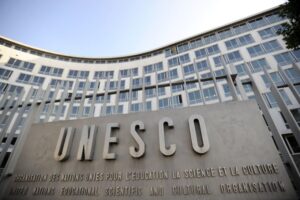
Ukraine will receive $1.3 million from Sweden through UNESCO in 2026–2027 to implement projects aimed at preserving cultural heritage—particularly at the Khortytsia National Reserve—and strengthening institutional capacity, Foreign Minister Andriy Sibiga announced.
According to him, Sweden is providing this support to protect Ukraine’s cultural heritage sites threatened by the war.
Sybiha noted that Russia’s brutal and aggressive war against Ukraine aims to destroy cultural heritage and undermine the country’s cultural identity.
“Sweden’s support will ensure the protection and preservation of Ukrainian cultural heritage sites threatened by Russia’s war against Ukraine. Protecting culture means preserving our identity and resilience, which is vital for the future of Ukraine and all of Europe. I thank Sweden for its support of Ukraine,” the minister noted in a post on social media.



