
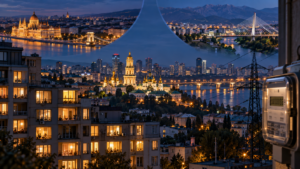
Kyiv ranked first among 33 European capitals for the lowest electricity costs for households in September 2026, reports the Experts Club information and analytical center. The cost of one kilowatt-hour, including taxes, in the Ukrainian capital was 8.4 euro cents, according to data from the international Household Energy Price Index (HEPI) study, published by Euronews Business on October 14.
Budapest ranked second at 10.3 euro cents per kWh, while Podgorica came third, where electricity cost 11.3 euro cents. The five cheapest capitals also included Belgrade (11.6 euro cents) and Valletta (12.3 euro cents).
The average cost of electricity in the capitals of European Union countries was 27.2 euro cents per kWh. Thus, electricity in Kyiv was approximately 69.1% cheaper than the EU average, in Budapest 62.1% cheaper, in Podgorica 58.5% cheaper, and in Belgrade 57.4% cheaper.
The most expensive electricity for households was recorded in Brussels, where the price reached 41.3 euro cents per kWh. It was followed by Berlin (39.6), Dublin (38.7), Bern (38.6) and London (38.3).
Among other European capitals, high tariffs were recorded in Rome (36.6 euro cents), Vienna (34.4) and Prague (34.3). In Madrid, electricity cost 28.3 euro cents per kWh, and in Paris, 28.1 euro cents.
The difference between the most expensive and the cheapest capitals was almost fivefold: 41.3 euro cents in Brussels compared with 8.4 euro cents in Kyiv.
According to HEPI, from the beginning of February to the beginning of September 2026, the average cost of electricity for households in EU capitals increased by 4.2%. Meanwhile, natural gas prices rose by 12% over the same period.
The differences between European capitals are explained by the structure of their energy mix, dependence on imported energy resources, tariff policies, taxes and government mechanisms for supporting households.
At the same time, researchers emphasize that comparing nominal tariffs does not fully reflect the affordability of electricity for the population. When purchasing power is taken into account, the ranking changes significantly, as household incomes and overall price levels differ considerably across European countries.
The Household Energy Price Index study has been conducted monthly since 2009 with the participation of the Austrian energy regulator Energie-Control, the Hungarian regulator MEKH and the international consulting company VaasaETT. It covers 33 European capitals and takes into account supplier tariffs, network charges, taxes and government subsidies.
Both directions of cross-border electricity trade increased during the period of October 5–11: imports rose by 6% compared to the previous week—to 13,100 MWh—while exports rose by 20%—to 176,400 MWh.
“Despite localized restrictions, Ukraine remained a net exporter throughout the week,” the DIXI Group analytical center reported on Tuesday, citing data from Energy Map.
As previously reported, since October 6, due to Russian attacks on energy infrastructure, power restriction schedules (PRS) for industry and businesses and hourly blackout schedules (HBS) for the general public have been in effect in some regions of Ukraine.
However, even amid localized restrictions, Ukraine remained a net exporter throughout the past week due to a power surplus in other regions. This situation was caused by the inability to transmit power to certain regions and cities because the enemy had damaged transmission grids, substations, and distribution lines—particularly near major cities.
According to Energy Map, Hungary accounted for the largest share of exports that week—84,900 MWh, or 48.1%. Moldova accounted for 56,600 MWh (32.1%), Romania for 33,100 MWh (18.7%), and Poland for 1,800 MWh (1.0%).
Exports to Hungary, Romania, and Moldova increased by 15%–26%, and exports to Poland increased eightfold, though the volumes remained insignificant. No electricity was sold to Slovakia. The average daily export volume for the week was 25.2 thousand MWh.
Hungary remained the main source of imports, accounting for 8.7 thousand MWh (66.6%). Romania accounted for 3.6 thousand MWh (27.6%), Poland for 0.7 thousand MWh (5.5%), and Moldova for 0.05 thousand MWh (0.4%).
Imports from Romania and Moldova increased by 70% and 124%, respectively, while those from Hungary and Poland decreased by 3% and 39%. There were no deliveries from Slovakia for five consecutive weeks. The average daily import volume was 1.9 thousand MWh.
As previously reported, the week before last, from September 28 to October 4, electricity exports rose by 75.6% compared to the previous week—to 147.0 thousand MWh, marking the highest weekly export volume since September 2025.
Electricity imports in September 2026 fell by 58.6% compared to August—to 76.1 thousand MWh, the lowest figure since November 2023, while exports rose by 24.4% to 473,700 MWh, marking the highest monthly volume since September 2025.
“As a result, Ukraine has been a net exporter for the third consecutive month, with sales exceeding purchases by a factor of 6.2,” the DIXI Group analytical center reported on Thursday, citing data from Energy Map.
As the center noted, weather remained the main factor driving foreign trade dynamics. September was noticeably cooler than August: the need for air conditioning had subsided, and the heating season had not yet begun, so demand remained moderate. At the same time, shorter daylight hours and cloud cover reduced output from residential and industrial solar power plants.
The price situation remained favorable for exports. In September, the average BASE baseload electricity price index on Ukraine’s day-ahead market (DAM) stood at EUR116.2/MWh—29–50% lower than in neighboring markets: in Poland – EUR149.8/MWh, Slovakia – EUR163.8/MWh, and Romania – EUR174.4/MWh.
However, as explained by DIXI Group, the SWAM carbon adjustment mechanism—which will take effect on January 1, 2026—remains a constraining factor for electricity exports to EU countries, as it increases the price of Ukrainian electricity on the European market, negatively impacting its price competitiveness and exporters’ margins.
According to Energy Map, Hungary accounted for the largest share of exports in September—232,500 MWh, or 49.1%. Moldova accounted for 152,500 MWh (32.2%), Romania for 81,600 MWh (17.2%), Slovakia for 5,300 MWh (1.1%), and Poland for 1,800 MWh (0.4%).
Compared to August 2026, exports to Romania, Hungary, and Moldova increased by 14–36%, while exports to Poland and Slovakia decreased by 39% and 75%, respectively.
On a year-over-year basis, total exports decreased by 25.4% compared to September 2025 (635.1 thousand MWh).
Hungary remained the main source of imports, accounting for 38.8 thousand MWh (50.9%). Poland accounted for 17.0 thousand MWh (22.4%), Romania for 14.8 thousand MWh (19.4%), Slovakia for 5.4 thousand MWh (7.1%), and Moldova for 0.1 thousand MWh (0.2%).
Compared to August 2026, imports decreased by 37–87% across all countries. Trade with Slovakia took place only during the first five days of the month; starting September 6, volumes from this source were zero.
For comparison: in September 2025, electricity imports totaled 139.7 thousand MWh, which is 83.5% more than in September 2026, according to DIXI Group.
The European Bank for Reconstruction and Development may provide EUR600 million to restore the electricity balancing market, said Ukraine’s First Deputy Prime Minister for Energy Denys Shmyhal after a meeting with EBRD President Odile Renaud-Basso.
“Ukrainian energy companies need EUR600 million in financing to revitalize the balancing market. We greatly appreciate the EBRD’s participation in this process and count on the bank’s support for this reform,” he wrote on his Telegram channel.
According to the First Deputy Prime Minister, the parties also discussed priorities for further cooperation across all areas. Currently, Ukraine, in partnership with the EBRD, is implementing 13 energy projects that cover virtually the entire energy chain—from gas production and supply to electricity generation and transmission—as well as projects in hydropower and renewable energy. The total value of the portfolio exceeds EUR3 billion.
In addition, Shmyhal and Reno-Basso coordinated further cooperation to attract new contributions for the reconstruction of the New Safe Confinement at the Chernobyl Nuclear Power Plant during the Donors’ Conference, which is scheduled to take place in Paris in November.
Electricity exports from Ukraine on September 14–20 decreased by 17.3% compared to the previous week, to 109.3 thousand MWh, while imports increased by 12.2%—to 18.6 thousand MWh.
“Overall, electricity sales were nearly six times higher than purchases,” the DIXI Group analytical center reported on Wednesday, citing data from Energy Map.
As the center noted, weather conditions had the greatest impact on electricity trade during the reporting period. A cloudy start to the week, combined with a gradual seasonal decline in solar power generation, reduced the daytime power surplus, and the largest decline in exports occurred during daylight hours. At the same time, comfortable temperatures, mostly without precipitation, did not create peak loads on the power grid. Industrial consumption remained low due to Russian attacks.
According to Energy Map, Hungary accounted for the largest share of last week’s exports—53.8 thousand MWh, or 49.2%. Moldova accounted for 36,2 thousand MWh (33.1%), Romania for 19,0 thousand MWh (17.4%), and Poland for 0,3 thousand MWh (0.3%).
Compared to the previous week, exports declined across all destinations: to Poland by 72% (due to insignificant supply volumes), to Romania by 28%, to Moldova by 22%, and to Hungary by 8%. Exports to Slovakia remained at zero.
Hungary also remained the main source of imports, accounting for 8,900 MWh (47.8%). Poland accounted for 5,900 MWh (31.4%), Romania for 3,800 MWh (20.6%), and Moldova for 0.04 thousand MWh (0.2%).
As previously reported, in August 2026, electricity imports to Ukraine increased by 5% compared to July—to 184,000 MWh—while exports jumped by 63.8% to 380,900 MWh, marking the highest monthly export volume since September 2025. As a result, Ukraine maintained its status as a net exporter for the second consecutive month: sales exceeded purchases by nearly double.

Ukraine’s Cyber Police have warned citizens about a scam involving fake electricity bills, which may be sent via email or messaging apps purportedly on behalf of the Ministry of Energy or other government agencies.
According to the statement, scammers may inform recipients of alleged outstanding balances, send payment invoices, or demand immediate payment. To make their messages more convincing, they use official logos, the names of government agencies, and formatting that resembles genuine communications.
The main goal of the attackers is to trick users into clicking a link to a phishing website. There, they may be asked to enter their credit card information, username, password, SMS verification code, or other personal information. Malware may also be distributed under the guise of a bill or document. As a result, scammers can gain access to bank accounts, email, social media, and other accounts.
The Cyber Police emphasize that the Ministry of Energy of Ukraine does not send electricity bills to consumers and does not collect utility payments. Bills are issued directly by the electricity suppliers with whom consumers have signed contracts.
Signs of a fraudulent message may include a demand for immediate payment via a link provided, information about a non-existent debt, a sender’s email address that does not belong to an official institution, a request to enter bank details or a password, as well as unknown attached files.
Grammatical errors, unusual phrasing, and attempts to create a sense of urgency should also raise red flags.
It is recommended to verify information about electricity payments only through your provider’s official website or app. The cyber police advise against clicking on links in suspicious emails and against entering personal or banking information on websites linked to via email or messaging apps.
If a user has already clicked on a suspicious link, entered banking information, or lost funds, they should contact their bank as soon as possible to block their payment instruments. It is also important to save the correspondence, links, phone number, and other evidence to report the incident to law enforcement.
Additional information about current fraud schemes and ways to protect yourself can be found on the “Cyber Brama” portal at stopfraud.gov.ua.



