

The number of successful electronic user identifications via the National Bank of Ukraine’s (NBU) BankID system rose to 33.2 million in the third quarter of 2026, a 19.9% increase compared to the same period last year, when there were 27.7 million, the regulator reported.
According to the National Bank, compared to the second quarter of 2026, the number of identifications increased by 1%, and on average, approximately 360,000 identifications were carried out through the system per day.
In the third quarter, the “Army+” mobile app was directly integrated with BankID, simplifying the authorization process for military personnel. The “112 Ukraine” app for contacting emergency services, the “My Passport Service” app for passport services, and Igor Sikorsky Kyiv Polytechnic Institute (KPI) for access to the university’s internal services have also joined the system.
In addition, three microcredit providers have joined BankID: “Terra Credit” Financial Company LLC, “Credit to You” LLC, and “Mega Credit” Financial Company LLC, which will use the system for remote identification when issuing online loans.
Currently, the NBU’s BankID system comprises 37 subscriber-identifiers and 120 subscriber-service providers.
In September 2026, Ukrainian banks increased their net loan portfolio by 1.9%, or 25.1 billion UAH, compared to August—to 1 trillion 329.4 billion UAH, while the deposit base increased by 0.7%, or 23.1 billion UAH, to 3 trillion 254.7 billion UAH, according to operational data from the National Bank of Ukraine (NBU).
The main growth came from the corporate segment: the business loan portfolio increased by 15.3 billion UAH, or 1.6%, over the month—to 946.3 billion UAH.
The volume of loans to households at the end of the month stood at 383.1 billion UAH, which is 9.8 billion UAH, or 2.6%, more than a month earlier.
Within the corporate portfolio, hryvnia-denominated loans increased by nearly 0.7%, or 4.3 billion UAH, to 654.9 billion UAH, while foreign-currency loans (in hryvnia equivalent) rose by 3.9%, or 11.1 billion UAH, to 291.4 billion UAH.
On a year-over-year basis, hryvnia-denominated loans to legal entities rose by 32.3%, foreign-currency loans (in hryvnia equivalent) by 29.7%, and the retail loan portfolio by 38.4%.
In the deposit market, the trend was the opposite of that in the loan market: the largest increase came from household deposits, which rose by 21.4 billion UAH, or 1.4%, to 1 trillion 556.0 billion UAH, while corporate deposits increased by 1.8 billion UAH, or 0.1%, to 1 trillion 698.7 billion UAH.
On a year-over-year basis, household deposits increased by nearly 17.0%, and corporate deposits by 14.9%.
The amount of cash in circulation in Ukraine from January through September 2026 increased by 5%, or 46.7 billion hryvnia, to 973 billion hryvnia, according to the National Bank of Ukraine (NBU).
According to the regulator, cash was withdrawn from circulation in the first quarter, while demand for cash picked up in the second and third quarters, in line with traditional seasonal trends.
At the same time, the growth rate of cash volume slowed compared to the same period in 2025, when the increase over nine months was 8.2%.
An additional factor contributing to the increase in the volume of cash in the third quarter was the intensification of airstrikes on critical infrastructure, particularly in the energy, logistics, food, and telecommunications sectors.
As of October 1, 2026, there were 2.6 billion banknotes in circulation with a total value of 962.5 billion UAH, as well as 15.4 billion coins—excluding commemorative and investment coins—with a total value of 10.4 billion UAH.
Among banknotes, those with a denomination of 500 UAH accounted for the largest share by number—25.3%—while those with a denomination of 2,000 UAH accounted for the smallest share—0.01%. Since this denomination was first introduced into circulation on September 4, 400,000 such banknotes totaling 700 million UAH have entered circulation.
The highest growth rates over the first nine months of 2026 were recorded for 1,000-hryvnia banknotes and 10-hryvnia coins: their quantities in circulation increased by 12.1% and 19.1%, respectively.
Among coins in circulation, 1-hryvnia coins were the most numerous, while 5-hryvnia coins were the least: their shares accounted for 4.9% and 2.7%, respectively, of the total number of coins in circulation.
One year after the start of the gradual withdrawal of 10-kopeck coins from circulation, the NBU withdrew 7.8 million of them on October 1, 2025. As of October 1, 2026, they accounted for 26.7% of the total number of coins in circulation.
Coins with a denomination of 50 kopecks accounted for 9.1%, and demand for them from the retail and service sectors remained steady.
As previously reported, during the first half of 2026, the volume of cash in circulation increased by 4.8%, or 44.5 billion hryvnias, to 970.8 billion hryvnias.
The National Bank of Ukraine (NBU) reduced its interventions in the interbank market by $63.9 million, or 4.9%, that week—to $1 billion 248.8 million, according to statistics on the regulator’s website.
According to the National Bank, during the first four days of last week, the average daily negative balance of corporate foreign exchange transactions decreased to $156.6 million from $217.2 million during the same period the previous week, totaling $626.2 million.
In the retail foreign exchange market, the average daily net outflow decreased to $46.9 million compared to $50.5 million during the same period the previous week, with retail purchases of non-cash foreign currency exceeding sales every day.
The official hryvnia-to-dollar exchange rate strengthened over the past week from 44.9857 UAH/$1 to 44.8526 UAH/$1, although on Tuesday, October 6, it weakened to a historic low of 45.0564 UAH/$1.
In the cash market, the buying rate for the dollar weakened by 2 kopecks to 44.66 UAH/$1, while the selling rate strengthened by 2 kopecks to 45.09 UAH/$1.

In August 2026, the National Bank of Ukraine (NBU) fined PJSC “USG Insurance Company” 30.8 million UAH for violating legal requirements regarding the prevention and counteraction of money laundering and terrorist financing. According to the regulator, the violations concerned the improper organization and conduct of initial financial monitoring.
In particular, the NBU identified shortcomings in the company’s internal documents regarding financial monitoring, the conduct of due diligence on customers, and the application of a risk-based approach.
The regulator also pointed out shortcomings in the additional screening of politically exposed persons (PEPs), as well as in the provision of information and documents to the National Bank upon its requests.
In addition to the fine, the insurance company received a written warning for violating requirements regarding the preparation and submission of statistical reports on financial monitoring.
The enforcement actions against SK “USG” were part of a series of measures taken by the NBU in August against one bank and four non-bank financial institutions. The total fines imposed by the regulator on the five companies exceeded 50 million UAH.
Specifically, the NBU simultaneously fined the state-owned “Ukrgasbank” 17.6 million UAH, “Max Credit” LLC 1.08 million UAH, “FC Goal” LLC 391,000 UAH, and “Zaporizhsvyazservis” PJSC 255,000 UAH.
USG Insurance Company has been operating in the Ukrainian insurance market for over 20 years. The company was founded in 2000 and has been part of the international Vienna Insurance Group (VIG) since 2008. The company is 100% foreign-owned and operates in the main segments of non-life insurance, including auto insurance, property insurance, liability insurance, travel insurance, and corporate risk insurance. Pavlo Nelga serves as Chairman of the Board.
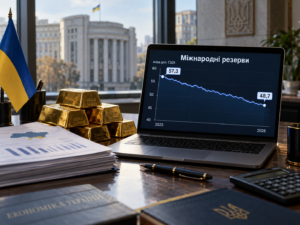
Ukraine’s international reserves amounted to $48.7 billion at the end of August 2026, which is approximately $8.6 billion, or 15%, less than at the beginning of the year, according to an analysis by the Experts Club information and analytical center.
As of January 1, reserves stood at a record level of $57.3 billion, and by the beginning of February they had risen to $57.7 billion. After that, they declined for four consecutive months: to $54.8 billion as of March 1, $52 billion as of April 1, $48.2 billion as of May 1, and $45.7 billion as of June 1.
The main factors behind the decline were significant foreign exchange interventions by the National Bank, government debt payments, and uneven inflows of international financial assistance.
The situation changed sharply in June, when Ukraine received large tranches of external financing. Reserves increased by 12.1% over the month — to $51.27 billion. About $11.3 billion was credited to the government’s foreign currency accounts, including $6.82 billion from the EU and almost $4.5 billion through the World Bank.
In July, reserves remained almost unchanged, but in August they again decreased by approximately $2.5 billion, or 5%, to $48.7 billion.
In August, the NBU sold about $4.82 billion on the foreign exchange market, while $927.3 million was credited to the government’s foreign currency accounts. Ukraine also directed $721.8 million toward servicing and repaying government debt in foreign currency and paid $258.2 million to the IMF.
Net international reserves declined even more sharply over the month — by 6.9%, to $33.8 billion.
At the same time, the current level of reserves remains approximately 5.8% higher than a year ago, when they stood at about $46 billion as of September 1, 2025.
Experts Club founder and economist Maksym Urakin previously emphasized that the absolute size of reserves should not be regarded as a guarantee of currency security.
“Reserves at the level of $51.2 billion remain a significant foreign exchange buffer, but the absolute figure itself should not create an impression of complete protection. The sustainability of reserves depends on the regularity of international financing, the volume of NBU interventions, debt payments, and the economy’s ability to increase export revenues,” Urakin noted.
According to the NBU, the current level of reserves remains sufficient and provides financing for approximately four months of future imports.



