

In August 2026, the National Bank of Ukraine (NBU) fined PJSC “USG Insurance Company” 30.8 million UAH for violating legal requirements regarding the prevention and counteraction of money laundering and terrorist financing. According to the regulator, the violations concerned the improper organization and conduct of initial financial monitoring.
In particular, the NBU identified shortcomings in the company’s internal documents regarding financial monitoring, the conduct of due diligence on customers, and the application of a risk-based approach.
The regulator also pointed out shortcomings in the additional screening of politically exposed persons (PEPs), as well as in the provision of information and documents to the National Bank upon its requests.
In addition to the fine, the insurance company received a written warning for violating requirements regarding the preparation and submission of statistical reports on financial monitoring.
The enforcement actions against SK “USG” were part of a series of measures taken by the NBU in August against one bank and four non-bank financial institutions. The total fines imposed by the regulator on the five companies exceeded 50 million UAH.
Specifically, the NBU simultaneously fined the state-owned “Ukrgasbank” 17.6 million UAH, “Max Credit” LLC 1.08 million UAH, “FC Goal” LLC 391,000 UAH, and “Zaporizhsvyazservis” PJSC 255,000 UAH.
USG Insurance Company has been operating in the Ukrainian insurance market for over 20 years. The company was founded in 2000 and has been part of the international Vienna Insurance Group (VIG) since 2008. The company is 100% foreign-owned and operates in the main segments of non-life insurance, including auto insurance, property insurance, liability insurance, travel insurance, and corporate risk insurance. Pavlo Nelga serves as Chairman of the Board.
In July 2026, the National Bank of Ukraine imposed a fine of 16.1 million UAH on Raiffeisen Bank JSC for a series of violations of anti-money laundering and counter-terrorism financing laws.
Among the violations identified by the regulator were inadequate customer due diligence and failure to apply a risk-based approach, as well as deficiencies in risk management during the implementation and use of information products and technologies, particularly when conducting transactions without direct contact with the customer.
The NBU also identified instances of untimely reporting of threshold financial transactions to the authorized state body and shortcomings in providing information and documents in response to the regulator’s requests.
In addition to the fine, Raiffeisen Bank received a written warning. It pertains, in particular, to the verification of customers and ultimate beneficial owners falling under the PEP category, internal documents regarding financial monitoring, updating information in customer questionnaires, and the transmission of information about payers.
Raiffeisen Bank has been operating in Ukraine since 1992, initially under the name Bank Aval. Since 2005, the bank has been part of the Austrian Raiffeisen Group. According to the ownership structure as of January 1, 2026, Raiffeisen Bank International AG holds 68.21% of the Ukrainian bank’s shares, while the European Bank for Reconstruction and Development holds 30%. Natalia Gurina is the chair of the bank’s board of directors.

In July 2026, the National Bank of Ukraine (NBU) imposed a fine totaling 42.545 million UAH on JSC “Ukrainian Capital Bank” for violating financial monitoring and foreign exchange supervision regulations.
The regulator imposed the main fine of 40.545 million UAH for the improper organization and conduct of initial financial monitoring. Specifically, the NBU identified shortcomings in the bank’s application of a risk-based approach, its assessment of customer risks, and its internal documents regarding financial monitoring and customer due diligence. The bank also did not always provide information and documents in a timely and complete manner in response to requests from the inspection team.
An additional fine of 2 million UAH was imposed for violations of foreign exchange legislation. According to the NBU, the bank improperly carried out foreign exchange supervision, failed to ensure a comprehensive analysis of documents related to certain foreign exchange transactions, and did not identify the indicators of such transactions as required by regulations.
In addition, “Ukrainian Capital” received two written warnings. One relates to additional due diligence on customers who are politically exposed persons (PEPs), the automation of certain procedures, and the completion of customer questionnaires. The second concerns the late submission of and errors in statistical reports on foreign exchange transactions.
The NBU announced the imposition of these enforcement measures on August 7, 2026. In total, in July, the regulator imposed sanctions for violations in the areas of financial monitoring and foreign exchange legislation on two banks and 19 non-bank financial institutions.
Ukrainian Capital Bank has been operating in the Ukrainian market since 1992 and was originally registered as Zakarpattia Bank; it has used its current name since 1996. The NBU classifies it as a privately owned bank. According to the regulator, as of February 1, 2026, the bank’s assets totaled 3.079 billion UAH, liabilities amounted to 2.874 billion UAH, and capital stood at 204.7 million UAH. The NBU lists Serhiy Belashov, Liliana Belashova, Daria Zlidar, and Nataliia Kiva as major shareholders. Yevhen Chechyl serves as chairman of the board.
BANK, financial monitoring, FINE, foreign exchange supervision, NBU
FUIB respects the decisions of the National Bank of Ukraine and prioritizes compliance with financial monitoring legislation.
The bank has taken into account the NBU’s comments to further improve and fine-tune its processes and procedures to meet the requirements of financial monitoring legislation. At the same time, the identified violations are not systemic and do not indicate a lack of an adequate risk management system or proper organization and conduct of initial financial monitoring at PUMB.
To date, PUMB has already developed an action plan to address the identified shortcomings and further improve internal procedures and controls in the area of financial monitoring. The bank systematically invests in the development of technological solutions and process automation aimed at enhancing the effectiveness of its financial monitoring system.
FUIB continues to engage constructively with the National Bank of Ukraine and is consistently working to improve the effectiveness of its financial monitoring system.
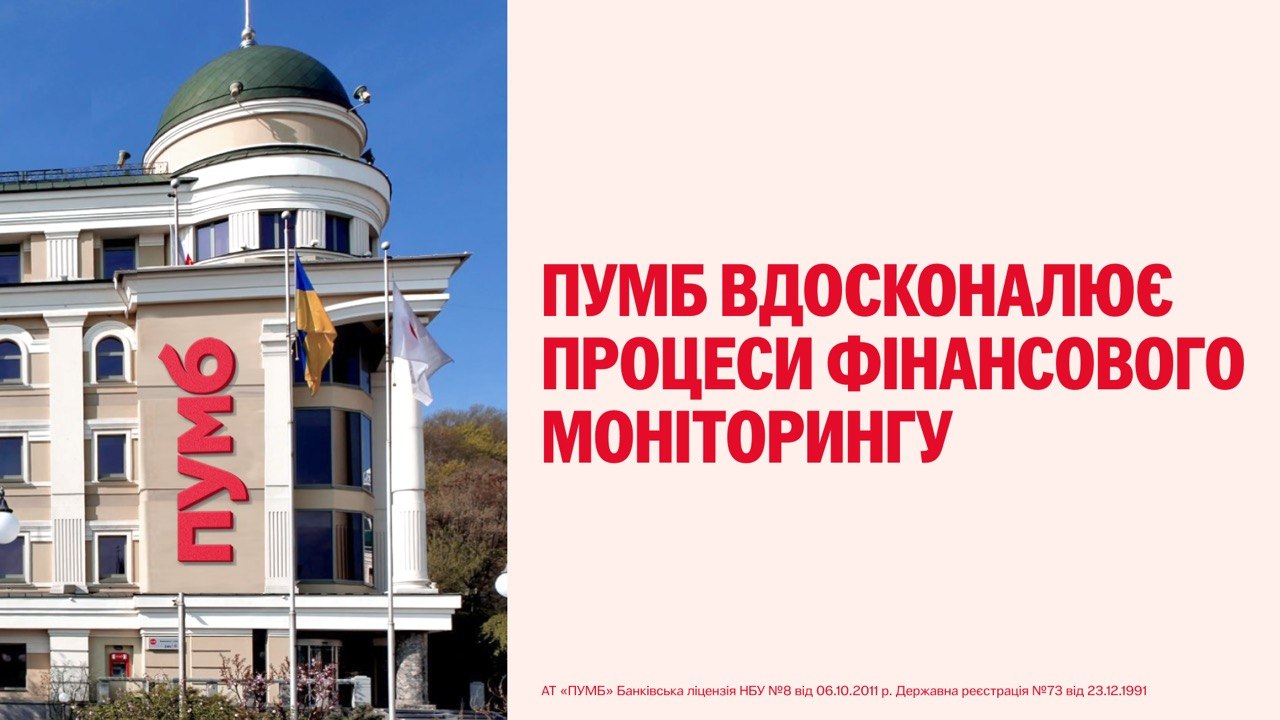
It should be noted that FUIB is one of the largest taxpayers in Ukraine. Since 2022, the bank has paid 20.4 billion UAH in taxes to budgets at all levels. At the same time, PUMB actively supports Ukraine and its defense forces: the bank’s investments in social projects since 2022 have exceeded 1.4 billion UAH, of which more than 544 million UAH has been allocated to support the Armed Forces of Ukraine, the Territorial Defense Forces, the State Emergency Service, the National Police, the National Guard, the Main Intelligence Directorate, and the Security Service of Ukraine.

In June 2026, the National Bank of Ukraine fined JSC “PUMB” 10 million hryvnia for violating financial monitoring regulations, the regulator announced on July 7.
According to the NBU, the violations involved inadequate verification of new and existing customers, as well as a failure to apply enhanced due diligence measures to customers with high-risk business relationships.
The regulator also pointed out the bank’s improper application of a risk-based approach. In particular, the NBU noted that the bank failed to identify a high level of risk in business relationships with clients whose ultimate beneficial owners are citizens of a state engaged in armed aggression against Ukraine.
Furthermore, according to the NBU, the bank failed to promptly notify the specially authorized body of threshold financial transactions and violated requirements regarding the termination of business relationships with clients who did not provide documents or information necessary for proper verification.
In addition to the fine, PUMB received a written warning for deficiencies in its internal financial monitoring documents. The NBU noted that these documents lacked procedures sufficient for effective risk management and for preventing the use of banking services for money laundering, terrorist financing, or the proliferation of weapons of mass destruction.
FUIB—First Ukrainian International Bank—is one of the largest private banks with Ukrainian capital. The bank has been operating since 1991 and provides services to private clients, entrepreneurs, and businesses. FUIB is classified as a systemically important bank by the NBU and serves approximately 147,000 corporate clients and 1.9 million retail clients.
According to “Serbian Economist,” the Financial Action Task Force (FATF) has added Bosnia and Herzegovina to the list of jurisdictions under enhanced monitoring—the so-called “gray list.”
At the same time, Iraq was also added to the “gray list.”
According to the FATF, countries on the “gray list” have strategic deficiencies in their systems for combating money laundering, terrorist financing, and the financing of the proliferation of weapons of mass destruction, but are committed to addressing these issues within agreed-upon timeframes.
FATF President Elisu de Anda Madrazo stated that Bosnia and Herzegovina must strengthen the protection of its financial system against exploitation by criminals and terrorists, as well as ensure more effective oversight of the banking sector.
This is a significant signal for the region. Bosnia and Herzegovina remains part of the Western Balkan economic space, closely linked to Serbia, Croatia, Montenegro, and EU countries through banking, trade, remittances from the diaspora, transportation, construction, and small businesses.
Being placed on the “gray list” does not imply sanctions or a ban on transactions, but it typically leads to stricter compliance requirements on the part of banks and financial institutions. International payments, opening accounts, servicing companies, transfers, and transactions with counterparties from such a jurisdiction may be subject to additional checks.
This is important for Serbia for two reasons. First, Bosnia and Herzegovina is a neighboring market and a key destination for regional trade. Second, Serbian banks, companies, and exporters working with partners in Bosnia and Herzegovina may face more detailed inquiries regarding the origin of funds, ownership structure, beneficial owners, and the purpose of payments.
From a practical standpoint, businesses working with Bosnia and Herzegovina should prepare transaction documents in advance, verify the authenticity of goods and services, and properly draft contracts and payment justifications. This applies particularly to financial services, trade, real estate, logistics, import-export, and companies with complex ownership structures.
For reference: as of June 19, 2026, the current FATF “gray list” includes Angola, Bolivia, Bosnia and Herzegovina, Bulgaria, Cameroon, Côte d’Ivoire, the Democratic Republic of the Congo, Haiti, Iraq, Kenya, Kuwait, Laos, Lebanon, Monaco, Nepal, Papua New Guinea, South Sudan, Syria, Venezuela, Vietnam, the British Virgin Islands, and Yemen.
The FATF blacklist—that is, the list of high-risk jurisdictions for which the FATF calls for enhanced measures or countermeasures—includes North Korea, Iran, and Myanmar.
Bosnia and Herzegovina, COMPLIANCE, FATF, financial monitoring, SERBIA



