Ukraine and Spain plan to accelerate the implementation of joint investment and trade projects in the fields of infrastructure, energy, transportation, industry, agricultural processing, defense technologies, and digitalization through the newly established Ukrainian-Spanish Business Council.
The first joint meeting of the Ukrainian and Spanish members of the council took place in Kyiv as part of the Ukrainian-Spanish Business Forum. More than 100 companies from both countries participated in the events, including 47 representatives of Spanish businesses.
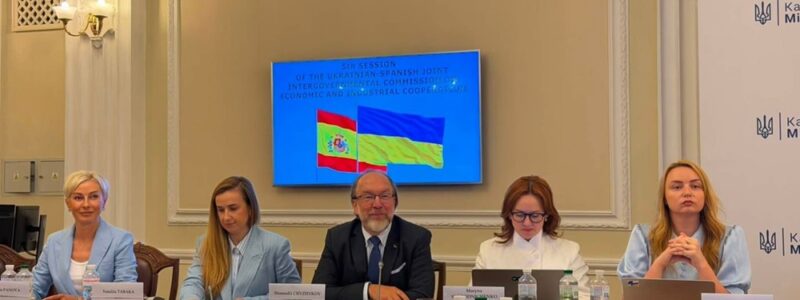
Kyiv also hosted the fifth meeting of the Ukrainian-Spanish Joint Intergovernmental Commission on Economic and Industrial Cooperation. The commission was co-chaired by Oleksiy Sobolev, Acting Minister of Economy, Environment, and Agriculture of Ukraine, and Carlos Cuervo, First Vice President of the Government and Minister of Economy, Trade, and Entrepreneurship of Spain.
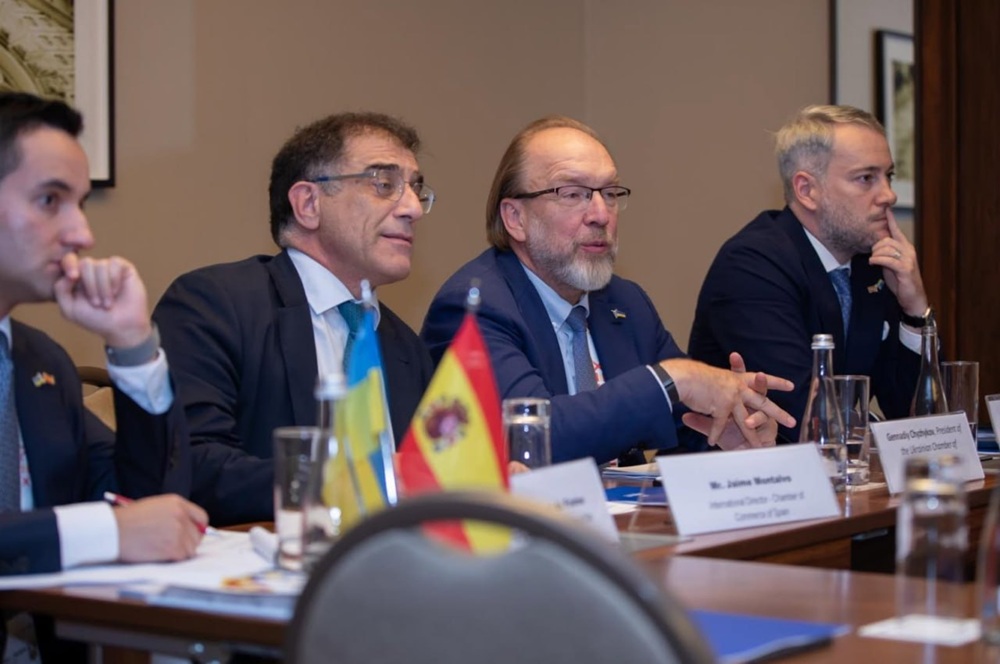
The parties discussed the transition from general dialogue to the development of specific projects, the involvement of Spanish companies in Ukraine’s reconstruction, the localization of production, and technology transfer.
“Ukraine is open to partnerships right now. An investor who comes today will have the opportunity to join the reconstruction effort and become part of Ukraine’s future European market,” said Hennadiy Chizhikov, President of the Ukrainian Chamber of Commerce and Industry.
In the transportation sector, the parties discussed the development of air, rail, and road transport, the creation of multimodal routes, and the application of Spanish expertise in high-speed rail construction.
In the energy sector, the main areas identified are solar and wind power generation, energy storage systems, energy efficiency, and the development of decentralized power generation. In industry and the defense and technology sectors, the parties intend to transition from conventional product supply to joint production, localization, and the creation of joint ventures.
In the agro-industrial sector, discussions focused on investments in food processing, storage, and logistics, as well as the production of finished goods for export to countries in the Mediterranean, North Africa, and Latin America. Specific areas of cooperation identified include water resource management, healthcare, tourism, science, and innovation.
The Spanish business delegation included, among others, representatives from the infrastructure company ACCIONA, the aerospace corporation Airbus, the technology and defense companies Indra, Grupo Oesía, Escribano, and Integrasys, the satellite operator Hispasat, and the railway company RENFE.
The Ukrainian side was represented by about 20 companies and associations operating in transportation, logistics, aviation, agriculture, the food industry, energy, mechanical engineering, construction, digital technologies, and professional services.
The Ukrainian-Spanish Business Council is intended to serve as a permanent mechanism for direct interaction between companies, chambers of commerce and industry, and the governments of the two countries. Its work will include identifying partners, compiling a portfolio of investment projects, establishing sector-specific working groups, and monitoring the implementation of agreements.
The Ukrainian side of the council is headed by Mykhailo Bno-Ayriyan, a representative of MHP. Its members include MHP, Metinvest, Nova Poshta, SkyUp Airlines, Epicentr Agro, DSV Logistics, Zammler Ukraine, WhiteBIT, Farmak, and other Ukrainian companies and industry organizations.
The next practical step in this cooperation will be a business mission by Ukrainian companies to Valencia on September 28–29, 2026.
The visit will take place as part of the EUROCHAMBRES 2026 Congress, during which a Ukrainian-Spanish business forum and one-on-one meetings between Ukrainian companies and potential Spanish partners are also planned.
According to 2025 figures, trade between Ukraine and Spain totaled nearly $2.8 billion, of which approximately $1.73 billion was accounted for by Ukrainian exports. Spain remains one of the largest European buyers of Ukrainian agri-food products.
According to calculations by the Experts Club information and analytical center, published on July 16, Ukraine exported $1.09 billion worth of goods to Spain in January–June 2026. Imports of Spanish products totaled about $512 million, and total bilateral trade amounted to approximately $1.60 billion.
Ukraine’s trade surplus with Spain reached $578.1 million, the largest among all 50 of the country’s leading trading partners.
Thus, Spain is a particularly advantageous major trading partner for Ukraine: Ukrainian exports to this market are more than double the value of imports of Spanish goods.