

The National Bank of Ukraine fined Avangard Bank JSC 2 million UAH for violating financial monitoring regulations, the regulator announced on its website.
According to the NBU’s statement, the bank was fined for improper application of a risk-based approach, failure to identify a financial transaction subject to financial monitoring, and improper analysis of customer transactions for indicators of suspicious activity.
In addition, the regulator issued written warnings to the bank. These warnings concern the improper development and implementation of internal documents on financial monitoring, as well as the submission of erroneous information on foreign exchange transactions to the NBU.
As previously reported, in May, the NBU imposed sanctions on one bank and nine non-bank financial institutions for violations in the areas of financial monitoring and foreign exchange legislation.
Bank Avangard JSC operates in the Ukrainian banking market and provides services to corporate and private clients.
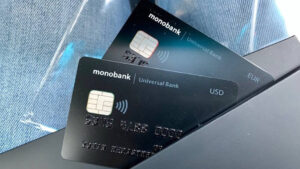
The digital bank monobank has eliminated fees for all incoming and outgoing international SWIFT payments for individual and business customers, according to the project’s co-founder, Oleg Gorokhovsky.
“Previously, a SWIFT transfer cost users an average of about 1,000 UAH in fees,” he wrote on his Telegram channel on Wednesday.
According to Gorokhovsky, such payments are currently important for businesses due to the possibility of cheaper procurement, and for individuals—to pay for education, medical treatment, and military equipment.
He added that the bank earned over 11 million UAH per year from these fees.
monobank is a branchless mobile bank founded in January 2017 by former PrivatBank top managers Oleg Gorokhovsky, Dmytro Dubilet, and Mykhailo Rogalsky. The project operates under the banking license of Universal Bank, which is part of the TAS Group (Kyiv).
According to the National Bank, as of April 1, 2026, Universal Bank had issued a total of 29.42 million cards, of which 10.17 million were used for transactions during the month.

The European Commission proposes new sanctions against Russia in the areas of finance and cryptocurrencies: for the first time, a complete ban on crypto-asset services in third countries is being proposed, and new banks have been added to the list.
European Commission President Ursula von der Leyen announced this on Tuesday in Brussels while unveiling the 21st package of sanctions against Russia.
“My second point concerns financial and cryptocurrency restrictions. We are expanding our banking transactions to include 31 Russian banks and up to 20 crypto firms or platforms and oil traders in third countries that have served Russian organizations and individuals subject to sanctions or circumvented our measures,” she said.
It is also proposed to impose a complete ban on crypto-asset services in third countries. “This will be a powerful deterrent for hosting platforms in countries that help Russia circumvent our sanctions,” von der Leyen emphasized.
BANKS, CRYPTOCURRENCY, EUROPEAN COMMISSION, RUSSIA, SANCTIONS

The share of non-performing loans (NPLs) in the banking sector fell by 1 percentage point to 12.92% during January–March 2026, according to data from the National Bank of Ukraine (NBU).
“The decline in the NPL ratio in January–March 2026 was driven by both an increase in the volume of new, higher-quality loans and the resolution of non-performing debts,” the National Bank noted in a press release on its website.
The banking system’s gross loan portfolio grew by 75.84 billion UAH in the first quarter of 2026—to 1 trillion 435.58 billion UAH—including an increase of 3.66 billion UAH in March.
The trend in the gross volume of non-performing loans during the quarter was uneven: after growing in January, the figure declined in February and March, and the March reduction of UAH 5.55 billion accounted for the bulk of the quarterly decrease of UAH 3.82 billion—to UAH 185.49 billion.
A reduction in the NPL ratio in the first quarter of the year was recorded across all bank groups: for banks with state ownership (excluding PrivatBank)—from 25.07% to 23.86%, at PrivatBank—from 8.45% to 7.74%, at financial institutions with foreign capital—from 6.46% to 6.17%, and at private Ukrainian banks—from 8.37% to 7.75%.
In absolute terms, as of April 1, NPLs increased at PrivatBank by UAH 592.0 million, to UAH 19.41 billion, and at banks with foreign capital by UAH 196.43 million, to UAH 18.76 billion.
The top five banks by NPL volume were state-owned banks: Oschadbank with UAH 44.78 billion (UAH 43.83 billion at the start of the year), Ukreximbank – UAH 25.52 billion (UAH 33.19 billion), Sens Bank – UAH 23.92 billion (UAH 22.46 billion), Ukrgasbank – UAH 21.87 billion (UAH 21.79 billion), and PrivatBank – UAH 19.41 billion (UAH 18.82 billion).
The top ten also included Raiffeisen Bank with UAH 8.17 billion (UAH 8.05 billion), PUMB – UAH 5.04 billion (UAH 4.94 billion), TAScombank – UAH 4.06 billion (UAH 4.08 billion), OTP Bank – UAH 3.71 billion (UAH 3.19 billion), and Idea Bank – UAH 3.52 billion (UAH 3.17 billion).
At the same time, Alliance Bank had the highest NPL ratio among banks with the largest loan portfolios—39.9% (49.6%), followed by Sens Bank with 29.8% (28.5%), and Idea Bank rounded out the top three with 28.8% (28.6%).
State-owned banks took fourth through sixth place: Oschadbank – 26.4% (26.5%), Ukreximbank – 20.8% (25.3%), and Ukrgasbank – 19.3% (20.1%).
The top ten also included TAScombank with 16.3% (16.6%), MTB Bank – 11.6% (9.9%), A-Bank – 10.9% (12.0%), and Radabank – 10.6% (12.3%).
The Central Bank noted that in the corporate sector, the share of non-performing loans decreased from 16.99% to 15.73% in the first quarter, and in the retail sector from 10.78% to 10.32%.
As reported, the downward trend in the NPL ratio has continued since early 2023, when it rose to 38.1%. Prior to Russia’s full-scale invasion, non-performing loans in Ukrainian banks had been declining since 2018: from 55% to 27% as of March 1, 2022.
In December 2025, the NPL ratio fell sharply—from 23.9% to 13.9%—after PrivatBank ceased recognizing approximately 140 billion UAH in old hryvnia-denominated assets as non-performing.

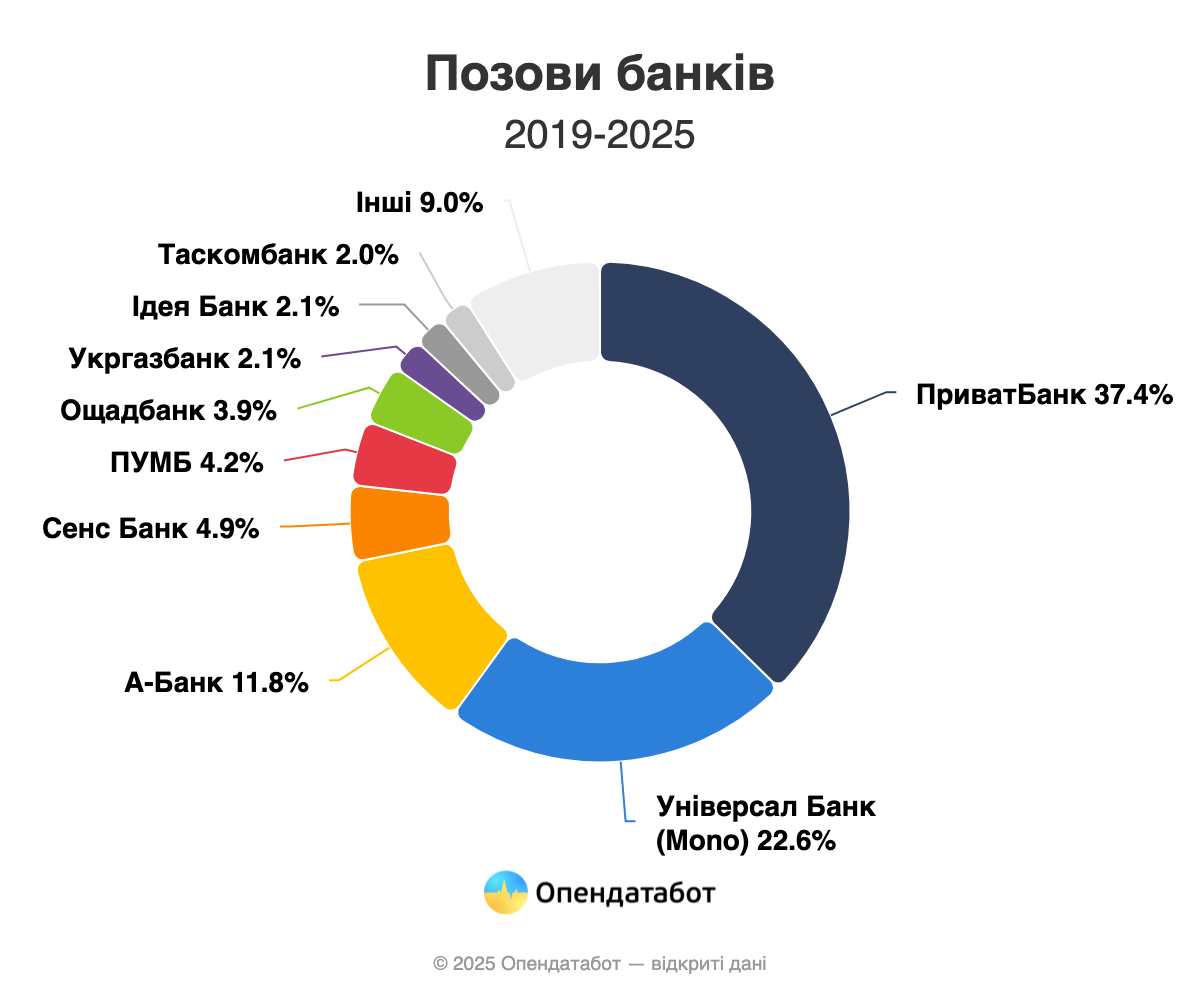
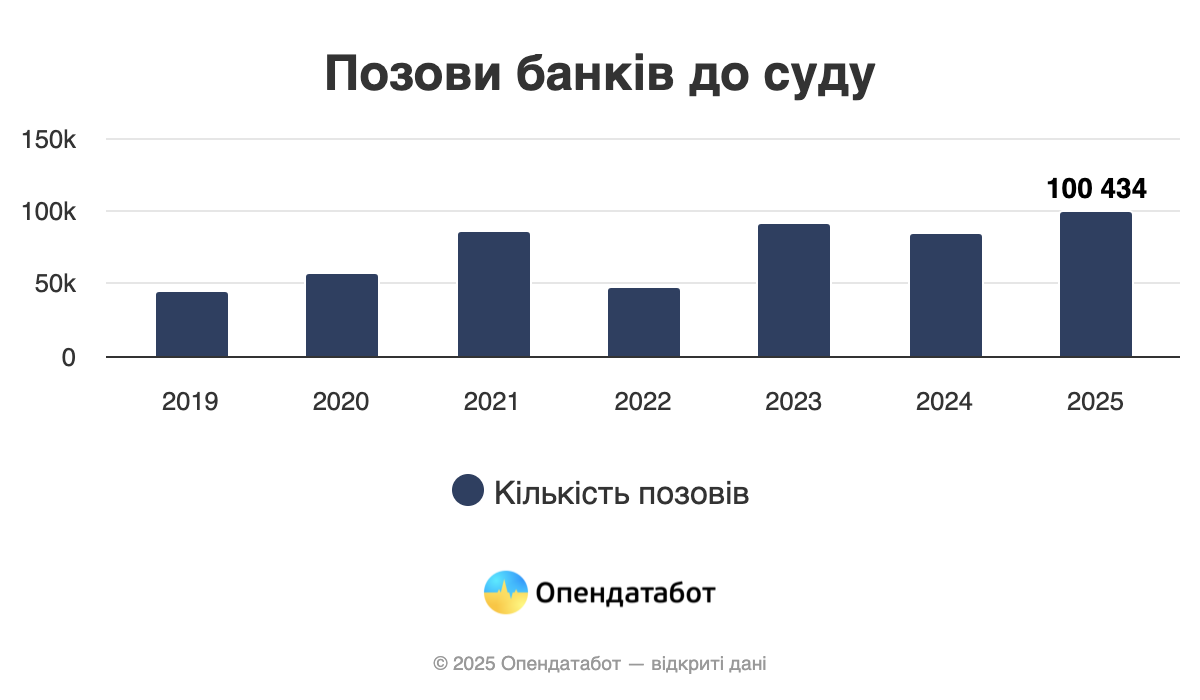
Banks are increasingly suing their debtors. According to the State Judicial Administration of Ukraine, a record 100,000 lawsuits were filed by Ukrainian banks this year. This is almost 1.5 times more than in the same period last year. In total, more than half a million lawsuits against debtors have been filed by banks over the past 7 years. Universal Bank (Mono), Privat and A-Bank account for 70% of the claims.
100,434 lawsuits against debtors were filed by Ukrainian banks. This is 1.5 times more than in the same period last year and a record for the last 7 years. A total of 511,865 lawsuits have been filed by banks since 2019.
Universal Bank/Mono (28,213 claims), A-Bank (22,221), and Privat (20,278) accounted for more than 70% of all claims this year. FUIB (9 , 225) and Sense Bank (6,831) are far behind.
In general, over the past 7 years, Privatbank has remained the unchanged leader in lawsuits against debtors – 191,353 lawsuits. It is followed by Universal Bank (115,702), A-Bank (60,421), Sense Bank (25,283) and FUIB (21,476).
TASKOMBANK saw the largest increase in the number of claims this year, up 3.5 times. PrivatBank (1.8 times), Kredobank (1.7 times), Accent Bank (1.6 times), and Sens Bank (1.6 times) also saw a significant increase.
At the same time, many banks have significantly reduced the number of court appeals. Unex Bank (4 times), Credit Agricole (2 times) and Ukrgasbank (2 times) showed the biggest drop.
It is worth noting that the ranking of the most “litigious” banks has been updated this year. New players entered the top – Radabank and Bank Alliance, which were not on the list last year. Instead, Accordbank and Unex Bank dropped out of the top twenty.
https://opendatabot.ua/analytics/banks-courts-2025

The number of banks in Ukraine in October 2025 has not changed and is 60, according to the website of the National Bank of Ukraine.
According to the regulator, the number of banking groups is also unchanged – 16. 15 payment systems created by residents, including state-owned ones, and 10 international payment systems continue to operate in the payment market.
Among payment service providers there are 16 payment institutions (17 a month earlier), 12 financial institutions authorized to provide payment services, one bank – issuer of electronic money, and one postal operator. Other payment market entities include 49 commercial agents and 32 technological payment service providers.
In October, the NBU received 243 requests for registration and licensing actions, including 41 requests for banks, 131 requests for financial companies, pawnshops and lessors, 55 requests for insurers, 14 requests for credit unions and collection companies, and 2 requests for payment institutions.



