
The EU economy today faces challenges such as rising energy prices, fragmentation of the single market, complex administrative rules, and competition that is not always fair, said European Commission (EC) President Ursula von der Leyen.
“For a long time, the European economic model was based on several self-evident truths: cheap imported energy, open global trade, ever-wider access to the Chinese market, strategic protection from the U.S., and the West’s technological edge. These truths have disappeared,” the EC President stated while delivering a speech on Thursday in Paris at the annual “2026 Meeting of French Entrepreneurs” conference.
Von der Leyen sees the solution to these pressing problems as restoring entrepreneurs’ freedom to invest in the short term and, in the long term, making innovation, productivity, and scaling up the sustainable drivers of European economic growth.
The European Commission President outlined her prescriptions for healing the European economy.
The first priority is to simplify regulations and restore a level playing field. The goal is to reduce the administrative burden by 25% for all businesses and by 35% for small and medium-sized enterprises by 2029.
“However,” von der Leyen continued, “the demand for simplicity must be combined with the demand for fairness regarding foreign competition. This is particularly relevant to our relations with China. China is our major economic partner, and our position is clear and unwavering: to reduce risks, but not to sever ties. However, being a partner does not mean putting up with constant imbalances.”
She identified the financing of EU member states’ economies as the second priority. In her view, far too many projects remain stalled because the initial investment step is too risky, demand is too uncertain, or capital is too expensive. Of course, the EC President noted, these efforts cannot be financed solely through national budgets.
“But Europe has savings. Unfortunately, these savings are ‘idle.’ 10 trillion euros in household savings continue to sit in bank deposits, and a significant portion of European savings is invested outside our continent. Europe must now channel these funds to support its own businesses,” von der Leyen said.
Among other measures to strengthen the EU economy, she highlighted the comprehensive development and consolidation of the EU single market, reducing energy costs, the adoption of artificial intelligence as a “powerful driver of productivity,” and expanding free trade with international partners.
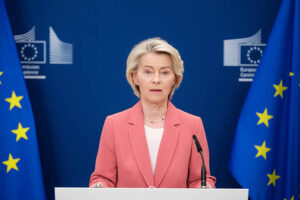
The European Union plans to restrict children’s access to social media in all 27 member states, said European Commission President Ursula von der Leyen.
The European Commission is considering a multi-stage approach to children’s and teenagers’ access to digital platforms. According to expert recommendations, children under the age of 13 will be able to use social media only for a limited time and under the supervision of parents, guardians, or teachers. As teenagers get older, the restrictions should be gradually eased.
“It is clear that we need age-based restrictions for these platforms,” von der Leyen told reporters in Brussels. She noted that the question now is not whether children face risks online, but how to give them a safer start in the digital environment.
The European Commission is expected to present a concrete proposal after the summer. Reuters reports that von der Leyen may announce it during her annual State of the Union address in September.
The new rules could apply not only to traditional social media platforms but also to a wider range of services with “age-inappropriate” and addictive features. Von der Leyen referred to this as the “social media plus” category, which could include platforms with infinite scrolling, autoplay videos, personalized algorithms, and other mechanisms designed to capture users’ attention.
The main services affected could include TikTok, YouTube, Instagram, and Facebook. Reuters notes that similar restrictions, aimed primarily at the largest short-form video and social media platforms, are already in place or under discussion in various countries around the world.
The Associated Press reports that an EU expert group has recommended restricting access to social media for children under 13 until tech companies can prove that their platforms are safe for children. For teenagers over 13, the proposal calls for phased access only to those services that meet safety and age-appropriateness requirements.
The European Commission is also developing its own app to verify users’ ages online. Such a system should help platforms and EU member states enforce age restrictions, although officials in Brussels acknowledge that it is technically impossible to completely prevent users from circumventing these measures.

The European Commission proposes new sanctions against Russia in the areas of finance and cryptocurrencies: for the first time, a complete ban on crypto-asset services in third countries is being proposed, and new banks have been added to the list.
European Commission President Ursula von der Leyen announced this on Tuesday in Brussels while unveiling the 21st package of sanctions against Russia.
“My second point concerns financial and cryptocurrency restrictions. We are expanding our banking transactions to include 31 Russian banks and up to 20 crypto firms or platforms and oil traders in third countries that have served Russian organizations and individuals subject to sanctions or circumvented our measures,” she said.
It is also proposed to impose a complete ban on crypto-asset services in third countries. “This will be a powerful deterrent for hosting platforms in countries that help Russia circumvent our sanctions,” von der Leyen emphasized.
BANKS, CRYPTOCURRENCY, EUROPEAN COMMISSION, RUSSIA, SANCTIONS
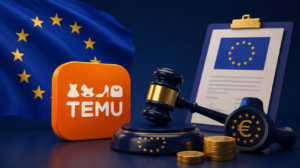
The European Commission has fined the Chinese online platform Temu €200 million for violating the EU’s Digital Services Act (DSA) due to insufficient assessment of the risks associated with the distribution of illegal and dangerous goods on its marketplace.
According to the European Commission’s statement, Temu failed to exercise due diligence in identifying illegal goods on its platform and in assessing the potential harm to consumers in the EU. The investigation revealed that the platform posed a high risk of purchasing goods that do not meet European safety requirements, including chargers, children’s toys, clothing containing banned chemicals, and jewelry containing lead.
The European Commission, in particular, highlighted the very high proportion of chargers that failed basic safety tests. Similar concerns were raised regarding children’s toys, which posed a threat due to chemical concentrations exceeding permissible limits, as well as other risks to consumers. During the inspection, the regulator used the “mystery shopper” method and laboratory testing of products.
According to the European Commission’s assessment, Temu’s risk assessment report did not meet DSA requirements, as it did not allow regulators, users, and the public to understand the true scale of potential harm from illegal goods sold on the platform. Brussels also believes that Temu’s recommendation system could have increased the risk of purchasing such goods by promoting problematic product categories to users.
“Temu’s risk assessment report leaves regulators, users, and the public in the dark regarding the scale of potential harm that illegal goods sold on the platform could cause,” said Henna Wirkkunen, Executive Vice President of the European Commission for Technological Sovereignty, Security, and Democracy.
Temu must pay the fine and submit a plan of corrective measures to the European Commission by August 28. If the regulator deems the proposed steps insufficient, the company could face additional sanctions. The investigation into other possible DSA violations by Temu is ongoing.
The company disagreed with the European Commission’s decision and called the fine disproportionate. Temu stated that it continues to cooperate with regulators and has already made changes to its risk assessment system and internal control procedures.
Temu is owned by China’s PDD Holdings and has become one of the largest international low-price marketplaces in recent years. The platform is actively operating in the EU market, where it falls under the DSA as a major online service. The Digital Services Act imposes obligations on such platforms to assess systemic risks, combat illegal content and goods, ensure algorithm transparency, and protect users. For serious violations of the DSA, companies can be fined up to 6% of their global annual turnover.
European Commission, Temu
The European Commission (EC) has announced an increase in support for “Ukrainian innovators in the high-tech sector.”
“The European Commission has allocated €20 million to fund 41 cutting-edge Ukrainian startups and small and medium-sized enterprises through the European Innovation Council (EIC) competition to help them turn innovative ideas into real solutions,” according to an EC communiqué published on Wednesday.
“This funding will help integrate Ukrainian startups into the European innovation ecosystem, strengthening Ukraine’s long-term economic ties with the EU,” noted EC Commissioner for Startups, Research, and Innovation Katerina Zakharieva.
The statement notes that each company will receive between EUR300,000 and EUR500,000, as well as the opportunity for accelerated access to the EIC’s flagship funding program—the EIC Accelerator—which offers larger grants and equity investments through the EIC Fund.

As part of preparations for the next, 20th package of sanctions against Russia, the European Commission has proposed a complete ban on cryptocurrency transactions related to Russia in order to block channels for circumventing restrictions through digital assets, the Financial Times reported, citing an internal European Commission document.
According to the publication, the idea is to move from targeted measures against individual Russian crypto platforms to a broader approach—banning interaction with crypto services linked to Russia. The document also mentions initiatives to restrict transactions related to the digital ruble and measures against certain payment instruments that, according to Brussels, could be used to circumvent sanctions.
Earlier, European Commission President Ursula von der Leyen, presenting the parameters of the new package, announced her intention to tighten restrictions in the financial sector and take measures against cryptocurrencies and platforms that could be used to circumvent the sanctions regime. Reuters also reported that the package includes additional measures against crypto companies that help Russia circumvent restrictions.
The European Commission’s proposals must be unanimously agreed upon by EU member states. EU countries planned to begin discussing the new sanctions package in the coming days, with a target date of February 23.



