
On July 14, the price of Bitcoin exceeded $120,000 for the first time in history, reaching a peak of $122,571. After that, the price stabilized at around $121,950. The daily growth was about 2–3%, and since the beginning of the year — almost 29%. Analysts attribute the dynamics to a massive influx of capital into Bitcoin-based exchange-traded funds (BTC-ETFs) — over $1 billion daily — and favorable expectations regarding regulation. This refers to the active debate surrounding the Genius Act bill and discussions during Crypto Week.
Institutional players, including giants such as BlackRock and Bitwise, are showing unprecedented activity: from January to July, net inflows into cryptocurrency products exceeded $14.4 billion. Bitcoin is increasingly being treated as a digital analogue of gold — a “store of strength” in times of financial volatility. Technical analysis indicates potential growth to $125,000–131,000 in the coming weeks. If the trend remains stable, the price could reach $200,000–250,000 by the end of the year.
Ethereum is not far behind. ETH updated its five-month high, rising to $3,060. Open interest in Ethereum futures reached $14.25 billion, and ETF inflows exceeded $1 billion. AI-based predictive models see ETH in the $3,000–3,200 range throughout July.
The altcoin market is also showing positive dynamics. XRP rose above $2.80, an increase of 6–7% over the week. The technical picture shows a breakout from the falling wedge formation, opening the way to $3 and possibly $4.35 as early as July. Solana is trading at $160–167, with potential to reach $186–200, while Cardano (ADA) is near $0.725 and showing an upward trend to $0.77. Investors are showing growing interest in assets such as CELO and DOGE, as well as new staking ETFs, particularly those based on Solana.
The total capitalization of the crypto market is approaching $3.8 trillion. Despite geopolitical instability, the market is showing a clear bullish trend. Central bank digital initiatives, including digital currency pilots (CBDCs) in Australia, are creating a favorable backdrop for further growth in crypto assets. Against this backdrop, Bitcoin is increasingly consolidating its status as a reserve asset, prompting large institutions and companies to withdraw significant amounts from traditional assets in favor of digital ones.
Bitcoin: a new high and institutional growth
Ethereum and altcoins
Overall trend: the bull market continues
Forecasts for July 2025
Source: https://www.fixygen.ua/news/20250710/oglyad-lipnevih-trendiv-na-rinku-kriptovalyut-vid-fixygen.html

Market under geopolitical pressure
This week, the cryptocurrency market experienced serious turbulence due to the escalation of the conflict in the Middle East. Following reports of Israeli strikes on Iranian targets, the price of Bitcoin fell below $103,000, and the total market capitalization of the cryptocurrency market declined by more than $140 billion. Later, BTC partially regained its positions, settling in the $105,000–107,000 range.
Ethereum also lost about 5%, dropping to $2,510.
Alternative tokens (Solana, Cardano) fell by 2–3%, while XRP unexpectedly rose by 2–2.4%.
The fear and greed index remains in the “Greed” zone (~60), but amid instability, it could quickly shift to the “Fear” zone.
How is the war between Israel and Iran affecting the crypto market?
Short-term and long-term forecasts
June forecast:
3–6 month forecast:
Long term:

Bitcoin (BTC) surpassed the $100,000 mark for the first time since February 2025, reaching an intraday high of $105,747. This was made possible by the reduction of trade tariffs between the US and China, as well as expectations of interest rate cuts in the US.
Ethereum (ETH) also showed growth, reaching $2,620, which is 40% higher than the previous week.
Institutional investment has increased significantly: over the past three weeks, $5.3 billion has flowed into Bitcoin ETFs, indicating growing confidence in cryptocurrencies among large investors.
Key trends
Bitcoin’s position as “digital gold” is strengthening: its market share reached 64%, the highest since 2021.
Growing institutional interest: Strategy acquired 13,390 bitcoins worth $1.34 billion, increasing its total assets to 568,840 BTC.
Analyst forecasts: According to Standard Chartered, bitcoin could reach $120,000 in the second quarter of 2025.
Potential risks
Low trading volumes may indicate caution among major players and possible volatility in the short term.
Regulatory uncertainties and possible policy changes could affect market dynamics.
Short-term forecast
Bitcoin is expected to continue fluctuating in the $100,000–$107,000 range, with a possible rise to $120,000 if current trends continue. However, investors should be prepared for short-term volatility and closely monitor macroeconomic and regulatory developments.

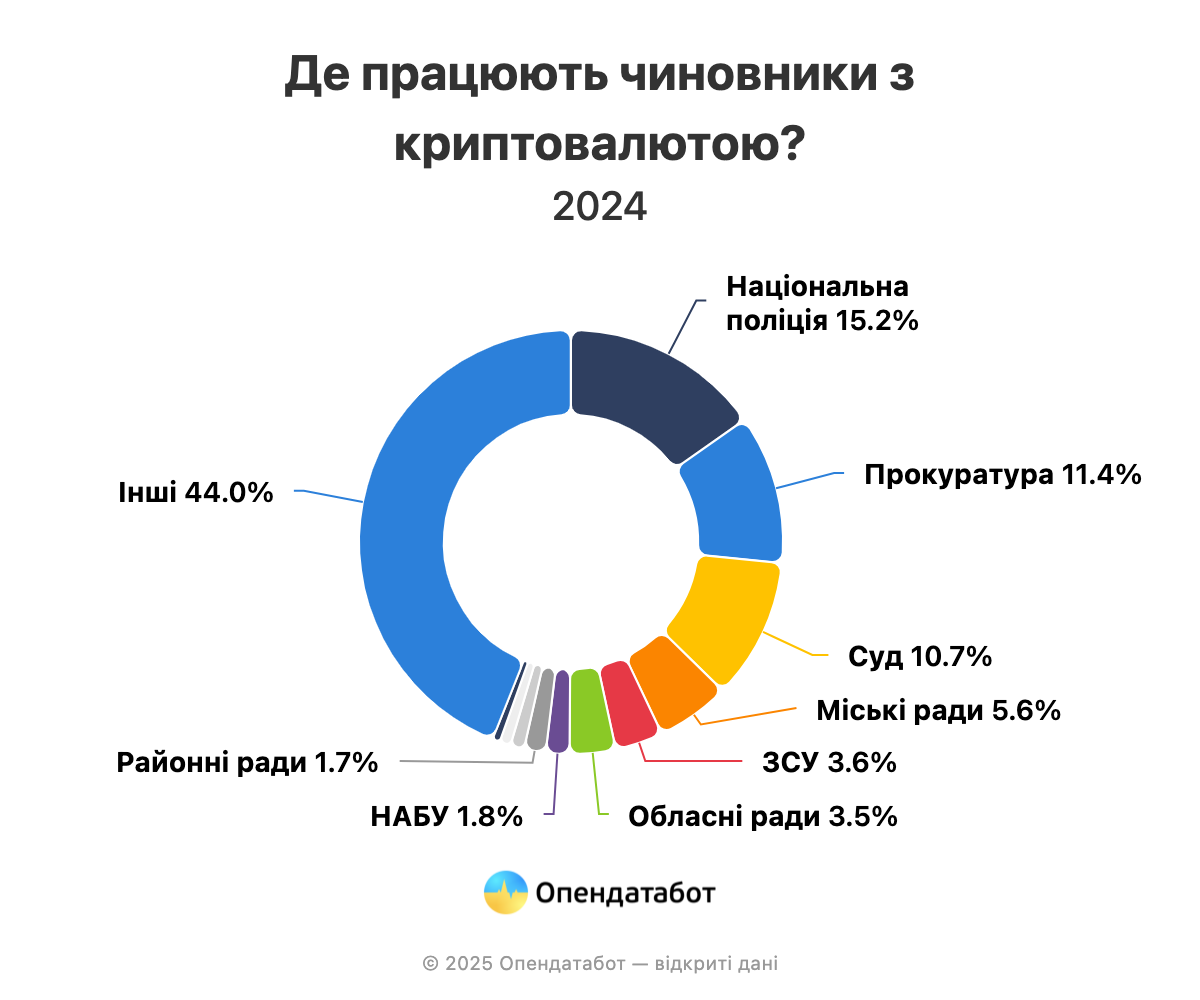
More than 2.1 thousand declarations with cryptocurrencies were filed by Ukrainian officials in 2024. This is 2.2 times more than before the full-scale campaign. Representatives of the National Police of Ukraine are particularly active in declaring cryptocurrencies. Tether (USDT), Bitcoin (BTC, XBT), and Ethereum (ETH) remain the most popular cryptocurrencies among officials.
Ukrainian officials are increasingly mentioning cryptocurrencies in their declarations. Thus, 2113 declarations with cryptocurrency were filed by officials in 2024. This is 2.2 times more than before the full-scale campaign. The number of such declarations increased by 10% over the year.
Representatives of law enforcement agencies are particularly active in declaring cryptocurrencies. The National Police of Ukraine is the most active: 322 declarations mentioning cryptocurrency. This is 15% of all such declarants.
The prosecutor’s office is not far behind: cryptocurrency is listed in 240 declarations. Judges filed 227 such documents, and there were 119 officials with digital assets in city councils. Among the representatives of the Armed Forces, cryptocurrency was listed in 77 declarations. In another 38 cases, crypto was declared by NABU representatives.
If we look at the geography of crypto declarations, everything is more predictable. Kyiv and the region are in the lead with 582 and 185 officials with cryptocurrencies. In Kharkiv region, 172 civil servants declared crypto, and in Dnipropetrovs’k region, 167. Lviv region rounds out the top five with 133 cryptocurrency declarants.
The most frequently declared crypto-dollars are Tether (USDT) – 802 civil servants. Bitcoin (BTC, XBT), despite all the exchange rate fluctuations, consistently ranks second with 731 declarations. Ethereum (ETH) was declared by 713 officials.
The most bitcoins were declared by Oleh Bondarenko, chairman of the Verkhovna Rada Committee on Environmental Policy. He has 80 BTC on his account, which is equal to UAH 279.4 million as of April 1. The leader in the Ethereum (ETH) category is MP Serhiy Maisel, who owns 200 tokens equivalent to UAH 15.5 million. However, the record for the number of crypto dollars belongs to Vitaliy Brovko, head of a department at the Prosecutor General’s Office, who has 847,908 USDT in his declaration, which is estimated at UAH 35 million.
It is also worth noting that there are several ex-officials who could have made it to the top, but indicated that they had lost access to their crypto assets. 380.95 bitcoins – a record amount among Ukrainian officials – were reported and lost in 2021 by Roman Saramaga, Deputy Head of the State Service of Geology and Subsoil of Ukraine. This is about UAH 1.33 billion in hryvnia equivalent as of April 1, 2025.
The largest amount of ethereum – 1,800 units or more than UAH 140 million as of April 1 of this year – belongs to Ihor Osipov, a deputy of the Podil District Council of Odesa Oblast. However, in last year’s declaration, the official noted that he had lost access to his assets.
https://opendatabot.ua/analytics/crypto-2025

Cryptocurrencies are increasingly becoming part of the global financial system, and countries in the Balkan region are demonstrating a variety of approaches to their regulation.
Serbia
Status: Officially recognized and regulated.
Legislation: Law on Digital Assets (2020).
Regulators: The National Bank of Serbia and the Securities Commission.
Taxes:
Capital gains tax: 15%.
Income tax: 15%.
Penalties: Up to 5 million dinars ($46,400) or 20% of annual income for operating without a license.
Croatia
Status: Not recognized as legal tender, but not prohibited.
Regulation: There is no special law, operations are regulated by general rules.
Taxes: Income from cryptocurrencies is subject to capital gains tax.
Albania
Status: Regulated by law (2020).
Regulators: Financial Supervision Authority and National Agency for Information Society.
Taxes:
Capital gains tax: 15%.
Corporate tax: 15%.
Sanctions: Administrative fines and restrictions on activities.
Status: There is no special legislation, operations with cryptocurrencies are not prohibited.
Warnings: The central bank notes the risks associated with cryptocurrencies.
Bosnia and Herzegovina
Status: Not legal tender, no exchange for official currency is possible.
Taxes: The tax on income from transactions is 10%.
Regulation: There is no legislation, but trading and buying cryptocurrencies is allowed.
Republika Srpska (part of Bosnia and Herzegovina)
Status: Cryptocurrencies are legalized (amendments to the law on the securities market, 2022).
Supervision: Securities Commission.
Taxes: Income tax is 10%.
North Macedonia
Status: Not recognized as legal tender.
Regulation: There is no regulation, cryptocurrency activities are not prohibited.
Kosovo
Status: Not recognized as legal tender, no special legislation.
Restrictions: A complete ban on mining has been introduced since 2022 due to the energy crisis.
Approaches to cryptocurrencies in the Balkans vary:
Serbia and Albania establish a clear legal framework, ensuring the legality of operations.
Montenegro and North Macedonia have no special regulation, but do not prohibit its use.
Kosovo restricts activities due to the energy crisis.
It is important for potential users and investors to study local laws and consult with experts to work safely and legally with cryptocurrencies in the region.
Source: https://t.me/relocationrs/434