Business news from Ukraine

Business news from Ukraine

Ukraine Can Help Honduras with Food Security

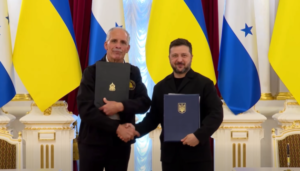
Ukraine can help Honduras with food security, according to Honduran President Nasri Asfura.

“Ukraine has extremely important ideas and technologies that could be useful to us in the agricultural sector and could also help us with food security,” Asfour said at a joint press conference with Ukrainian President Volodymyr Zelenskyy on Friday.

For his part, Zelenskyy noted that Ukraine is ready to assist Honduras in matters related to drone technology.

“We are ready to share our knowledge on digitalization. We have made significant strides forward, especially during the war… We are ready to help with drone technology,” Zelenskyy said.

He emphasized that drones are not just about weapons—they are about security, coastal defense, and intelligence.

, , ,

Experts Club analyzed wheat cultivation indicators worldwide from 1990 to 2026

The information and analytical center Experts Club presented a video analysis of the dynamics of wheat cultivation worldwide for the period from 1990 to 2026, prepared on the basis of comparative data on wheat production in the main producing countries.

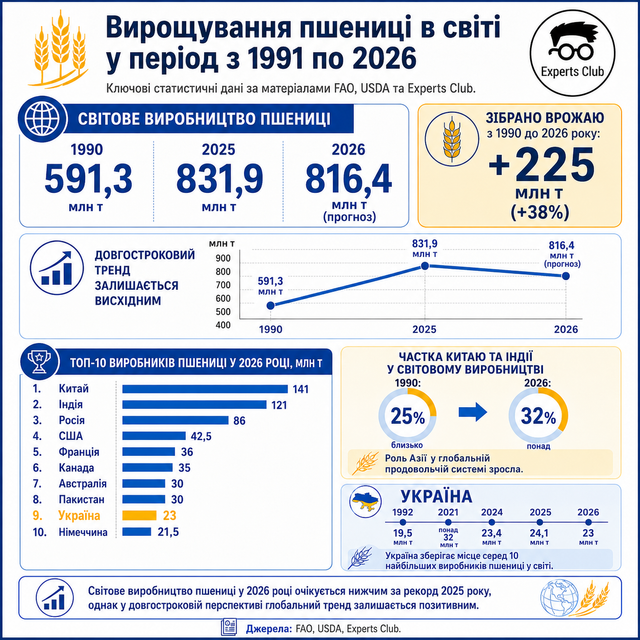
According to available data, global wheat production in the countries included in the analysis increased from about 591.3 million tonnes in 1990 to an estimated 816.4 million tonnes in 2026. Thus, over 36 years, the volume of production increased by approximately 225 million tonnes, or by 38%.

At the same time, the highest indicator in the available data set was recorded in 2025 — about 831.9 million tonnes. The forecast indicator for 2026 is lower — 816.4 million tonnes, which may indicate a partial correction after the high harvest of the previous year, but the overall long-term trend remains upward.

Experts Club notes that the video format makes it possible to visually trace not only the growth of global wheat production, but also the change in the geography of the main producers. If in the early 1990s the largest producers included the USSR, China, the United States, India, France and Canada, then in the current structure the leading positions are occupied by China, India, Russia, the United States, France, Canada, Australia, Pakistan and Ukraine.

According to FAO and USDA data, in 1990 the largest volume of wheat production was accounted for by the USSR — about 101.9 million tonnes, China — 98.2 million tonnes, the United States — 74.3 million tonnes, India — 49.8 million tonnes, France — 33.3 million tonnes and Canada — 32.1 million tonnes. The combined share of the ten largest producers at that time was about 77% of the global indicator.

In 2026, according to available data, China remains the largest wheat producer — about 141 million tonnes. India ranks second — 121 million tonnes, and Russia ranks third — 86 million tonnes. They are followed by the United States — 42.5 million tonnes, France — 36 million tonnes, Canada — 35 million tonnes, Australia and Pakistan — 30 million tonnes each, Ukraine — 23 million tonnes, and Germany — 21.5 million tonnes.

The share of China and India in global wheat production increased significantly during this period. If in 1990 these two countries accounted for about 25% of global production, then in 2026 they already account for more than 32%. This reflects the long-term strengthening of Asia’s role in the global food system.

“Wheat remains one of the basic indicators of food security. Over the past decades, we have seen not only an increase in global production, but also a gradual shift in the centers of agricultural weight. China and India have become key producers, while the countries of the Black Sea region have significantly strengthened their influence on the international grain market,” said Maksym Urakin, founder of the information and analytical center Experts Club and Candidate of Economic Sciences.

Ukraine plays a separate role in the modern production structure. According to available data, after Ukraine appeared as a separate statistical unit in the early 1990s, wheat production amounted to about 19.5 million tonnes in 1992. In 2021, the indicator reached more than 32 million tonnes, after which it declined due to the war, logistical restrictions, mined territories, changes in the structure of sown areas and the loss of part of production capacity.

In 2024, wheat production in Ukraine was estimated at approximately 23.4 million tonnes, in 2025 — 24.1 million tonnes, and in 2026 — about 23 million tonnes. Despite difficult conditions, Ukraine remains among the ten largest wheat producers in the world and retains strategic importance for the global grain market.

The data also indicate changes in the position of the United States. In 1990, the United States produced more than 74 million tonnes of wheat and was one of the three largest producers in the world. In 2026, its indicator stands at about 42.5 million tonnes. This does not mean a loss of U.S. agricultural potential as a whole, but reflects structural changes in agriculture, competition with other crops and a change in the global production balance.

Russia, which has been reflected separately in statistics after the collapse of the USSR, has become one of the key wheat producers in the 21st century. According to available data, in 2025 its production was estimated at approximately 90.3 million tonnes, and in 2026 — 86 million tonnes. At the same time, the countries of the former USSR as a whole remain an important center of global grain production.

“The global wheat market has become much more multipolar. If previously several major producers played the key role, now several regions at once are critically important for food stability — Asia, North America, Europe, the Black Sea basin and Australia. Any climatic, logistical or military-political risks in one of these regions quickly affect global prices,” Urakin emphasized.

Experts Club draws attention to the fact that when analyzing wheat, it is important to distinguish between absolute production volumes, export potential and domestic consumption. China and India are the largest producers, but a significant part of their harvest is used on the domestic market. Instead, Ukraine, Russia, Canada, Australia, the United States and France have a significant influence specifically on international wheat trade.

The center’s analysts note that the further dynamics of wheat production will depend on several key factors: climatic conditions, access to fertilizers and seeds, energy costs, the state of logistics infrastructure, trade restrictions, war risks and state policy to support the agricultural sector.

According to Experts Club’s assessment, long-term visualization of wheat cultivation indicators makes it possible to better understand how the global food system has changed since 1990, which countries have strengthened their positions and why grain production remains one of the key elements of economic and political security.

, , ,

Norway to help Ukraine ensure food security

Norway will allocate NOK 200 million (approximately EUR 17 million) to the World Food Program, including the Grain from Ukraine program, and NOK 50 million (approximately EUR 4 million) will be transferred to the World Bank’s Ukraine Fund, the Norwegian government said in a statement.

“Norway will continue to support the people of Ukraine. At the same time, we do not lose sight of other crises in the world. The Nansen Program (5-year support program for Ukraine – IF-U) is one example of how we manage to combine these efforts,” Norwegian Foreign Minister Espen Barth Eide said in a statement.

In addition, it is noted that another 150 million Norwegian kroner (about EUR 12 million) will be allocated to the World Food Program in response to its call for emergency assistance to Ukraine.

“In addition to providing food aid near the front line, these funds will be used to demine agricultural land, allowing farmers to return to food production as soon as possible,” the statement said.
,

EU DOES NOT YET SEE THREAT TO ITS FOOD SECURITY IN CONNECTION WITH SITUATION IN UKRAINE

The European Union sees no threat to its food security in connection with the situation in Ukraine and will try to contribute to ensuring global food security, said EU Commissioner for Agriculture Janusz Wojciechowski.

“Fortunately, we do not see a direct threat (food security) in European markets. The main problem on them is corn, which we import from Ukraine. It is important for feed production in Europe. But imports from Ukraine are still even larger than in previous years,” Wojciechowski said on Monday evening at a press conference following the meeting of the EU Council at the level of ministers of agriculture.

The central topic of the meeting was the threat of a global food crisis in connection with the Ukrainian issue.

The problem that the EU sees, according to the official, is to organize “corridors of solidarity” for grain supplies to third countries.

The meeting also presented a forecast for the grain harvest for the current year in the EU countries. It will be “for sure more than in 2021, and in 2023 the grain harvest will be no less than in 2022, subject to the same weather conditions.”

“In Europe, we have the necessary food security. (…) We must ensure that Europe contributes to global food security,” added the European Commissioner.
,

WEAPONS FOR UKRAINE ARE KEY TO WORLD FOOD SECURITY – PODOLIAK

Arms for Ukraine today are the key to world food security, adviser to the head of the Office of the President of Ukraine Mykhailo Podoliak said.
“One should understand the cause-and-effect relationships of global processes. Russia threatened the food security of the world by unleashing war in Ukraine. The only way to restore order is to help Ukraine win. Weapons for Ukraine today are the key to the food security of the world,” he wrote in Twitter.


, ,