
According to Experts Club, Ukrainians’ attitudes toward the United Kingdom, the Scandinavian countries, and the Baltic states remain predominantly positive: in August 2026, the share of positive assessments for the countries included in the study ranged from 66.9% to 72.6%. At the same time, the balance between positive and negative attitudes toward all countries in this group has declined slightly compared to the previous survey wave in March 2026. This is evidenced by the results of a study conducted by Active Group and the Experts Club Information and Analytical Center, reports the Experts Club Information and Analytical Center.
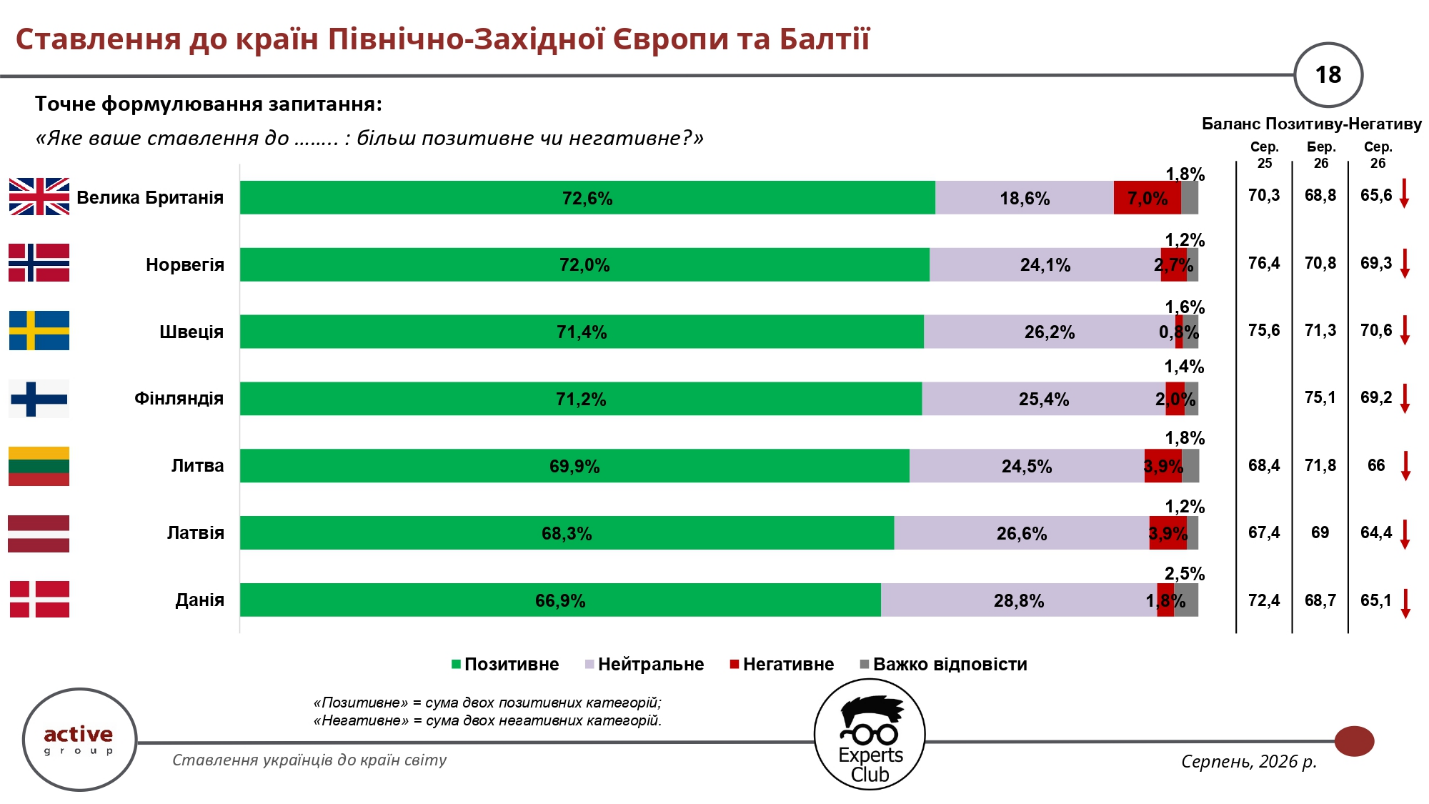
The United Kingdom received the highest share of positive assessments in the group—72.6%. 18.6% of respondents had a neutral attitude toward it, 7% had a negative attitude, and another 1.8% were undecided. The balance of positive and negative assessments stands at 65.6 percentage points, compared to 68.8 percentage points in March 2026 and 70.3 percentage points in August 2025.
Seventy-two percent of Ukrainians view Norway positively, while only 2.7% view it negatively, resulting in a balance of 69.3 percentage points. In March, this balance stood at 70.8 percentage points, and in August of last year, at 76.4 percentage points. Sweden has 71.4% positive and only 0.8% negative assessments—its balance stands at 70.6 percentage points and is the highest among the countries presented on the slide. Overall, the study records approximately 67–73% positive ratings for the countries of Northwestern Europe and the Baltic states.
71.2% of respondents view Finland positively, 25.4% neutrally, and 2% negatively. The balance stands at 69.2 percentage points, down from 75.1 percentage points in March. Lithuania is viewed positively by 69.9% of respondents and negatively by 3.9%; the balance fell from 71.8 percentage points in March to 66 percentage points in August.
A positive attitude toward Latvia was expressed by 68.3% of respondents, a neutral one by 26.6%, and a negative one by 3.9%. Its balance stands at 64.4 percentage points, compared to 69 percentage points in March. For Denmark, the corresponding figures are 66.9% positive, 28.8% neutral, and 1.8% negative assessments, with a balance of 65.1 percentage points, compared to 68.7 percentage points in the previous survey wave.
Maksym Urakin, founder of the Experts Club Information and Analytical Center, deputy director of the Interfax-Ukraine news agency, and candidate of economic sciences, emphasized the importance of constant communication between foreign partners and Ukrainian society.
“The first recommendation is to regularly showcase concrete achievements and concrete actions. Second, be open to questions and inquiries from the media and the public,” Urakin noted. According to him, the results of sociological surveys can be used to strengthen bilateral relations, particularly trade relations.
Alexander Pozniy, director of the research company Active Group, also drew attention to the need to combine public perceptions of countries with the development of practical economic cooperation.
“We should do more than just raise general awareness. We need to expand cooperation with countries where we can maintain a positive balance,” Pozniy noted. He also emphasized the role of business associations and government agencies in developing bilateral economic ties.
Overall, the results show that Northern and Northwestern Europe, along with the Baltic states, continue to enjoy a high level of positive perception among Ukrainians. At the same time, the decline in the balance compared to March 2026 indicates that even regarding countries with traditionally high ratings, public opinion is not static. In the overall ranking, Sweden, Finland, Norway, Lithuania, and the United Kingdom were among the top ten countries with the highest net sentiment.
The survey was conducted in August 2026 using self-administered online questionnaires via the SunFlowerSociology panel. It included 800 Ukrainian citizens aged 18 and older. The sample is representative by age, gender, and region; the stated maximum theoretical margin of error is ±3.5 percentage points. This is the third wave of the study, following surveys conducted in August 2025 and March 2026.
ACTIVE GROUP, DENMARK, EXPERTS CLUB, FINLAND, LATVIA, LITHUANIA, NORWAY, SOCIOLOGY, SWEDEN, UKRAINE, UNITED KINGDOM
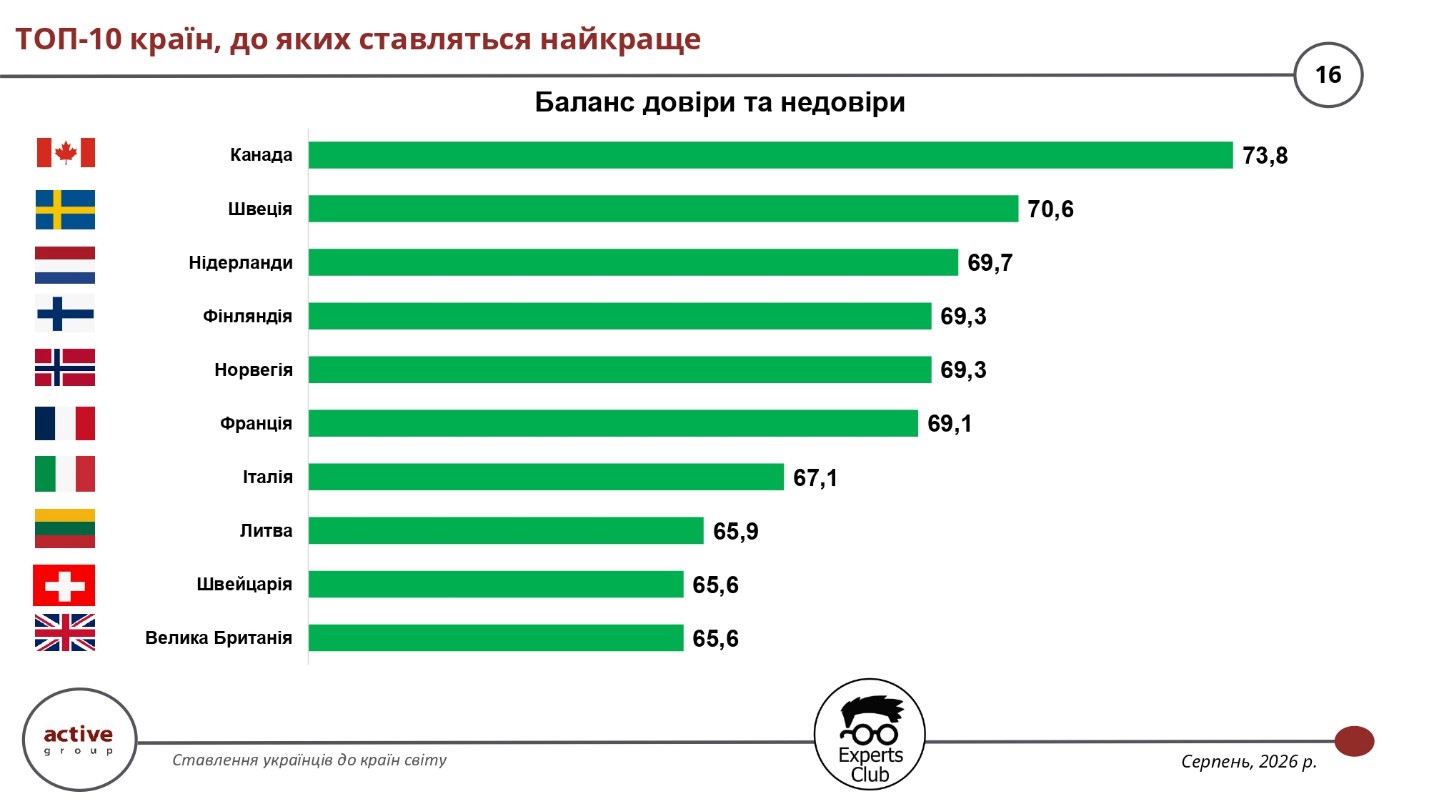
Canada ranked first among countries with the highest net positive sentiment among Ukrainians—in August 2026, this figure stood at 73.8 percentage points. The top ten also included mainly countries from Northern and Western Europe, according to the results of the third wave of the study “Ukrainians’ Attitudes Toward Countries Around the World,” conducted by Active Group in collaboration with Experts Club, reports the Experts Club Information and Analytical Center.
Sweden took second place in terms of the balance of trust and distrust with a score of 70.6 percentage points, while the Netherlands came in third with 69.7 percentage points. Finland and Norway each scored 69.3 points, France scored 69.1 points, Italy scored 67.1 points, and Lithuania scored 65.9 points. Rounding out the top ten are Switzerland and the United Kingdom, which both scored 65.6 percentage points.
The sentiment score is calculated as the difference between the proportion of positive and negative ratings. Specifically, 76.3% of respondents view Canada positively, 2.5% negatively, and 19.2% neutrally. Thus, Canada’s high score is due not only to a significant proportion of favorable ratings but also to a minimal level of negative sentiment.
The survey results show that the top ten countries with the most favorable balance of attitudes consist almost entirely of countries in Northern and Western Europe, along with Canada. At the same time, the level of public favor does not always directly correspond to the scale of Ukraine’s trade and economic ties with a specific country. For example, China was Ukraine’s largest trading partner in the first half of 2026, yet it received the lowest balance of positive and negative assessments—minus 25.4 percentage points.
Maksym Urakin, founder of Experts Club, deputy director of the Interfax-Ukraine news agency, and candidate of economic sciences, emphasized that studies of public perception should be considered alongside actual foreign trade indicators.
“That is why it is very important for us to analyze our main partners. We must be open to questions and inquiries from the media and the public,” Urakin noted. According to him, the results of sociological surveys can be used to assess international relations and their further development.
Alexander Pozniy, Director of Active Group, drew attention to the need to combine the creation of a positive image of countries with the practical development of bilateral economic ties.
“We should focus on developing more than just general awareness. We need to expand cooperation with countries where we can achieve a positive balance,” Pozniy noted. According to him, both government agencies and business associations should be involved in this process.
The survey was conducted in August 2026 using self-administered online questionnaires via the SunFlowerSociology panel. A total of 800 Ukrainian citizens aged 18 and older were surveyed. According to the organizers, the sample is representative in terms of age, gender, and region; the maximum theoretical statistical margin of error at a 95% confidence level is 3.5%. This is the third wave of the survey, following surveys conducted in August 2025 and March 2026.
ACTIVE GROUP, CANADA, EXPERTS CLUB, FINLAND, international relations, NORWAY, SOCIOLOGY, SWEDEN, THE NETHERLANDS, UKRAINE, URAKIN
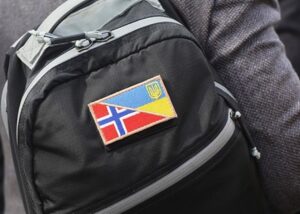
Norway will allocate a total of NOK25 million (approximately $2.62 million) to support Ukrainian children who have returned from deportation, as well as to search for missing children and assist illegally detained civilians and prisoners of war through UNICEF and the International Committee of the Red Cross (ICRC).
This was announced in a press release published on the Norwegian government’s website on Tuesday.
Specifically, NOK 15 million will be allocated to UNICEF’s efforts to support the reintegration of children who have returned to Ukraine and to locate missing children. This funding is part of Norway’s broader contribution of NOK 132 million to UNICEF’s humanitarian program in Ukraine.
An additional NOK 10 million will be directed to the Central Tracing Agency (CTA) of the International Committee of the Red Cross.
The support package was announced at the international conference “Pathways to Peace: Returning Ukrainian Children, Detained Civilians, and Prisoners of War,” taking place in Toronto on September 28–29. Norway is co-hosting the conference alongside Canada and Ukraine.
“Russia’s illegal war of aggression against Ukraine has led to serious violations of international humanitarian law and human rights. We must continue to draw attention to these violations and do everything possible to support Ukrainians who have suffered as a result of the war,” said Norwegian Foreign Minister Espen Bart Eide.
According to him, the funds will help locate those missing in action, support efforts to bring more people home, and facilitate the rehabilitation and reintegration of those affected by the war.
The conference will feature testimonies from people who have returned after being held captive or deported. Prior to the conference’s opening, Norwegian State Secretary for Foreign Affairs Eivind Vad Petersen will participate in a trilateral meeting with Canadian Foreign Minister Anita Anand and Ukrainian Foreign Minister Andriy Sybiga.
In addition, Norway is allocating NOK 90 million to support the ICRC’s broader humanitarian activities in Ukraine.
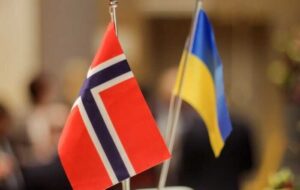
The Norwegian government will propose to the Storting (parliament) to extend emergency aid to Ukraine in the amount of 85 billion Norwegian kroner (approximately $9.1 billion) into 2027 as well, the government’s press service reported.
“Norway will continue to support Ukraine’s defense efforts. Ukraine is facing a difficult winter. We are now sending a clear signal that Norway will continue to support Ukraine, both through civilian and military aid,” said Prime Minister Jonas Gar Støre.
As noted, the government’s proposal was conveyed to Ukrainian President Volodymyr Zelenskyy during a meeting between Stere and Zelenskyy in Kyiv on Sunday.
The Norwegian prime minister noted that supporting and rebuilding Ukraine is also important for European security. Norwegian support is provided through the Nansen Program for Ukraine and is directed toward both civilian and military purposes.
“The bulk of the funds will go toward military support, specifically purchases from the Ukrainian defense industry. The government will revisit the distinction between military and civilian services at a later date,” the press release states.
The Nansen Program for Ukraine is Norway’s long-term government program to support Ukraine, launched in February 2023 with broad cross-party support from the Norwegian parliament—the Storting. It initially allocated 75 billion NOK for 2023–2027, but the program was subsequently expanded and extended through 2030.
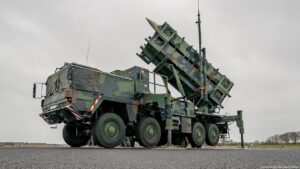
Norway has announced the allocation of 3 billion kroner (268 million euros) to strengthen Ukraine’s air defense, specifically as part of the PURL program and to purchase Patriot missiles from countries that already have them, the Norwegian government’s press service reported.
“Norway is now providing an additional 3 billion Norwegian kroner to strengthen Ukraine’s air defense systems,” the government press service stated on its website.
It is reported that Norway, together with Denmark, Germany, and Canada, will order new Patriot air defense missiles directly from the manufacturer in the U.S. as part of the PURL program.
“Given the long delivery times for some of these missiles, Norway also plans to purchase Patriot missiles from countries that already have them in order to deliver them to Ukraine as quickly as possible,” the Norwegian government emphasized.
Norway is also allocating funds to join Ukraine’s initiative to jointly develop anti-ballistic systems with European partners. “Ukraine has invited European partners to participate in the development of a specialized missile defense system. This could also be significant for the defense of Norway and other NATO member states. Norway is allocating funding to be able to contribute to this initiative,” the statement said.
“In the future, ballistic missiles may also pose a serious threat to Norway and its allies. Therefore, the Ukrainian initiative is of interest from the perspective of strengthening Norway’s defense capabilities,” said Defense Minister Tore O. Sandvik.
During the NATO summit in Ankara, Ukrainian President Volodymyr Zelenskyy stated that a key topic of discussion with partners would be the supply of interceptor missiles for the Patriot air defense system, which are critical to Ukraine’s ability to shoot down Russian ballistic missiles—and noted that these missiles are not exclusive to the United States.
As previously reported, the Netherlands, Germany, Finland, Sweden, Lithuania, Estonia, Latvia, Denmark, and Poland have appealed to the European Commission to grant authorization as soon as possible for the purchase of missiles for U.S.-made air defense systems as part of the 90 billion euro “defense” component that the EU is providing to Ukraine in 2026–27.
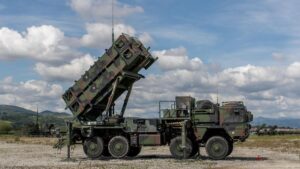
Norway is now providing an additional 3 billion Norwegian kroner to strengthen Ukraine’s air defense systems, according to the Norwegian government.
“Ukraine has been successful in intercepting most drones and cruise missiles, but it needs to strengthen its defenses against ballistic missiles. This is one of Ukraine’s most urgent priorities. That is why Norway is now allocating 3 billion Norwegian kroner for air defense,” said Prime Minister Jonas Gar Støre.
On Tuesday, the prime minister met with Ukrainian President Volodymyr Zelenskyy at the NATO summit in Ankara, Turkey.
“Russia is sending hundreds of drones and missiles into Ukraine day and night. The Patriot air defense system is highly effective and can counter a wide range of threats, including ballistic missiles,” said Defense Minister Tore O. Sandvik.
Together with Denmark, Germany, and Canada, Norway will order new Patriot air defense missiles directly from the manufacturer in the United States. Norway will continue to support the U.S.-led PURL program. PURL is a NATO program for coordinating the funding and donation of advanced U.S. military equipment to Ukraine, including air defense systems. Given the long lead times for some of these missiles, Norway also plans to procure Patriot missiles from countries that already possess them to facilitate rapid donations to Ukraine.
According to the Norwegian government, Ukraine has asked its European partners to participate in the development of a specialized missile defense system. This could also be significant for the defense of Norway and other Alliance member countries. Norway is allocating funding to be able to contribute to this initiative.
“In the future, ballistic missiles could also pose a serious threat to Norway and its allies. Therefore, the Ukrainian initiative is of interest in terms of strengthening Norway’s defense capabilities,” Sandvik said.
The government noted that between 2023 and 2025, Norway provided Ukraine with air defense support totaling 30 billion Norwegian kroner. Norway is also providing significant funding to strengthen Ukraine’s air defense in 2026.



