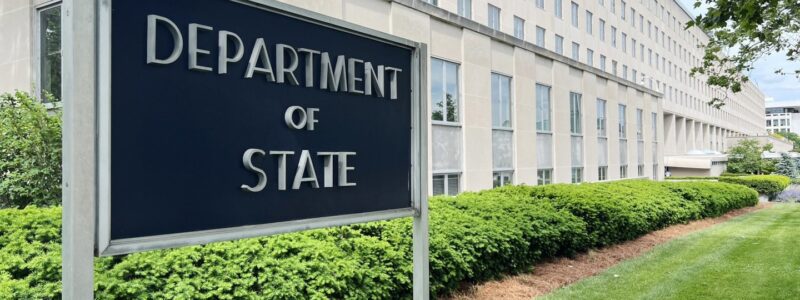
According to Serbian Economist, the U.S. State Department presented a report to Congress on Washington’s policy toward the Western Balkans, in which it effectively announced a shift from the former model of international intervention and “nation-building” to a more pragmatic policy of partnership, stability, energy, security, and economic cooperation.
The document is titled “United States Policy to Promote Regional Stability and Prosperity in the Western Balkans”.
It states that the era of U.S.-led “nation-building” is over, and Washington’s new policy in the region will be built not around “rescue or reconstruction,” but around stability and mutually beneficial partnerships.
For Serbia, this is an important signal: Washington views the Western Balkans as a region of direct importance to U.S. security and economic interests. The report notes that the U.S. intends to cooperate with Serbia in a way that advances American interests, and plans to launch an official strategic dialogue with Belgrade in 2026.
Stability is cited as one of the top priorities. The State Department notes that unresolved disputes and ongoing political disagreements continue to undermine regional stability. In the case of Serbia and Kosovo, Washington states that it will continue to support the normalization of relations with the aim of reaching a negotiated and sustainable agreement acceptable to both sides.
Regarding Bosnia and Herzegovina, the U.S. reaffirms its commitment to the Dayton Peace Agreement, the country’s sovereignty, and its territorial integrity. At the same time, Washington states that in 2025, American diplomacy helped resolve the most serious crisis in BiH since the 1992–1995 war, preserving the constitutional order and legal integrity of the state.
Special emphasis is placed on the energy sector. The State Department describes the region’s dependence on Russian energy resources as a strategic vulnerability and proposes diversification through U.S. LNG, nuclear technologies—including small modular reactors—and renewable energy. For Serbia, this is directly linked to issues regarding the NIS, gas infrastructure, the future nuclear program, and the modernization of the electricity sector.
The report also addresses competition with Russia and China. Washington believes that Moscow and Beijing are exploiting instability, corruption, and weak governance in the region to expand their influence. According to the U.S. assessment, Russia relies on energy leverage and ethno-political tensions, while China strengthens its position through loans, trade, infrastructure projects, and ties with elites.
The economic component of the new strategy is particularly important for Serbia.
The region is described as an area with a favorable geographic location, transport corridors, natural resources, a growing technology sector, and a skilled workforce. The U.S. intends to reduce regulatory barriers, improve contract enforcement, develop procurement procedures, and promote projects that benefit American companies and the region’s economies.
For Serbia, this strategy opens up opportunities but also creates pressure. The opportunities relate to potential strategic dialogue with the U.S., investments in energy, infrastructure, technology, and defense cooperation. The pressure stems from the expectation that Belgrade will reduce its dependence on Russian energy resources, take a more cautious approach to Chinese capital, and play a more active role in ensuring regional stability.
Thus, the new State Department report reflects a shift in U.S. policy: the Western Balkans remain important to the U.S., but now primarily as a region of strategic corridors, energy, markets, security, and great power competition. For Serbia, this could be an opportunity to strengthen its dialogue with Washington, but only on the condition that economic cooperation is not constantly blocked by unresolved political issues.
https://t.me/relocationrs/2898