
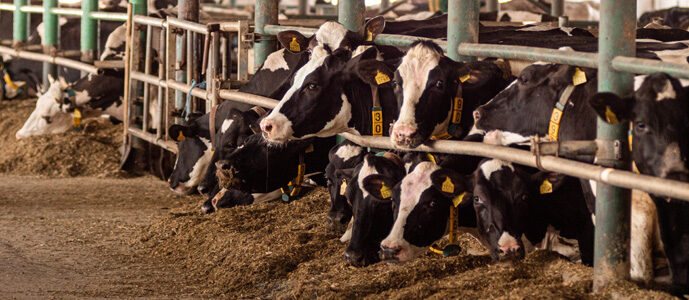
According to experts.news, as of June 1, 2026, there were 1,786,900 head of cattle in Ukraine, including 941,200 cows, the Milk Producers Association reported on June 26, citing preliminary data from the State Statistics Service.
Compared to June 1, 2025, the cattle herd decreased by 383,000 head, or 18%, while the number of cows decreased by 208,000, also by 18%. Over the month, the total cattle herd increased slightly—by 2,100 head—while the number of cows decreased by 3,300.
About 53% of the herd is held by agricultural enterprises, with the remaining 47% held by private households.
In the industrial sector, there were 951,200 head of cattle as of early June, including 391,900 cows. Over the year, enterprises increased their cattle herd by 4% and their number of cows by 3%.
At the same time, private households held 835,700 head of cattle, of which 549,300 were cows. Over the past year, the private sector lost 33% of its cattle herd and 28% of its cows. It is precisely this reduction in livestock holdings by private households that remains the main cause of the overall decline in the country’s figures.
An increase in the number of cows at agricultural enterprises was recorded in 11 regions. The largest increases in herd size were observed in Rivne Oblast (29%), Lviv Oblast (22%), Kharkiv Oblast (13%), Ternopil Oblast (11%), and Khmelnytskyi Oblast (9%). In Kyiv Oblast, the number of cows in the commercial sector increased by 3%.
The largest cattle herds across all farm categories were held in Poltava Oblast—168,000 head, Vinnytsia Oblast—160,000, Khmelnytskyi—143,400, Odesa—131,600, Chernihiv—126,100, Cherkasy—125,400, and Kyiv—105,700 head. These seven regions accounted for approximately 54% of the country’s total cattle population.
The Milk Producers Association attributes the decline in the herd size to low milk purchase prices, rising costs of feed, fuel, and fertilizers, insufficient farm modernization, and the consequences of hostilities. Farms in frontline regions are also forced to transport their livestock to central and western regions.
According to the association’s estimates, approximately 850 of Ukraine’s 1,375 thousand dairy farms require renovation to meet European standards for animal husbandry. The estimated investment need is approximately EUR219 million.
At the beginning of 1991, Ukraine had 24,623,400 head of cattle, including 8,378,200 cows. By early 2001, the cattle herd had declined to 9,424,000 head, and the number of cows to approximately 4,958,000.
In 2013, Ukraine had 4.646 million head of cattle and 2.554 million cows. As of early 2021, these figures stood at 2.874 million and 1.673 million head, respectively.
As of January 1, 2025, the cattle herd was estimated at 2.002 million head, including 1.155 million cows. By the beginning of 2026, these figures had fallen to 1.804 million head of cattle and 1.022 million cows.
Thus, from the beginning of 1991 to the beginning of 2026, the total cattle herd in Ukraine decreased by approximately 92.7%, or 13.6 times. The number of cows decreased by 87.8%, or 8.2 times.
By June 1, 2026, the number of cows fell below 1 million heads for the first time—to 941,200. Compared to 1991, this represents a decline of nearly 89%, or 8.9 times.
When comparing long-term indicators, changes in statistical coverage should be taken into account. Data for 2015–2021 do not include the temporarily occupied Crimea, Sevastopol, and parts of the Donetsk and Luhansk regions, while figures from 2022 also exclude other occupied territories and parts of combat zones.
Despite the sharp overall decline in livestock numbers, industrial dairy farms in relatively safe regions are partially increasing their herds of productive cows. However, this is not yet sufficient to compensate for the mass exodus of smallholder farms from livestock production.
https://www.experts.news/posts/poholivya-vrkh-v-ukrayini-za-rik-skorotylosya-na-18
CATTLE, Cow, livestock farming, MILK, UKRAINE

Related:






