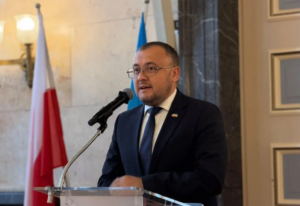
Poland’s Deputy Minister of the Interior, Maciej Duszkiewicz, highlighted the contribution of Ukrainians to the functioning of the Polish economy. He made this statement during an appearance on Polsat News.
Polsat News reports that Duszczyk believes that in many cases, the absence of Ukrainians is noticeable. “If it weren’t for Ukrainian citizens, we’d be waiting 10 minutes for the bus instead of five. After all, they fill the gaps in the Polish labor market. That’s why a certain part of the Polish economy depends on refugees from Ukraine. Generally speaking, these are Ukrainians living in Poland, and we need to reiterate this more and more often, because if a situation were to arise where one day all Ukrainians united and refused to go to work, the Polish economy would grind to a halt,” he said.
He also criticized the Law and Justice (PiS) party’s proposal to deport unemployed men of draft age from Ukraine. In this context, the figure of 3,000 people has been mentioned in public discussions. “Three thousand is a small group. Let me remind you that 900,000 people have been mobilized in Ukraine, so this is no help at all. In fact, those who aren’t working in Poland are either caring for their disabled children or are people who were wounded on the front lines and are undergoing rehabilitation in Poland,” he said.
When asked whether refugees will begin returning to Ukraine once the war ends, Dushchyk replied that “this is a process we’ve observed in other countries, and it’s very easy to predict.”
“Sometimes, those who say, ‘I’m staying,’ end up leaving because something happens. And those who say, ‘I’ll leave as soon as the war ends,’ end up staying. Of course, these trends change with each passing month, as the roots they put down in the host society—in this case, Polish society—grow deeper and deeper. “If someone has enrolled their children in school, they’re learning Polish; if a person is working in the labor market, the likelihood that they’ll return to Ukraine without a strong incentive to do so is practically very low,” he noted.