

Poland’s Deputy Minister of the Interior, Maciej Duszkiewicz, highlighted the contribution of Ukrainians to the functioning of the Polish economy. He made this statement during an appearance on Polsat News.
Polsat News reports that Duszczyk believes that in many cases, the absence of Ukrainians is noticeable. “If it weren’t for Ukrainian citizens, we’d be waiting 10 minutes for the bus instead of five. After all, they fill the gaps in the Polish labor market. That’s why a certain part of the Polish economy depends on refugees from Ukraine. Generally speaking, these are Ukrainians living in Poland, and we need to reiterate this more and more often, because if a situation were to arise where one day all Ukrainians united and refused to go to work, the Polish economy would grind to a halt,” he said.
He also criticized the Law and Justice (PiS) party’s proposal to deport unemployed men of draft age from Ukraine. In this context, the figure of 3,000 people has been mentioned in public discussions. “Three thousand is a small group. Let me remind you that 900,000 people have been mobilized in Ukraine, so this is no help at all. In fact, those who aren’t working in Poland are either caring for their disabled children or are people who were wounded on the front lines and are undergoing rehabilitation in Poland,” he said.
When asked whether refugees will begin returning to Ukraine once the war ends, Dushchyk replied that “this is a process we’ve observed in other countries, and it’s very easy to predict.”
“Sometimes, those who say, ‘I’m staying,’ end up leaving because something happens. And those who say, ‘I’ll leave as soon as the war ends,’ end up staying. Of course, these trends change with each passing month, as the roots they put down in the host society—in this case, Polish society—grow deeper and deeper. “If someone has enrolled their children in school, they’re learning Polish; if a person is working in the labor market, the likelihood that they’ll return to Ukraine without a strong incentive to do so is practically very low,” he noted.

Ukrainians in the U.S. under Temporary Protected Status (TPS) were set to lose their Employment Authorization Documents (EADs) as of July 22, but a Massachusetts court temporarily suspended that decision the day before, according to Valeriy Chaly, chairman of the board of the Ukrainian Cultural and Media Center (UKMC), who served as Ukraine’s ambassador to the U.S. from 2015 to 2019.
“On July 22, hundreds of thousands of Ukrainians with TPS status were set to lose their jobs in the U.S. Because initially there was one regulation, and then the president’s ‘One Big Beautiful Bill Act’ (IBBBA) was introduced, and it shortened the validity period of the work permit—the so-called EAD—to July 22… In just one state, the matter went to court, and that court has so far temporarily suspended the decision,” Chalyi described the situation during a discussion organized by NV dedicated to lobbying and promoting Ukraine’s interests in the U.S.
The diplomat noted with regret that the new wave of Ukrainian refugees in the U.S. has so far been unable to unite and organize to defend themselves, and many advocacy organizations dealing with issues of American political and military support have also failed to provide assistance to Ukrainians.
“The situation for these Ukrainians in America is very difficult right now. But our government isn’t doing anything about it—not at all,” Chalyi noted, although, in his opinion, the vast majority of these Ukrainians will not return to Ukraine anyway.
He told the “Interfax-Ukraine” news agency that the current TPS term for Ukrainians expires on October 19 of this year, and if it is not extended and a person does not have any other legal status, they will have to leave the U.S. According to Chaly, the decision to extend this status must be made no later than 60 days before its expiration, that is, by mid-August.
According to information on specialized websites, on July 21, the U.S. District Court for the District of Massachusetts, in the case of Venezuelan Association of Massachusetts v. USCIS (U.S. Citizenship and Immigration Services), issued an emergency injunction preventing the termination of EADs for TPS beneficiaries—including Ukrainians—effective July 22. A final decision on this matter is expected no later than August 5, 2026.
The U.S. Department of Homeland Security (DHS) may extend TPS status for Ukrainians for 12 or 18 months; if DHS does not issue a decision by August 20 of this year, the status will be automatically extended for another 6 months.
According to the nonprofit organization Nova Ukraine, the cost of the initial TPS application is $510, while a TPS-based EAD costs $1,030, and the reduced fee under certain conditions is $560.
Current estimates indicate that more than 100,000 Ukrainians hold TPS status in the U.S.
As previously reported, the EU recently decided to extend temporary protection for Ukrainians for another year—until March 4, 2028—but to impose restrictions on granting it to those subject to military service.

Ukrainians remain a key foreign workforce for the Polish economy: as of the end of January 2026, 757,700 Ukrainian citizens were officially employed in the country, accounting for nearly 68% of all employed foreigners, according to the analytical center of the international recruitment company Gremi Personal, citing Poland’s Central Statistical Office (GUS).
The total number of foreign workers exceeded 1.1 million—a 7.1% increase from the previous year. “More than a million foreign workers is no longer a response to a temporary labor shortage, but a structural change in the Polish economy. Businesses have grown accustomed to operating in conditions where it is impossible to ensure the normal functioning of manufacturing, logistics, construction, the service sector, and agriculture without foreign workers,” notes Yevhen Kirichenko, founder of Gremi Personal.
According to him, this trend will have long-term consequences for the entire region of Central and Eastern Europe, including Ukraine.
“Once the war ends, Ukraine will find itself in a situation where it will have to simultaneously rebuild its economy, implement large-scale infrastructure projects, and compensate for demographic losses. However, at the same time, Poland, Germany, the Czech Republic, and other countries will also need workers. In effect, competition for the same workforce will begin,” Kirichenko believes.
Analysts emphasize that Ukrainians are already well-integrated into the European labor market, know the languages, have work experience, and do not require a long adaptation period. For employers, this means lower integration costs compared to hiring workers from more distant countries. At the same time, they also point out that Ukraine has so far had virtually no discussion on how to compensate for a potential labor shortage, and if, after the war, a significant portion of the population chooses to work abroad, the country will face a labor shortage precisely when workers are needed most for economic recovery.

The Consulate General of Ukraine in Lyon will resume consular services for citizens starting July 9, following the completion of administrative procedures and technical preparations, the consulate announced on its official website.
Appointments will be scheduled via an online queue, and a separate appointment system is in place for vulnerable groups. The Consulate General urged Ukrainians to familiarize themselves in advance with the procedures for obtaining consular services and the document requirements.The consular district of the Consulate General of Ukraine in Lyon covers three regions of France: Auvergne-Rhône-Alpes, Provence-Alpes-Côte d’Azur, and Corsica. Citizens residing in these regions will be able to register for temporary and permanent consular registration, register the acquisition of Ukrainian citizenship by birth, and register adopted children.
At the same time, other consular services will be provided without restrictions based on place of residence in France. The Consulate General also clarified that foreign passports previously issued by the Embassy of Ukraine in France can only be obtained at the Embassy of Ukraine in France.
The Consulate General also plans to provide mobile consular services in remote cities with the highest concentration of Ukrainians. The first such visits are scheduled for September in Nice and October in Marseille. The possibility of providing mobile services in other cities may also be considered depending on the community’s needs.
The opening of the Consulate General in Lyon is expected to reduce the workload on the Embassy of Ukraine in France and simplify access to consular services for Ukrainians living in the southeastern part of the country, particularly in the regions of Lyon, Grenoble, Marseille, Nice, and Corsica.
According to Eurostat, as of April 30, 2026, there were 4.37 million non-EU citizens in the EU under temporary protection who had fled Ukraine due to the war; more than 98.5% of them were Ukrainian citizens. At the same time, regarding France, Eurostat specifically notes that its data typically does not include minors, so official statistics on temporary protection do not fully reflect the total size of the Ukrainian community in the country.
According to media estimates, there may be approximately 80,000–100,000 Ukrainians in France who left after the start of the full-scale war, although some of them have already transitioned from temporary protection to other legal statuses or have left the country.
CONSULAR SERVICES, consulate general, FRANCE, Lyon, UKRAINIAN

Employers offered jobs to 1,554 Ukrainians aged 50 and older as part of the government’s “Experience Matters” program; as of June 22, 2026, 841 participants had successfully found employment, and another 713 are currently undergoing internships.
According to a statement on the website of the Ministry of Economy, Environment, and Agriculture of Ukraine, more than 2,300 candidates have joined the initiative overall, while employers have posted nearly 2,600 job openings.
Kyiv, as well as the Lviv, Kharkiv, Mykolaiv, and Zaporizhzhia regions, have shown the highest activity in terms of the number of candidates. The regions with the highest number of job openings are Kyiv, Lviv, Kharkiv, Zaporizhzhia, and Rivne. The greatest demand is for salespeople of food and non-food items, accountants, drivers, unskilled laborers, cooks, office cleaners, security guards, seamstresses, janitors, and administrators.
The ministry notes that, given the labor shortage, workers aged 50 and older are an important group for the labor market; however, some of them face age-based stereotypes, the need to update their skills, or difficulties after a long break from work. To overcome these barriers, the program combines career counseling, assistance from the employment service, internships, and direct contact with employers.
Training, which began in the second half of June, is a separate component of the program. Specifically, the course on collaboration in intergenerational teams attracted 1,350 registrations, the course on digital tools and artificial intelligence (AI) received 1,100 applications, and the course on career strategy drew 883 applications.
The ministry added that the Ministry of Economy, the State Employment Service (SES), the Astarta agro-industrial holding, the Zhiznelub Charitable Foundation, the Federation of Employers of Ukraine (FEU), as well as the multi-donor initiative Skills4Recovery, Skills Alliance, and other partners are involved in implementing and funding the program.
As previously reported, the Ministry of Economy, Environment, and Agriculture, together with its partners, launched the “Experience Matters” internship project for adults on May 11, 2026. The initiative is being implemented as part of the National Accessibility Strategy for 2026 and aims to address the labor shortage that, according to the EBA, affects 75% of companies in Ukraine. The project model is based on three components: a training program to update resumes and prepare for job interviews; face-to-face meetings with business representatives to discuss collaboration opportunities; and a hands-on internship lasting up to 10 days to assess mutual compatibility before making a hiring decision.
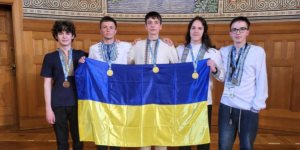
Ukrainian high school students won five medals at the European Physics Olympiad (EuPhO 2026), which took place June 12–16 in Gothenburg, Sweden.
According to the official results of the Olympiad, the Ukrainian team won three gold, one silver, and one bronze medal.
The gold medals were won by Sviatoslav Lavreniuk, Nazarii Vrashchuk, and Mykyta Voznyi. Lavreniuk scored 36.90 points and took second place in the overall individual standings of the Olympiad. Vraschuk, with a score of 30.10 points, took tenth place, while Voznyi, with 29.60 points, took eleventh.
Oleg Kurnitsky received a silver medal, scoring 17.20 points and placing 50th. Mykhailo Rubtsov won a bronze medal with a score of 12.50 points and a 101st-place finish in the overall standings.
The overall winner of EuPhO 2026 was Bryant Yu of the United States, who scored 38.60 points. Third place in the overall standings went to Haoyi Li of China with a score of 34.60 points.
A total of 199 students from 41 countries participated in the competition. At the conclusion of the Olympiad, 23 gold, 37 silver, and 51 bronze medals were awarded, along with 34 honorable mentions.
The official team rankings were not published in the final results of EuPhO 2026. However, China led all countries in the number of gold medals, with its representatives winning five gold medals.
The European Physics Olympiad is held for high school students. Each country may send a team of up to five participants. In 2026, the Olympiad took place in Gothenburg with the participation of Chalmers University of Technology and the University of Gothenburg.



